
ADHD Morning Routine Ideas That Actually Stick
Table of Contents
- Why ADHD Morning Routines Fail (And How to Fix It)
- The Low Dopamine Morning Routine: Designing for Your Brain's Chemistry
- The Restart Protocol: Permission to Begin Again
- Creating an ADHD Morning Routine for Adults Without Decision Fatigue
- Using an ADHD Friendly Daily Schedule Template
- Co-Regulation and Environmental Design for Morning Success
- Common Mistakes That Sabotage Your Morning
- Frequently Asked Questions
Last Updated: September 21, 2026
Why ADHD Morning Routines Fail (And How to Fix It)
Most people with ADHD don't fail at mornings because they lack discipline. They fail because traditional morning routines are designed for neurotypical brains, brains that naturally regulate dopamine, manage decision fatigue, and follow linear sequences without friction. An ADHD friendly morning routine has to work differently.
The problem isn't motivation. It's that standard productivity advice ignores how executive function actually works for neurodivergent brains. When you're told to "just set an alarm" or "prepare the night before," those steps assume a baseline of impulse control and working memory that ADHD brains often don't have in the morning. The result: you abandon the routine within days, then feel shame about it, then avoid trying again.
Here's what changes everything: designing your morning around your brain's actual chemistry instead of fighting against it. An ADHD morning routine for adults works when it reduces decision fatigue, builds in sensory-friendly elements, and gives you permission to restart on difficult days. At Anchor Grove Studio, we've built tools specifically for this, systems that don't require perfection, just intention.

Below, we'll walk through the strategies that actually stick, including the Restart Protocol that lets you begin again without guilt, dopamine-friendly design principles, and practical templates you can use immediately.
The Low Dopamine Morning Routine: Designing for Your Brain's Chemistry
Your morning dopamine is naturally lower than it will be later in the day. This isn't a personal failing, it's biology. A low dopamine morning routine acknowledges this reality and works with it instead of against it.
Most productivity systems try to fight low dopamine by adding stimulation: motivational quotes, aggressive alarms, cold showers. These can work temporarily, but they exhaust your system and create a cycle of avoidance. A smarter approach is to design your morning so that low dopamine doesn't become a barrier to starting.
Wake-Up Cues That Actually Work
An alarm sound is not a wake-up cue. A cue is something that signals your brain that it's time to transition, without the jolt of panic that traditional alarms create.
Effective wake-up cues include natural light, a gentle sound that gradually increases in volume, or a physical sensation like a weighted blanket being removed. The key is that your brain recognizes the signal and begins orienting toward wakefulness before you're suddenly expected to make decisions.
Many people with ADHD find that a light-based alarm works better than sound because it triggers a biological response without the startle reflex. If you use your phone, set the alarm volume low and place the phone across the room so you have to physically move to silence it. That movement itself becomes part of the wake-up sequence.
Building a Sensory-Friendly Environment
Your morning environment shapes whether you can actually follow through on your routine or whether you get stuck in sensory overwhelm before you even start.
A sensory-friendly morning space means reducing unnecessary stimulation: dim lighting until you're ready for it, minimal clutter on surfaces you use, a consistent temperature, and quiet or familiar background sounds. If you live with others, this might mean using headphones or having a small corner that's yours during morning hours.
Texture matters too. Some people with ADHD find that soft clothing, a specific blanket, or a particular texture helps them ground. Others need movement and texture change to feel alert. The point is to notice what helps your nervous system settle into the morning rather than spiral into overwhelm.
The Restart Protocol: Permission to Begin Again
This is the single biggest shift that changes whether an ADHD morning routine sticks: the Restart Protocol gives you permission to begin again at any point without shame.
Most routines are built on consistency, the idea that you follow the same steps every day, and breaking the chain means failure. For ADHD brains, this creates a trap. You miss one day, feel bad about it, then avoid the routine entirely because you've already "failed."
The Restart Protocol says: you can restart your routine on any page, at any time, without judgment. You didn't finish yesterday? Start today. You got halfway through and got stuck? Restart at the next step. You skipped three days? Begin again right now.
This isn't lowering standards. It's removing the psychological barrier that stops people from trying again. When you know you can restart without shame, you're far more likely to actually restart.
Creating an ADHD Morning Routine for Adults Without Decision Fatigue
Decision fatigue is real in the morning. Your executive function is already taxed, and every choice, what to wear, what to eat, which task to do first, drains your cognitive resources.
An effective ADHD morning routine for adults minimizes decisions by pre-deciding as much as possible. This doesn't mean rigidity. It means removing choices that don't matter so you can focus energy on what does.
The No-Decision Breakfast Strategy
Breakfast decisions consume mental energy you don't have in the morning. The no-decision breakfast strategy means you choose your breakfast options the night before or establish a rotation so you don't have to think about it when you wake up.
Printable ADHD Planner: No-Shame Daily →
This could mean: Monday is toast with peanut butter, Tuesday is cereal, Wednesday is toast again. Or it could mean: you always have the same three options available, and you pick whichever one feels most doable that morning. The point is that breakfast isn't a decision, it's a given.
Many people with ADHD find that having a specific breakfast ritual makes mornings feel more grounded. Some pair breakfast with a particular activity: coffee and a podcast, toast and five minutes of scrolling, a smoothie while getting dressed.
Habit Stacking for Task Initiation
Habit stacking is the practice of linking a new task to an existing habit so that the established routine triggers the new behavior automatically.
Instead of trying to add "shower" as a separate task, you stack it after breakfast: breakfast happens, then shower. Instead of trying to remember to take medication, you stack it with your first cup of water in the morning. The existing habit becomes the trigger.
For ADHD brains that struggle with task initiation, habit stacking reduces the friction between knowing you need to do something and actually starting. You're not relying on willpower or memory, you're relying on the automatic sequence.
Using an ADHD Friendly Daily Schedule Template
A visual schedule template designed for ADHD is different from a standard planner. It accounts for time blindness, reduces cognitive load, and gives you permission to adjust as you go.
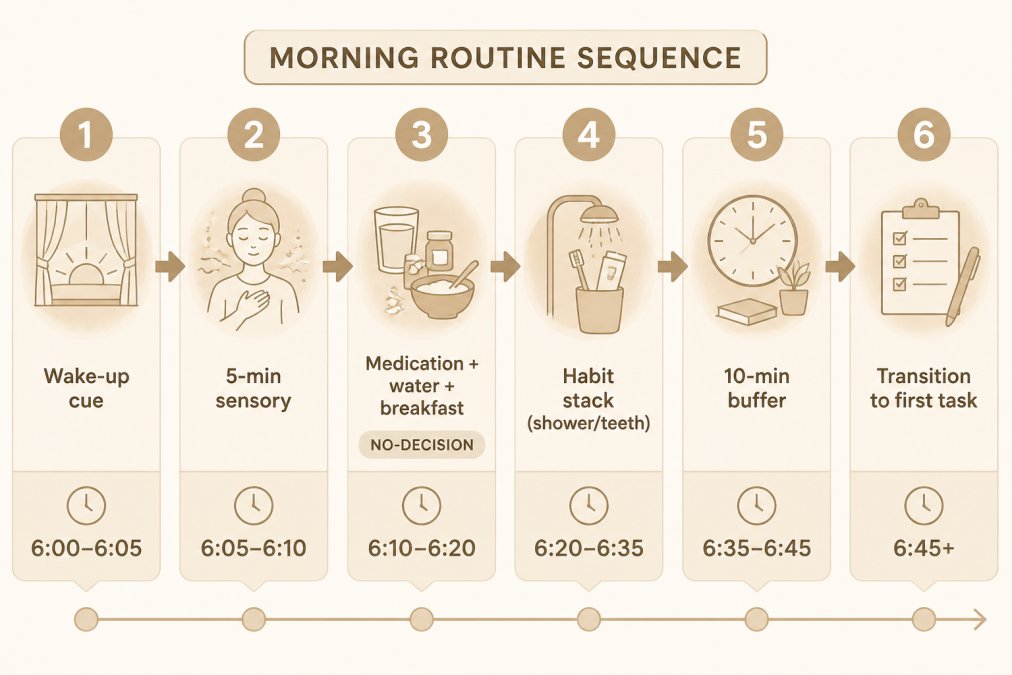
An ADHD friendly daily schedule template includes time blocks (not minute-by-minute breakdowns), buffer zones between tasks, and a realistic number of priorities. Most people with ADHD can realistically focus on three main priorities per day, not ten.
Visual Aids and Checklists That Reduce Cognitive Load
Visual aids work because they externalize information that would otherwise live in your working memory. A checklist you can see and check off is far more effective than trying to remember the steps.
Effective visual aids for ADHD mornings include:
- A printed or digital checklist with 4-6 morning tasks in order
- Color-coded time blocks showing when each task happens
- A visual timer showing how much time is left for each task
- Icons or pictures instead of words where possible (shower icon, medication icon, breakfast icon)
The checklist should be placed somewhere you see it first thing, on your bathroom mirror, your nightstand, or your phone home screen. Checking off items as you complete them provides a small dopamine hit that reinforces the behavior.
Medication Timing and Buffer Zones
If you take ADHD medication, timing matters. Many people find that taking medication right after waking, with food and water, helps it work more effectively. Building this into your routine as a non-negotiable step makes it automatic.
Buffer zones are the gaps between tasks where nothing is scheduled. These aren't wasted time, they're the space that prevents your morning from becoming overwhelming. If you shower, eat breakfast, and take medication back-to-back with no breathing room, you're more likely to get stuck or shut down.
A realistic morning routine includes 5-10 minute buffer zones between major transitions.
Co-Regulation and Environmental Design for Morning Success
Co-regulation, the practice of regulating your nervous system with another person's presence, can make mornings significantly easier, especially on difficult days.
Common Mistakes That Sabotage Your Morning
The most common mistake is trying to change everything at once. You read about an ideal morning routine and attempt to implement all seven steps immediately. By day three, you've abandoned it because it's too much.
Frequently Asked Questions
How do I wake up consistently if I have ADHD?
Use a multi-sensory wake-up cue instead of relying on willpower. Place your alarm across the room so you must physically get up, pair it with a specific song or light that signals morning, and set a backup alarm 5 minutes later. Many people with ADHD respond better to light-based alarms or vibrating wristbands than standard sounds. The key is removing the decision about whether to get up, make the action automatic instead.
What's a low dopamine morning routine, and why does it help ADHD?
A low dopamine morning routine avoids overstimulation early in the day, which can trigger dopamine crashes and afternoon energy crashes. Instead of scrolling social media or checking email immediately, start with grounding activities: cold water on your face, stretching, or quiet breathing. Follow this with a small dopamine boost you control, like upbeat music while showering or a favorite tea. This prevents the morning panic that comes from starting already overstimulated.
How can I reduce decision fatigue in my morning routine?
Eliminate choices before morning arrives. Lay out clothes the night before, prepare a no-decision breakfast (same meal every day, or a rotation of two options), and use a visual checklist instead of relying on memory. Use an ADHD friendly daily schedule template with fixed time blocks for each task. This removes the executive function demand of deciding what to do next, which is often harder for ADHD brains than actually doing the task.
What should I do if I miss my routine or have an off day?
Use the Restart Protocol: you can begin again at any point in your routine without shame or judgment. Missed your morning? Start fresh at lunch. Didn't shower? That's not a failure, reset and try again tomorrow. ADHD-friendly systems don't penalize inconsistency; they expect it. The Printable ADHD Planner includes pages designed specifically for restarting after gaps, so you never feel locked out of your routine.