
Brain-Designed vs. Shame-Free: ADHD Planner Comparison
Table of Contents
- Why ADHD Planners Need to Match How Your Brain Actually Works
- Brain Dump for ADHD: Clearing Mental Clutter Before You Plan
- ADHD-Friendly Planner Design: What Sets Them Apart from Rigid Systems
- ADHD Planner Printable vs. Digital: Format Comparison & Energy Flexibility
- Notion ADHD Planner Template Approach: When You Want Full Customization
- Comparison: Three Core Approaches to Simplifying Mental Load
- How to Choose: What Actually Matters When You Fall Behind
- Conclusion: Start with One System, Not a Perfect Routine
- Frequently Asked Questions
Last Updated: October 9, 2026
Why ADHD Planners Need to Match How Your Brain Actually Works
Your brain doesn't work like a traditional planner assumes it does, which is why an ADHD planner comparison reveals how differently systems can be designed. When you have ADHD, the executive function systems that handle task prioritization, working memory, and sustained attention operate differently. A planner designed to work with your brain acknowledges this reality instead of fighting against it.
The core problem isn't laziness or lack of motivation. It's that standard planners demand you hold everything in working memory, decide between competing priorities without support, and maintain rigid consistency. For ADHD brains, this creates constant cognitive load and often ends in shame when the system fails.
At Anchor Grove Studio, we've built our ADHD planner collection around one principle: your system should reduce mental clutter, not add to it. This means fewer items per page, clearer decision-making frameworks, and most importantly, no guilt when you fall behind.

Brain Dump for ADHD: Clearing Mental Clutter Before You Plan
Before you can prioritize anything, you need to get everything out of your head. This is where the brain dump becomes essential for ADHD brains struggling with constant mental clutter.
When tasks, ideas, and worries live in your working memory, they consume cognitive resources even when you're not actively thinking about them. The unfinished tasks create what researchers call the Zeigarnik effect: your brain keeps circling back to incomplete items, draining focus and energy (pubmed.ncbi.nlm.nih.gov). A brain dump interrupts this cycle by externalizing everything onto paper or a digital system.
The practical process is simple: write down every task, worry, appointment, and idea without organizing or prioritizing. Don't judge whether items are important yet. The goal is to clear your mental space so you can think clearly about what actually matters today.
Many people find that a brain dump alone reduces anxiety immediately. Once your thoughts are external, your brain stops using energy to hold them. From there, you can triage what needs attention now versus what can wait.
ADHD-Friendly Planner Design: What Sets Them Apart from Rigid Systems
An ADHD-friendly planner design prioritizes clarity over comprehensiveness. Instead of endless task lists, it limits options. Instead of rigid streaks that trigger shame, it supports pattern-noticing. Instead of language that implies failure, it uses language that supports recovery.
An ADHD planner comparison shows what separates ADHD-friendly design from traditional approaches:
Fewer items per view. Traditional planners show 10+ tasks daily. Your brain can't meaningfully prioritize that many options at once. ADHD-friendly planners typically show 3 priorities, forcing you to choose what actually matters rather than hoping you'll tackle everything.
Low-pressure habit tracking. Rigid streak systems create all-or-nothing thinking: miss one day and the streak breaks, triggering shame and abandonment. ADHD-friendly trackers instead ask "Did I do this today?" without judgment, letting you notice patterns over time rather than chase perfection.
Flexibility for energy fluctuation. ADHD comes with variable energy and motivation. Some days you can focus for hours; other days executive function is nearly offline.
The Printable ADHD Planner from Anchor Grove Studio demonstrates this approach: it includes a Brain Dump system, a three-priority daily structure, and a low-pressure habit tracker that lets you notice patterns without demanding perfect streaks.

ADHD Planner Printable vs. Digital: Format Comparison & Energy Flexibility
Choosing between printable and digital formats matters because the format itself affects whether you'll actually use the system. Both have real advantages depending on your working memory, energy levels, and environment.
Printable ADHD planners work well if you benefit from tactile engagement. Writing by hand activates different neural pathways than typing, often improving memory and focus (pubmed.ncbi.nlm.nih.gov).
The drawback is friction: you need paper, a printer, and physical storage. If you're having an executive function crash, printing feels like too many steps.
Digital planners reduce friction for low-energy days. They're always available on your device, searchable, and don't require setup.
Digital systems also support quick recovery: if you miss a week, you can jump back in without reprinting. But they come with the risk of digital overwhelm and the distraction of notifications.
Many people benefit from having both available. Use the printable version on high-energy days when you have time to print and handwrite. Use the digital version on low-energy days when friction needs to be minimal.
Notion ADHD Planner Template Approach: When You Want Full Customization
If you're drawn to Notion but hesitant about setup, the middle ground is a pre-built template that's already structured. This reduces customization to the essentials: connecting your own data, not building the system from scratch.
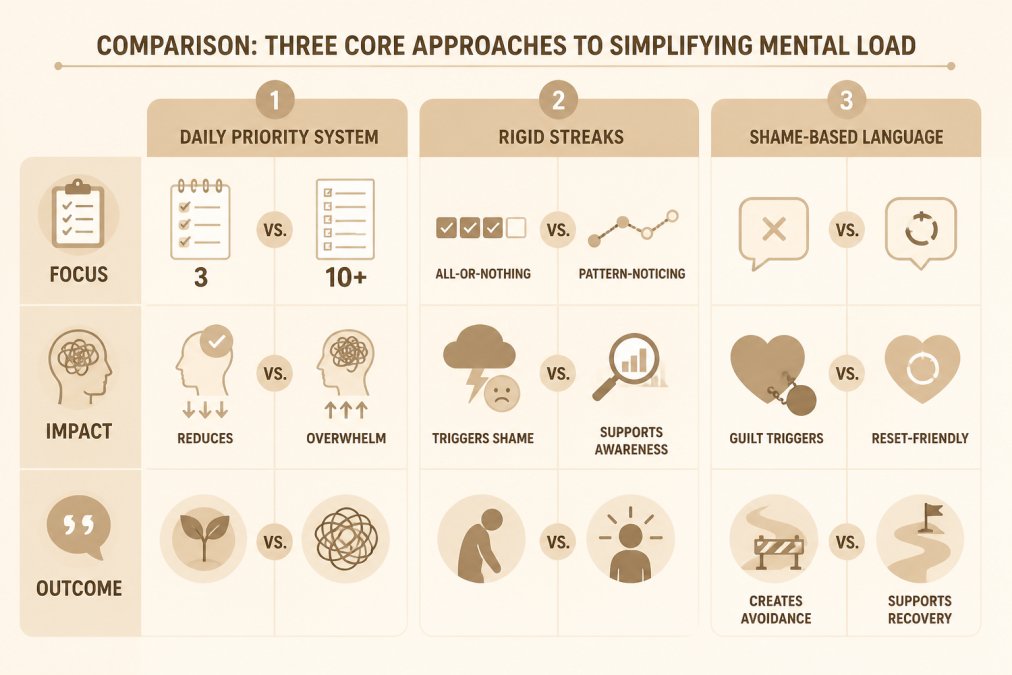
Comparison: Three Core Approaches to Simplifying Mental Load
The most important distinction isn't between printable and digital. It's between three fundamentally different approaches to how a planner handles ADHD's core challenges: managing overwhelm, supporting recovery, and reducing shame.
Daily Priority System vs. Endless Task Lists
A daily priority system limits what you see each day. Instead of 10+ tasks, you choose 3 that matter most. Your brain can meaningfully prioritize three items. It cannot meaningfully prioritize 10, so it defaults to either avoidance or random selection.
An endless task list creates cognitive load before you even start. Scanning 10+ items takes mental energy. Deciding which to start feels impossible. Many people with ADHD respond to this overwhelm by doing nothing.
The priority system works because it forces a decision upfront: "What actually matters today?" This is hard, but it's a one-time decision rather than an ongoing burden. Once you've chosen three priorities, your working memory is freed up to focus on execution.
Printable ADHD Planner: No-Shame Daily Planning System →
Rigid Streaks vs. Flexible Pattern-Noticing
Rigid streak systems demand perfect consistency: do the habit every single day or the streak resets to zero. This creates all-or-nothing thinking that often triggers shame and abandonment.
Flexible pattern-noticing instead asks: "Did I do this today?" without judgment. You track the data over time and notice patterns. Some weeks you do it five days. Some weeks three. The goal isn't perfection, it's awareness of what's realistic for your energy and capacity.
ADHD brains respond better to pattern-noticing because it acknowledges reality: some days you have executive function available, some days you don't. A system that supports this is one you'll actually return to.
Shame-Based Language vs. Supportive Reset Options
Traditional planners use language that triggers shame: "failed," "missed," "didn't complete." This language is powerful, it sticks in your mind and makes you less likely to open the planner again.
ADHD-friendly systems use language that supports recovery: "reset here," "start fresh," "try again tomorrow." This isn't about avoiding accountability. It's about recognizing that falling behind is normal, and the system should help you restart, not make you feel worse.
How to Choose: What Actually Matters When You Fall Behind
The real test of an ADHD planner isn't how it works on a good day. It's what happens when you fall behind.
You'll miss days. You'll miss weeks. You'll abandon the system for a month and wonder if you should start over.
When evaluating an ADHD planner, ask these questions:
Can I reset without shame? If missing a day means the whole system feels "failed," you won't come back. Look for planners with reset pages, weekly check-ins, or structures that let you pick up mid-week without judgment.
Is setup low-friction? If the planner requires 30 minutes of customization before you can use it, you won't start during low-energy periods.
Does it match my working memory capacity? Some people can handle 10 tasks on a page. Most ADHD brains work better with 3. Know your own threshold and choose accordingly.
Does it support task initiation? The ADHD Focus & Deep Work System addresses this directly: it includes prompts for body doubling, the two-minute floor, and temptation bundling, practical strategies that make starting easier.

Can I use it on low-energy days? If every page requires perfect penmanship or 15 minutes of setup, you won't use it when your executive function is depleted.
The Printable ADHD Planner and Digital ADHD Planner both support recovery: you can open to any page, choose one priority, and begin. Neither requires perfect consistency.
Conclusion: Start with One System, Not a Perfect Routine
The goal isn't to build a perfect routine. It's to build a system your brain will actually use, even on hard days.
An ADHD planner designed to work with your brain reduces mental load, supports recovery, and removes shame language. It limits daily choices to what's manageable, tracks patterns instead of demanding perfection, and makes restarting easy.
The best planner is the one you'll open tomorrow, not the one that looks perfect on day one.
When you're ready to reduce mental clutter and build a system that works with your ADHD brain, Anchor Grove Studio's collection of ADHD-friendly planners is built for exactly this. The Printable ADHD Planner includes a brain dump system, three-priority daily structure, and low-pressure habit tracker. The Digital ADHD Planner brings the same approach to your tablet. And if you struggle with task initiation specifically, the ADHD Focus & Deep Work System gives you practical strategies for making starting easier.
Frequently Asked Questions
What makes an ADHD planner different from a regular planner?
An ADHD-friendly planner reduces cognitive load by limiting choices (three priorities instead of ten), using no shame language, and allowing you to reset after missed days without guilt. Regular planners often demand perfect consistency and assume you can decide what matters without external support. ADHD planners recognize that executive function challenges mean you need fewer decisions upfront, a brain dump system to externalize thoughts, and flexibility to work with energy fluctuations instead of against them.
Can you really use an ADHD planner if you keep falling behind?
Yes. Systems designed without shame are built specifically for this. They include reset pages, no streak penalties, and the expectation that you'll miss days. The Printable ADHD Planner ($22) and Digital ADHD Planner ($22) both state upfront that they work after you miss a week. You open them, choose your next step, and begin again. The key difference is that shame-free systems treat falling behind as normal, not failure.
Should I use a brain dump if I have ADHD?
A brain dump is one of the most effective ways to reduce mental load for ADHD brains. It works because ADHD working memory struggles when you hold many competing tasks. Writing everything down, unfinished tasks, worries, ideas, random thoughts, moves them from your brain to paper or screen. Then you triage: what actually needs attention today? The Printable ADHD Planner includes a Brain Dump & Triage System for exactly this reason.
Is a Notion ADHD planner template worth setting up if I'm not tech-savvy?
Notion templates require initial setup time and comfort with digital tools. If you struggle with task initiation or tech frustration, a printable or tablet-ready planner may be lower friction. However, if you already use Notion and want full customization, a template can save time versus building from scratch. Consider your energy for setup: printable planners ($5-$22) are ready to use immediately, while Notion requires configuration.
What's the real difference between a designed-to-work-with-your-brain system and a shame-free one?
A brain-designed system accounts for how ADHD executive function actually works: it reduces decisions, supports task initiation, recognizes energy fluctuations, and includes tools like brain dumps and focus session planners. A shame-free system removes guilt language and all-or-nothing thinking. The best systems do both, they're designed around ADHD neurobiology AND use supportive language. This combination means you're not fighting your brain while also not feeling bad when you miss days.