
Restart-Anywhere vs. Brain-Designed Planning: Which Works Better
Table of Contents
- The Two Approaches to ADHD Planning: Restart-Anywhere vs. Brain-Designed Flexible Systems
- What Makes an ADHD Daily Planner Different
- Restart-Anywhere Planning: Starting Fresh Without Guilt
- Brain-Designed Planning: Flexibility Built Into the System
- Planner Layouts: Daily and Weekly Pages in Both Approaches
- ADHD Planner Layouts and How They Support Executive Function
- Daily Planning Method for ADHD: Priority-Based Task Selection
- Comparison Table: Restart-Anywhere vs. Brain-Designed Planning
- Which Approach Should You Choose?
- Frequently Asked Questions
Last Updated: October 6, 2026
The Two Approaches to ADHD Planning: Restart-Anywhere vs. Brain-Designed Flexible Systems
Most people with ADHD have abandoned at least one planner. Miss a few days, guilt kicks in, and the system feels like a failure.
Traditional planners force linear progress, building on yesterday. At Anchor Grove Studio, we build systems that let you restart without shame or build flexibility into the structure itself: restart-anywhere planning and ADHD planner flexible planning.

What Makes an ADHD Daily Planner Different
A traditional daily planner assumes consistency: open it every morning, fill in tasks in order, check them off. It's built for linear thinking and sustained momentum.
An ADHD-friendly daily planner recognizes that ADHD brains struggle with task initiation, executive function, and deciding what matters. A regular planner asks "What will you do today?" An ADHD planner asks "What matters most today, and what's one realistic next step?"

Restart-Anywhere Planning: Starting Fresh Without Guilt
Restart-anywhere planning is simple: start over on any page, any week, any month. Miss three weeks? Skip the backlog and open a fresh page. No guilt, no catching up, no visual reminder of what you didn't do.
How restart-anywhere works
Restart-anywhere planning relies on undated pages. You write the date yourself, so skipping weeks creates no visual gap. When you're ready, grab a fresh page, write today's date, and move forward.
The system includes a brain dump section to capture everything in your head. Then you triage, pick your top three priorities, identify one clear next action, and that's your day.
When restart-anywhere planning shines
This approach works best if you struggle with shame and all-or-nothing thinking. If blank pages trigger guilt or you've abandoned systems because you felt behind, restart-anywhere removes that barrier.
The Printable ADHD Planner from Anchor Grove Studio uses this approach: an undated, reprintable system with a simple core structure of brain dump, triage, top three priorities, and one next action.
Brain-Designed Planning: Flexibility Built Into the System
An ADHD planner flexible planning approach doesn't ask you to restart. It builds flexibility into the structure, accounting for energy, focus, and capacity that fluctuate day to day.
How brain-designed planning reduces friction
Brain-designed systems use layouts that work on high- and low-energy days. Some days you fill in detailed task blocks; other days you just note what you're doing. The system adapts to your capacity, not the reverse.
These systems reduce friction by making the next action obvious. Instead of staring at a blank page, the planner prompts: "What's one thing you can do in the next 15 minutes?" Weekly overviews help you see the broader picture without getting lost in daily details, so you can notice patterns and adjust without starting from scratch.
When brain-designed planning works best
This approach suits people who want continuity. You're not restarting; you're adjusting. If you want a consistent routine that bends with your energy level, brain-designed planning removes the friction of deciding how to use the system on hard days.
The Digital ADHD Planner from Anchor Grove Studio is built this way: tablet-ready, low-clutter layouts, flexible sections for changing energy and capacity, and hyperlinked daily and weekly pages.
Planner Layouts: Daily and Weekly Pages in Both Approaches
Both systems include daily and weekly pages. The difference is how they're structured and how they relate.
Restart-anywhere planners use undated daily pages; you write the date when you use them. Weekly pages are optional, there for the broader picture but not required.
The choice depends on whether you prefer optional structure (restart-anywhere) or integrated structure (brain-designed).
ADHD Planner Layouts and How They Support Executive Function
Executive function challenges show up as difficulty with task initiation, prioritization, and working memory. An ADHD planner layout addresses these directly.
A brain dump section offloads everything in your head onto paper, reducing the cognitive load of holding tasks in working memory. Priority-based structure, three priorities instead of ten tasks, removes the decision fatigue of figuring out what matters.
Daily Planning Method for ADHD: Priority-Based Task Selection
The most effective daily planning method for ADHD brains is priority-based task selection.
First, you brain dump. Everything on your mind goes onto the page.
Next, you triage. Look at everything you wrote.
Printable ADHD Planner: No-Shame Daily Planning System →
Then, for each priority, identify one clear next action. Not the whole project.
Finally, you pick one of those next actions to start with.
The ADHD Planning & Focus Bundle from Anchor Grove Studio includes a full system for this.
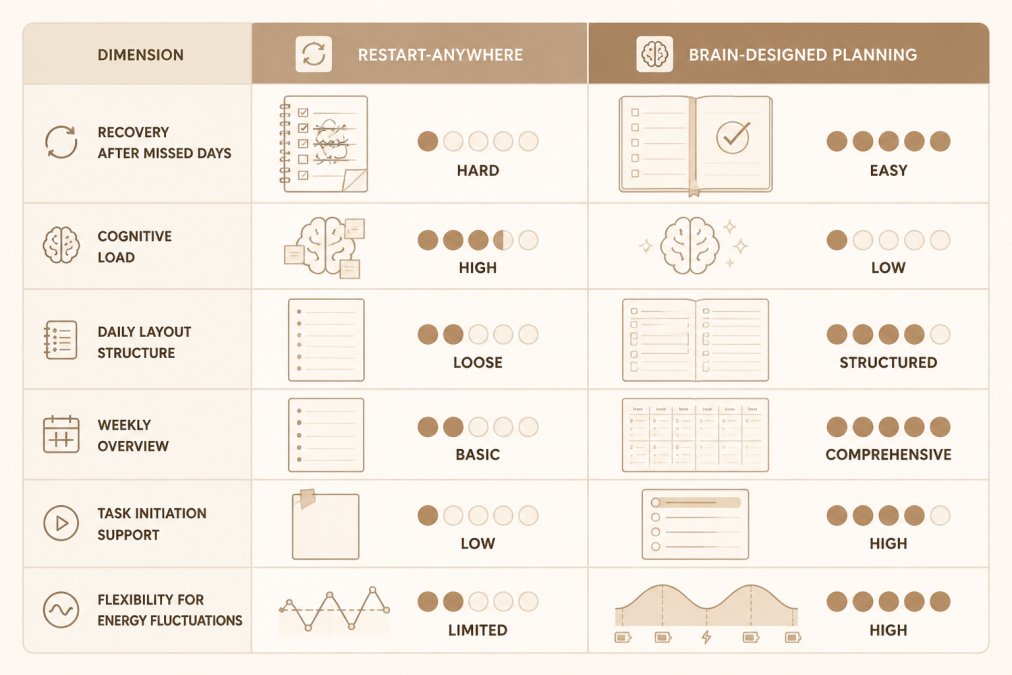
Comparison Table: Restart-Anywhere vs. Brain-Designed Planning
A table of dimensions is useful, but it doesn't show you what the difference actually looks like. Below is the same week planned in both systems, followed by the comparison table.
The same week, planned two ways
Imagine a week where Monday and Tuesday go well, Wednesday and Thursday collapse, and Friday you're back but behind.
Restart-anywhere version
- Monday: Fresh undated page, today's date written in. Brain dump, triage, top three priorities, one next action. Page used.
- Tuesday: Same routine. Page used.
- Wednesday and Thursday: No pages exist. Nothing to skip, nothing to backfill.
Brain-designed version
- Monday: Weekly overview filled in first, then the daily page. Detailed task blocks because capacity is high.
- Tuesday: Weekly view checked, daily page used with normal detail.
- Wednesday and Thursday: Pages exist but stay blank. The weekly view still shows what mattered, so the thread isn't lost.
The practical difference: restart-anywhere removes the evidence of missed days, while brain-designed keeps the context so you can pick the thread back up. Neither is wrong. They solve different problems.
Side-by-side comparison
| Dimension | Restart-Anywhere Planning | Brain-Designed Flexible Planning |
|---|---|---|
| Recovery after missed days | Start fresh on a new page, no backlog | Continue with the same structure, adjust capacity |
| Cognitive load | Lower on restart days, minimal guilt | Consistent, built for flexibility |
| Daily layout structure | Undated, simple, minimal sections | Dated, integrated with weekly view |
| Weekly overview | Optional, not required for system to work | Core part of the routine |
| Task initiation support | Brain dump + triage + top three + next action | Flexible prompts adapted to energy level |
| Flexibility for energy fluctuations | High (you can disappear and restart) | High (structure adapts to capacity) |
| Best for | Shame-sensitive, inconsistent engagement | Pattern-noticing, routine-building |
| Continuity | Broken by restarts, but intentionally | Maintained across weeks and months |
| Setup effort | Low, write the date and go | Slightly higher, weekly view comes first |
| Visual density | Low, fewer sections per page | Moderate, weekly and daily pages together |
Which Approach Should You Choose?
Most planner comparisons stop at "it depends on your brain." That's true but useless when you're standing in front of a blank page on a Tuesday afternoon. Use the decision guide below to match the approach to the friction you keep hitting.
Start with the failure pattern, not the planner
Ask yourself one question: when a planner stops working for you, what actually happens?
- You feel behind and avoid opening it. Blank pages, missed weeks, and a visible backlog create shame. This points to restart-anywhere planning.
- You open it but freeze on what to write. The page is there, but the structure doesn't tell you where to start. This points to brain-designed flexible planning.
- You use it for two weeks, then drift. You don't feel shame and you don't freeze, you just lose the thread. Brain-designed planning tends to hold continuity better because the weekly view keeps pulling you back.
Decision guide by planning preference
| If your priority is... | Lean toward... | Because... |
|---|---|---|
| Zero setup effort and freedom to skip | Restart-anywhere | Undated pages mean a missed week leaves no visible gap |
| A weekly overview you actually use | Brain-designed | The weekly page is part of the routine, not an optional extra |
| Low visual density and fewer choices | Restart-anywhere | Fewer sections per page means less to process |
| Prompts that adapt to energy level | Brain-designed | Layouts change based on capacity instead of staying fixed |
| Noticing patterns over time | Brain-designed | Consistent structure makes trends visible |
| Recovering after a bad stretch without guilt | Restart-anywhere | The reset is built in, not something you have to earn |
A low-friction reset process for missed days
Whichever approach you pick, missed days will happen. The difference is what you do next. A reset that works in under five minutes:
- Do not backfill. Skip the missed pages entirely. Filling them in retroactively is busywork that reinforces the feeling of being behind.
- Brain dump what's still live. Anything from the missed days that still matters goes onto today's page. Anything that doesn't, let it go.
- Pick three priorities for today only. Not for the week you missed. Today.
- Choose one next action and start it. The reset is complete the moment you begin one small task.
If you're using a restart-anywhere system, this is the whole method: fresh page, today's date, move forward. If you're using a brain-designed system, glance at the weekly view to reorient before you start.
Accessibility and cognitive-load considerations
Planner usability isn't just about features. It's about how much work the page asks your brain to do before you've written anything.
- Visual density. Pages with many lines, boxes, and decorative elements increase the amount of visual information to filter. Lower density reduces that load, which matters more on low-capacity days.
- Choice overload. A page offering ten categories to fill in forces a decision before any task gets done. Fewer sections means fewer decisions.
- Time estimation. ADHD often comes with difficulty estimating how long tasks take (Checking your browser). A planner that asks for time blocks without helping you estimate can add friction rather than remove it.
What "brain-based" does and doesn't mean
"Designed to work with your brain" is a useful design principle, not a clinical claim. In practice it means the layout reduces friction: fewer decisions, clearer next actions, and structure that tolerates fluctuation. That's a reasonable design goal, but it is not a treatment, and no planner replaces support from a qualified professional. Treat brain-based language as a description of layout choices, not evidence of a clinical outcome.
Try before you commit
The cheapest way to decide is to run both approaches for a short trial. The 1-Month ADHD Printable Planner from Anchor Grove Studio is a low-cost way to test the restart-anywhere workflow ($5). If it clicks, the full Printable ADHD Planner ($22) extends the same system.

The real difference isn't which approach is "better." It's which one matches how your brain actually works.
Frequently Asked Questions
What's the difference between an ADHD daily planner and a regular planner?
An ADHD daily planner is built around how ADHD brains actually work. It reduces cognitive load by limiting daily priorities to three instead of ten, includes a brain dump section to clear mental clutter, and contains no shame language or rigid streak-tracking. Regular planners often expect perfect consistency and can feel overwhelming. ADHD-friendly designs support task initiation, flexible scheduling, and the ability to restart after missed days without guilt.
Can I really start over on any page or week without falling behind?
Yes. Restart-anywhere planning is built on the principle that you can open your planner at any point and begin again without backlog or guilt. There's no concept of 'failed' pages or catching up. You simply choose what matters today and move forward. This approach works because it removes the shame that typically stops people from returning to rigid planners after a break.
How does a brain-designed ADHD planner layout actually reduce planning friction?
Brain-designed layouts minimize decision fatigue by using clear visual hierarchy, low-clutter designs, and built-in structure that doesn't feel restrictive. Features like a Top 3 daily-priority system, hyperlinked navigation on digital versions, and flexible pages for high- and low-energy days all reduce the cognitive effort needed to plan. The result: you spend less mental energy organizing and more energy on actual work.
Which approach works better for someone with energy fluctuations?
Brain-designed planning systems typically handle energy fluctuations better because they're intentionally built with flexible pages for different capacity levels. You can use a simplified version on low-energy days and expand on high-energy days. Restart-anywhere planning also supports fluctuations by letting you pause and restart, but brain-designed systems anticipate the fluctuation and design for it from the start.
Is a daily or weekly planner better for ADHD?
The best ADHD planner includes both. Daily pages help with immediate task initiation and priority selection, while weekly pages provide a broader view for planning and noticing patterns. A planner with daily and weekly pages together gives you the immediate focus you need plus the bigger-picture perspective that prevents overwhelm and supports habit formation.
Choosing an ADHD planner isn't about finding the perfect system. It's about finding one you'll actually use on the days when executive function is hardest. Anchor Grove Studio's planning systems are designed to work with your brain, not against it, whether you need to restart without guilt or build flexibility into your daily routine. Start with the 1-month trial, or dive straight into the full system. Either way, you're choosing a planner built for how ADHD brains actually function.