
ADHD-Friendly Financial Tracking: A Practical System
Table of Contents
- Why Traditional Budgeting Fails for ADHD Brains
- Build a Simple Financial Tracker for ADHD
- How to Automate Finances with ADHD
- Managing Impulse Spending with an ADHD Impulse Spending Tracker
- Overcoming Financial Paralysis and Avoidance
- Breaking the Financial Shame Cycle
- Frequently Asked Questions
Last Updated: September 2, 2026
Why Traditional Budgeting Fails for ADHD Brains
Most budgeting systems assume you'll check in daily, categorize every expense, and maintain consistent habits. For people with ADHD, this creates immediate friction. Your executive function, the mental system handling planning, impulse control, and task initiation, works differently (peer-reviewed research). Traditional budgets demand sustained attention and rigid structure that ADHD brains naturally resist.
The real problem isn't laziness. Conventional financial tracking ignores how your brain actually works. They're designed for neurotypical patterns of sustained focus and sequential task completion. Time blindness, task initiation challenges, and executive function fluctuations make daily budget reviews feel impossible (the NIH). You might intend to log expenses every evening, but by day three, the habit collapses under cognitive load.
An ADHD-friendly financial tracking system needs to work with your brain, not against it. This means fewer categories, less daily friction, and more automation. It means accepting that some days you'll have energy for financial tasks and other days you won't, and building flexibility so you don't abandon the system when your energy crashes.
Build a Simple Financial Tracker for ADHD
A simple financial tracking system starts with one principle: reduce decision fatigue. Instead of complex category trees and daily logging, you need a tracker that captures essential information with minimal friction. This means fewer categories, clearer visuals, and a system you can actually return to on difficult days.
Choose Your Tracking Method
Your first decision is format: digital, printable, or template-based like Notion. Each has different friction levels depending on how your ADHD brain works.
Digital apps offer the lowest friction for logging. One-click transaction entry, automatic syncing, and push notifications reduce cognitive load. However, they often include too many features. The key is finding an app designed for simplicity.
Printable trackers work well if you process information better on paper. Writing engages different cognitive pathways than typing. The downside: you have to remember to print, carry it, and manually transfer data if you want digital records.
Notion templates offer flexibility between digital and visual. Pre-built templates like the ADHD Life Dashboard remove the friction of building from scratch while giving you a customizable system with visual dashboards.
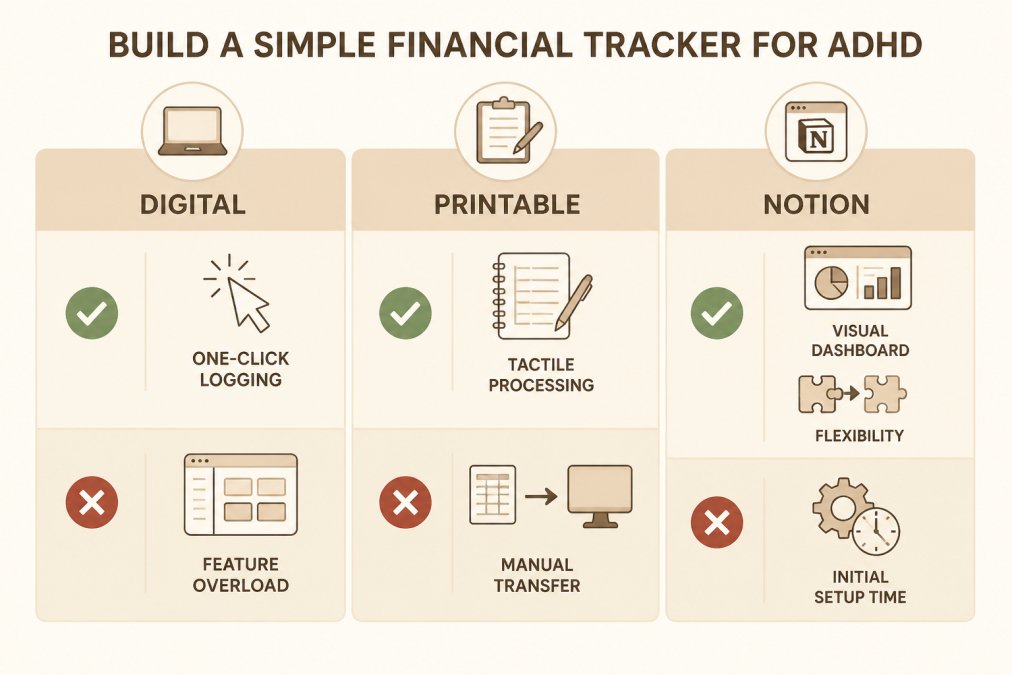
The choice depends on your specific executive function challenges. If task initiation is your main barrier, digital with one-click logging wins. If you struggle with screen time, printable works. If you want a middle ground with beautiful visuals and no setup headache, a pre-built Notion template removes decision paralysis.
Set Up Visual Dashboards for Clarity
A visual dashboard is the difference between a tracking system you use and one you abandon. Your brain needs to see your financial situation at a glance, not interpret numbers in a spreadsheet.
A good dashboard shows four things clearly: current account balances, upcoming bills, recent transactions, and a simple spending snapshot. No complex graphs. Just the essentials, presented without cognitive translation.
Color coding helps. Green for healthy balances, yellow for upcoming bills, red for accounts needing attention. This visual language lets you understand your situation in seconds.
The Anchor Grove Studio ADHD Financial Tracker Money Snapshot gives you a quick visual of accounts, bills due, and spending patterns without the complexity of traditional budgets.

How to Automate Finances with ADHD
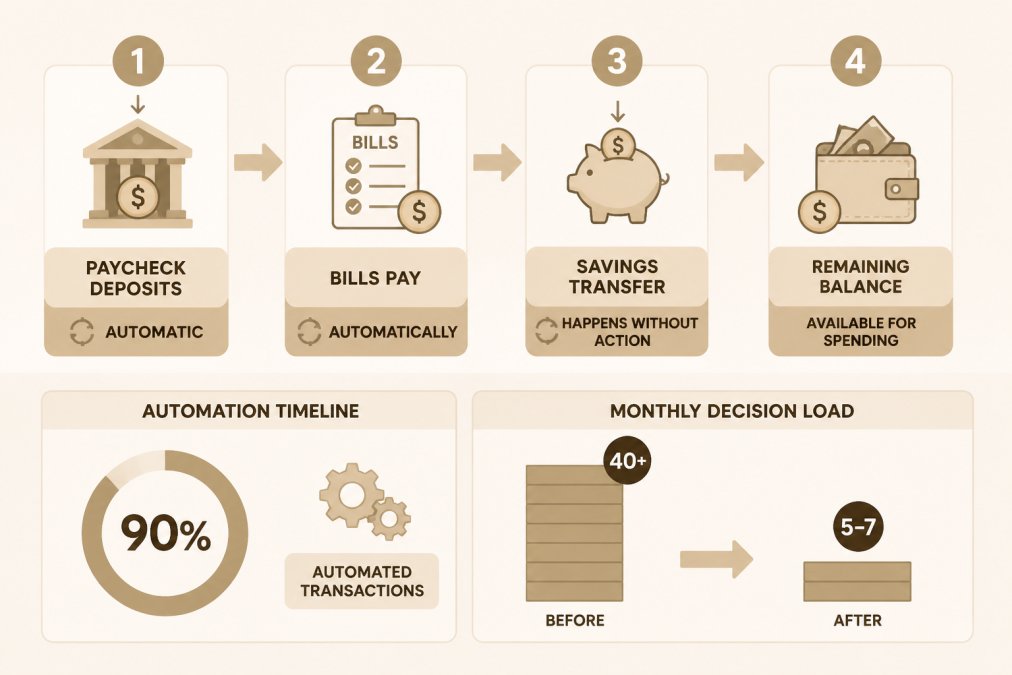
Automation is the secret weapon for ADHD financial management. Every transaction you automate is one less decision to make, one less thing to remember. The goal is to move as much as possible to "set and forget" so your financial life runs on autopilot.
Automate Bill Payments and Transfers
Set up automatic payments directly from your checking account for fixed expenses. You'll never miss a payment or face late fees.
For savings, automate transfers the day after you get paid. Move money to a separate savings account before you can spend it. This removes the willpower requirement entirely. If your income varies, automate a conservative amount based on your lowest recent income.
Set Up One-Click Expense Logging
Make logging so frictionless that you do it in the moment. Use an app that lets you snap a photo of a receipt and auto-categorize it, or one that syncs with your bank and requires just one tap to confirm a transaction.
Set a weekly review habit, not daily. Look at what you spent, notice patterns, and adjust if needed. This gives you feedback without constant monitoring that creates anxiety.
Managing Impulse Spending with an ADHD Impulse Spending Tracker
Impulse buying is painful for people with ADHD. It's not about willpower, it's about how your brain seeks dopamine. When understimulated or dysregulated, spending provides immediate reward (peer-reviewed research). An ADHD impulse spending tracker isn't about judgment, it's about awareness and pattern recognition.
Capture Impulse Purchases Without Judgment
Create a simple log for impulse purchases: what you bought, cost, what you were feeling, and whether you still wanted it 24 hours later. Don't judge yourself. This is data collection.
The act of logging creates a tiny pause. Over time, you'll notice patterns: you impulse-buy when bored, tired, or procrastinating. Once you see the pattern, you can intervene with systems. If you impulse-buy when bored, remove saved payment methods from shopping apps. If you buy after social media, set app time limits.
Address the Dopamine-Seeking Pattern
The underlying issue with impulse spending is dopamine regulation. Your ADHD brain seeks stimulation, and spending provides it. The solution isn't white-knuckling restraint. It's providing healthier dopamine sources and making impulse spending slightly harder.
Build alternative reward systems. When you feel the urge to buy, try a five-minute walk, a different snack, or a quick game. These won't always work, but they'll work sometimes. For online shopping, add friction: log out of accounts, delete saved payment methods, use a waiting list instead of a cart. A 24-hour rule before any non-essential purchase helps. Many impulses fade within hours.
Overcoming Financial Paralysis and Avoidance
Financial avoidance is common for people with ADHD. The thought of checking your account balance or opening bills creates overwhelming anxiety. Days turn into weeks. Weeks turn into months. The avoidance worsens because the financial situation deteriorates, increasing shame and anxiety.
This is financial paralysis, not laziness. It's a real executive function challenge combined with emotional dysregulation. The solution isn't forcing yourself to care more about money. It's making the task so small that avoidance loses its power.
Start with a five-minute weekly check-in. Just: open your account, look at the balance, check if any bills are due soon. That's it. If you do nothing else, you've broken the avoidance cycle.
Use a visual tracker to mark when you complete your weekly check-in. This gamifies the process and provides dopamine reward for following through. Make the environment supportive. Review your finances at a time when you have energy, in a comfortable space, with something pleasant nearby.
Breaking the Financial Shame Cycle
Financial shame keeps many people with ADHD stuck in avoidance. You made a mistake, overspent, missed a payment, or didn't track for months. Now you feel ashamed. The shame makes you avoid looking at finances. The avoidance makes the problem worse. The worsening problem deepens the shame.
The only way out is to break the shame association entirely.
Reframe your relationship with money. Your ADHD brain isn't broken because you struggle with traditional budgeting. Traditional budgeting was designed for neurotypical brains. You're not failing the system; the system failed you. You're not lazy, irresponsible, or bad with money. You have a different neurotype that needs different tools.
Accept that your financial system will look different from your non-ADHD friends' systems. You might have more automation, fewer categories, more visual dashboards, and more frequent resets. That's not failure; that's adaptation.
Build in explicit permission to start over. If you fall off your tracking system, restart without guilt. No "I've already failed this month" spiral. Just: reset, restart, continue. Flexible systems welcome you back.
At Anchor Grove Studio, we've built our ADHD-friendly financial tracker around this principle: no shame, no judgment, just clarity. The Printable ADHD Planner No-Shame Daily System includes financial tracking pages designed to work with variable energy levels. You can use it intensively when regulated, or just check essentials when struggling.

Financial tracking with ADHD doesn't require willpower, discipline, or personality overhaul. It requires systems designed for how your brain actually works: automation wherever possible, visual clarity, minimal daily friction, and explicit permission to be imperfect. The Anchor Grove Studio ADHD Financial Tracker Money Snapshot provides exactly this, a calmer way to see your money without the shame and complexity of traditional budgets. Start with a five-minute weekly check-in, automate your fixed expenses, and let the system do the heavy lifting while you focus on what matters.
Frequently Asked Questions
Q: How do you track finances with ADHD?
A: Start with one simple method: either a printable tracker, a digital app with minimal categories, or a Notion template. The key is reducing decision fatigue. Track only income, fixed bills, and discretionary spending. Use visual dashboards instead of spreadsheets, automate what you can, and set a weekly 10-minute check-in rather than daily logging. Most people with ADHD succeed with systems that require minimal executive function and allow you to start over anytime without shame.
Q: What makes a financial tracking system ADHD-friendly?
A: An ADHD-friendly system has low cognitive load, visual clarity, and built-in flexibility. It avoids rigid daily categories, doesn't punish you for missing days, and uses one-click logging or automation. The best systems allow you to reset any week, and pair tracking with a visual dashboard so you see progress without doing mental math. Templates designed specifically for ADHD brains reduce decision paralysis.
Q: How can I stop impulse spending if I have ADHD?
A: Use an ADHD impulse spending tracker that captures purchases without judgment, then review them weekly. The goal isn't to shame yourself but to understand your dopamine-seeking patterns. Automate your savings first so impulse money is limited to what's left. Create a 24-hour rule for non-essential purchases over a set amount. Pair this with addressing the underlying need: if you're spending on stimulation, build in low-cost dopamine activities like walks, music, or games that don't drain your account.
Q: Can I really automate my finances if I have variable income?
A: Yes. Set up automation for fixed expenses (rent, insurance) first. For variable income, track your average monthly earnings and automate a conservative amount to savings and bills. Keep a small buffer account for income fluctuations. Use a simple financial tracker to log what actually comes in each month, then adjust automation quarterly. This approach removes the guesswork and reduces financial anxiety while keeping you flexible when income changes.
This article was written using GrandRanker