
Flexible Daily Routine for ADHD: A 2026 Guide
Table of Contents
- Why rigid schedules fail and a flexible daily routine for ADHD wins
- Anchor your day: the role of anchor tasks and time blocking
- How to overcome time blindness with visual cues and buffers
- ADHD morning routine examples that build momentum
- Designing your own ADHD friendly daily schedule template
- Why the best digital planners for ADHD offer a dopamine menu
- Routine maintenance for executive dysfunction episodes and burnout
- Frequently Asked Questions
Last Updated: September 8, 2026
Most productivity advice assumes a brain that moves in a straight line. For the roughly prevalence statistics from the CDC of adults managing Attention Deficit Hyperactivity Disorder, that assumption sets us up for failure from the start. A flexible daily routine for ADHD isn't a luxury or a softer option; it is the only kind of schedule that respects how executive function, time blindness, and motivation actually operate. At Anchor Grove Studio, we design planning systems around this reality, and this guide explains why flexibility wins and how to build a routine that works with your brain rather than against it.
The core insight is simple: rigid schedules demand consistent executive function, which is precisely the skill ADHD makes unreliable. A flexible daily routine for ADHD anchors your day to stable activities while leaving the timing and order of tasks open.
Why rigid schedules fail and a flexible daily routine for ADHD wins
Rigid schedules fail because they rely on sustained working memory and reliable task initiation. When you plan your day in hourly blocks, one missed slot collapses the entire structure, triggering overwhelm and shame.
A flexible daily routine for ADHD wins by reducing cognitive load. Instead of asking "What should I do at 2:00 PM?", you ask "What needs to happen today?" This lowers the barrier to starting and accommodates natural fluctuations in focus and energy.
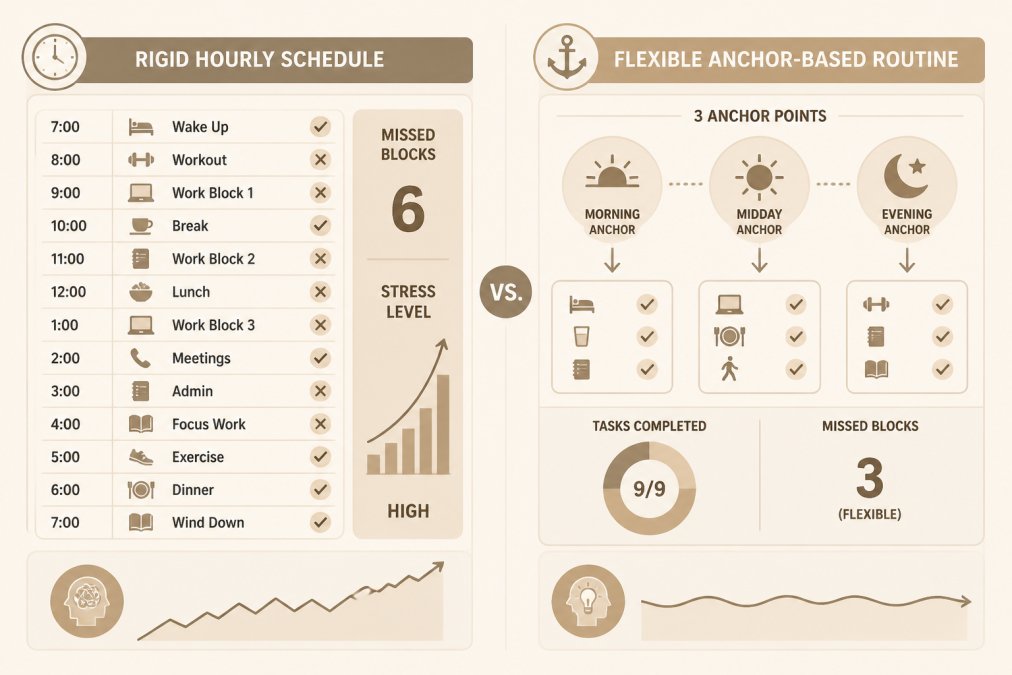
The goal is not to schedule every minute but to create a container for your day that holds space for both productivity and rest. Consistency becomes a pattern that repeats, not a streak that breaks.
Anchor your day: the role of anchor tasks and time blocking
An anchor task is a fixed activity that happens at roughly the same time each day, regardless of what else is going on. Common anchors include waking up, meals, medication, and bedtime. They act as structural supports because they are tied to biological rhythms rather than willpower.
Time blocking, applied flexibly, means assigning tasks to broad windows rather than specific hours. For instance, "morning focus block" might run from after breakfast until lunch, accommodating both early birds and slow starters.
Limit yourself to a few anchors. Too many fixed points recreate the rigidity you are trying to escape. Pick two or three anchors that reliably happen, and build flexible windows around them.
How to overcome time blindness with visual cues and buffers
Time blindness is the ADHD brain's inability to accurately perceive the passage of time (peer-reviewed research). It's not about being lazy; it's a neurological difference. The solution isn't to try harder to 'feel' time, but to externalize it, to make time visible and tangible.
The Mechanics of Visual Cues
Visual cues convert the abstract concept of time into a concrete, spatial representation. The most effective tools include:
- Time Timers: Analog clocks with a red disk that disappears as time elapses. They show 'time remaining' rather than 'time of day.' Set one for 25 minutes and start a task; the shrinking disk provides a constant, non-verbal reminder that time is passing.
- The 'Timeboxing' Method: Instead of writing "Work on report," write "Report: 9:00 AM - 9:45 AM." Treat the end time as a hard boundary, when the timer goes off, you stop, even mid-sentence. This trains your brain that tasks have a finite duration.
- The 'One-Task-at-a-Time' Visual Board: Write the only task you are currently working on a small whiteboard. When tempted to switch, look at the board. This externalizes focus and prevents mental sprawl.
- Physical Clocks in Every Room: A quick glance at an analog clock reorients you in time without the distraction risk of a phone.
Building Effective Buffer Zones
Buffers are intentional gaps between tasks that absorb overruns and transition difficulties. A common pattern is to underestimate task duration by 50%, if you think a task takes 30 minutes, schedule 45 (PubMed).
Here is a practical way to implement buffers:
- The 15-Minute Rule: After every major task or appointment, schedule a 15-minute buffer. This is not 'free time' to be filled; it's a transition zone. Use it to tidy up, use the restroom, or simply take a breath.
- The 'Travel Time' Double: If you have an appointment, double the time you think it will take to get there, including parking and walking. This turns a stressful, time-blind rush into a calm, predictable journey.
- The 'Hard Stop' Alarm: Set an alarm 15 minutes before you actually need to leave or switch tasks. This is your 'wrap-up' warning. It gives you a concrete signal to start finishing what you're doing, rather than relying on your internal sense of time.
Managing Transitions with a 'Next Action' Checklist
Transitions are a common point of failure for ADHD brains. To make them smoother, create a 'next action' checklist. Before starting a task, write the first three steps of the next task on a sticky note, e.g., finishing work and starting dinner: 1. Take chicken out of fridge. 2. Put water on to boil. 3. Chop vegetables. When you finish, you just follow the list.
By combining these visual cues and buffer zones, you build external scaffolding that compensates for the internal timekeeping your brain struggles with. This turns time from an enemy into a tool.
ADHD morning routine examples that build momentum
A morning routine for ADHD isn't about a perfect sequence; it's about a predictable launchpad that minimizes decision fatigue. The most effective routines are built on a single, non-negotiable anchor and flexible, optional steps. Here are three examples.
The Early Bird (for those who wake up alert)
This routine capitalizes on the natural peak in focus many people experience after waking, protecting that window for high-cognitive-load tasks.
- Anchor: Wake up and get vertical. This is the only non-negotiable step. Open the curtains or turn on a bright light to signal to your brain that the day has started.
- Move your body (5-10 minutes). This doesn't need to be a workout. A quick stretch, a walk around the block, or a few yoga poses can increase blood flow and dopamine, which aids in focus.
- Hydrate and medicate. Drink a full glass of water and take any morning medication immediately. This is a classic habit stack that ties a critical task to the anchor of waking up.
- Dopamine bridge (15 minutes). Engage in a preferred activity like reading, listening to a podcast, or having a slow cup of coffee. This provides a low-stakes reward that makes the transition to work less jarring.
- Deep work block (60-90 minutes). Use a visual timer to work on your single most important priority for the day. The goal is to start, not to finish. After the timer goes off, you are done with this block.
- Brain break. Step away from the screen. Do a physical task like loading the dishwasher or folding laundry. This is a transition activity that helps your brain consolidate and prepare for the next phase of the day.
The Slow Starter (for those who need time to wake up)
This routine accepts that your brain takes time to power on, using gentle, physical activities to build momentum instead of forcing high-level tasks early.
- Anchor: Wake up and stay in bed for 5 minutes. This is a deliberate, guilt-free buffer. Use this time to do a body scan or just let your thoughts wander.
- Sit up and have a glass of water. Keep a water bottle on your nightstand to make this step effortless.
- Low-demand physical task (15 minutes). Make your bed, get dressed, or prepare a simple breakfast. The goal is to get your body moving without requiring significant planning or focus.
- Engage in a 'brain-warming' activity (10 minutes). This could be reading the news, doing a crossword puzzle, or playing a quick game on your phone. The goal is to gently stimulate your brain without demanding output.
- Review your flexible daily routine for ADHD. Now that you are more awake, look at your task list for the day. Choose one priority for your first work block, but don't schedule a start time. Just decide what it is.
- Start your work block when you feel ready. This might be 9:00 AM or 11:00 AM. The anchor is the sequence of steps, not the clock time. This approach removes the shame of a late start and replaces it with a sense of control.
The 'I Hit Snooze Three Times' Routine (for the most difficult mornings)
This is a minimum-viable routine for days when executive function is particularly low, designed to get you to a baseline without overwhelming you.
- Anchor: Sit up in bed. That's it. Don't think about the day. Just sit up.
- Put your feet on the floor. This is a physical commitment to starting the day.
- Drink water and take medication. This is the most critical step for your physical and mental health.
- Do one small, physical task. This could be brushing your teeth, washing your face, or changing your clothes. Any single action counts as a win.
- Move to your designated 'launch pad'. This is a spot in your home where you keep your keys, wallet, and phone. Just being there is a step forward.
- Give yourself permission to have a slow start. If you need to sit on the couch for 20 minutes before you can do anything else, that is acceptable. The routine is a success because you got out of bed and took your meds.
Night-before preparation is the secret to making any of these routines work. Laying out clothes, pre-making coffee, and packing your bag reduces morning decisions. If you have a bad morning, the routine isn't broken, you just had a bad morning.
Designing your own ADHD friendly daily schedule template
An effective ADHD friendly daily schedule template contains three zones: a morning anchor block, a midday flexible block, and an evening wind-down block. Within each zone, list tasks as options rather than timed appointments.
| Schedule Zone | Anchor Activity | Task Options | Buffer |
|---|---|---|---|
| Morning (7-10 AM) | Breakfast & meds | Focus work, exercise, errands | 15 min |
| Midday (12-3 PM) | Lunch | Meetings, admin, creative work | 30 min |
| Evening (6-9 PM) | Dinner | Family time, hobby, planning tomorrow | 15 min |
This template lets you choose tasks based on current energy and focus. Some days you complete three tasks; other days, one. Both are acceptable, the template is a guide, not a test.
For those who prefer digital systems, the Digital ADHD Planner Good Notes Tablet-Ready offers low-clutter layouts that support this flexible structure. It is designed to help you organize time and priorities without adding overwhelm, and you can start over on any page without shame.

Why the best digital planners for ADHD offer a dopamine menu
The best digital planners for ADHD integrate a dopamine menu, a personalized list of quick, rewarding activities used as breaks, rewards, or reset tools during a slump.
A dopamine menu addresses the motivation gap that traditional planners ignore. When a task feels impossibly boring, the brain needs a reward to initiate action; a dopamine menu provides that in a structured, guilt-free way.
The ADHD Productivity Focus Bundle Digital ADHD Planner embodies this philosophy. It includes a focus system designed to help you manage attention while providing space for the breaks your brain requires. This bundle combines printable and digital formats for maximum flexibility.

Routine maintenance for executive dysfunction episodes and burnout
Every routine will fail eventually. Executive dysfunction episodes, where even simple tasks feel impossible, are part of the ADHD experience. The difference between a helpful and harmful system is how it handles these moments.
The maintenance rule is simple: have a "minimum viable day" plan. This is a list of two or three non-negotiable tasks, like eating a meal and taking medication, that count as success on hard days. When struggling, drop everything else and aim for the minimum.
Routine fatigue and burnout are signals that your system needs adjustment, not that you are broken. Sensory regulation also plays a role; reducing noise, clutter, and visual stimulation can lower the barrier to starting. The Printable ADHD Planner No-Shame Daily System offers a low-clutter place to reset after an off day.

Building a flexible daily routine for ADHD takes experimentation and self-compassion. The structure will evolve as you learn your energy patterns and triggers. Begin with a single anchor and a single buffer, then build from there.
Building a routine that works with ADHD means abandoning the myth of the perfectly scheduled day. Anchor Grove Studio creates planning tools designed to support this flexible approach, offering printable, digital, and Notion-compatible systems that prioritize mental health over rigid adherence. Our planners include no-shame reset pages and dopamine-friendly layouts to help you get started, and our instant digital downloads mean you can begin today. Get started with Anchor Grove Studio and build a routine that finally fits your brain.
Frequently Asked Questions
What is the 1-3-5 rule for ADHD?
The 1-3-5 rule is a prioritization method that helps reduce overwhelm by limiting your focus. You pick 1 big task, 3 medium tasks, and 5 small tasks for the day. For an ADHD brain, this structure provides a clear finish line and prevents the cognitive load of an endless to-do list. It works best when integrated into a flexible daily routine, allowing you to choose tasks based on your energy levels without guilt.
How do you create a routine when you have time blindness?
Creating a routine with time blindness starts with externalizing time. Use visual schedules, timers, and alarms to make time tangible. Instead of planning by the clock, plan by sequence or anchor tasks, such as 'after breakfast' or 'when the laundry is done'. This reduces the pressure of exact times and builds a flexible daily routine for ADHD that focuses on completing actions rather than watching the clock.
Can a flexible schedule help with ADHD executive dysfunction?
Yes. A flexible schedule is key for managing executive dysfunction because it removes the shame of falling behind. It allows you to swap tasks based on your current capacity, which helps with task initiation. By using an ADHD friendly daily schedule template, you can plan for brain breaks and buffer zones, making it easier to transition between tasks and maintain momentum even on difficult days.
What does an ADHD friendly daily schedule template need to include?
An effective ADHD friendly daily schedule template focuses on time blocking and anchor tasks rather than strict hourly slots. It should have space for a 'dopamine menu' to help with task initiation and include a visible checklist to support working memory. Crucially, it needs a built-in reset for off days, so you can start over on any page without the pressure of a broken streak. Digital planners like the Digital ADHD Planner are ideal for this.