
How to Build a Flexible Routine: A Guide for ADHD Brains
Table of Contents
- Why Rigid Routines Fail and Flexible Ones Work
- Step 1: Set Priorities and Goals Without Perfectionism
- Step 2: Create a Daily Routine Template You'll Actually Use
- Step 3: Use Time Blocking for ADHD to Organize Your Day
- Frequently Asked Questions
Last Updated: October 21, 2026
Why Rigid Routines Fail and Flexible Ones Work
Rigid routines sound great in theory. Wake up at 6 a.m., exercise for 45 minutes, eat breakfast at 7:15, start work at 8. Every day, exactly the same. But if you have ADHD, you already know how this story ends: you miss one day, feel like you've failed, and abandon the whole system.
The problem isn't you. It's that rigid routines ignore how ADHD brains actually work. Your energy, focus, and capacity change day to day. Sometimes hour to hour. A system that demands perfection will always feel impossible.
A flexible routine is different. Instead of one fixed schedule, you build a framework that adapts. You have core priorities and time blocks, but you adjust them based on what's actually happening in your brain and life today. Some days you follow the plan exactly. Other days you use a stripped-down version. Both count as wins.
At Anchor Grove Studio, we've built planning tools specifically for this reality. The goal isn't perfection. It's a system you'll actually return to, even after a rough week. A flexible routine gives you structure without shame.
Step 1: Set Priorities and Goals Without Perfectionism
Start by identifying what actually matters. Not the ten things on your to-do list. The three things that would make today feel successful.
This is harder than it sounds, especially with ADHD. Your brain might pull you toward urgent tasks instead of important ones. You might struggle to decide where to start. That's why we recommend writing down everything first, then choosing three.
Your three priorities might change daily. Monday might be: finish the report, pay bills, eat lunch. Tuesday might be: attend the meeting, call the dentist, take a walk. That's not inconsistency. That's flexibility.
Avoid the perfectionism trap. You don't need to identify your life's purpose or set five-year goals before building a routine. Start with this week. What three things would make this week feel manageable? That's enough.
When you set realistic goals, you actually complete them. Completion builds momentum. Momentum makes starting easier tomorrow.
Step 2: Create a Daily Routine Template You'll Actually Use
A daily routine template is a basic outline of your day. Not a rigid schedule, but a structure you can reference when you're stuck.
Start with your non-negotiables. These are activities that happen most days: sleep, eat, work, personal care. Write them down. Then add one or two optional activities you'd like to do if energy allows: exercise, hobbies, social time.
Printable ADHD Planner: No-Shame Daily Planning System →
Your template might look like:
- Morning: wake up, eat, get ready
- Work block: focused time on priorities
- Midday: break, eat, move your body
- Afternoon: meetings or secondary tasks
- Evening: wind down, prepare for tomorrow
That's it. No specific times yet. Just a sequence.
The power of a template is that it removes decision-making when your brain is tired. At 2 p.m., when you're stuck, you don't have to figure out what comes next. You already know: it's the afternoon block. Now you just pick which task to tackle.
A good template has three to five major blocks, not ten. Fewer decisions mean fewer opportunities to get overwhelmed. Fewer blocks also mean you can adjust them when plans change.
Step 3: Use Time Blocking for ADHD to Organize Your Day
Time blocking is assigning specific time slots to specific activities. For ADHD brains, it's one of the most effective ways to build structure without rigidity.
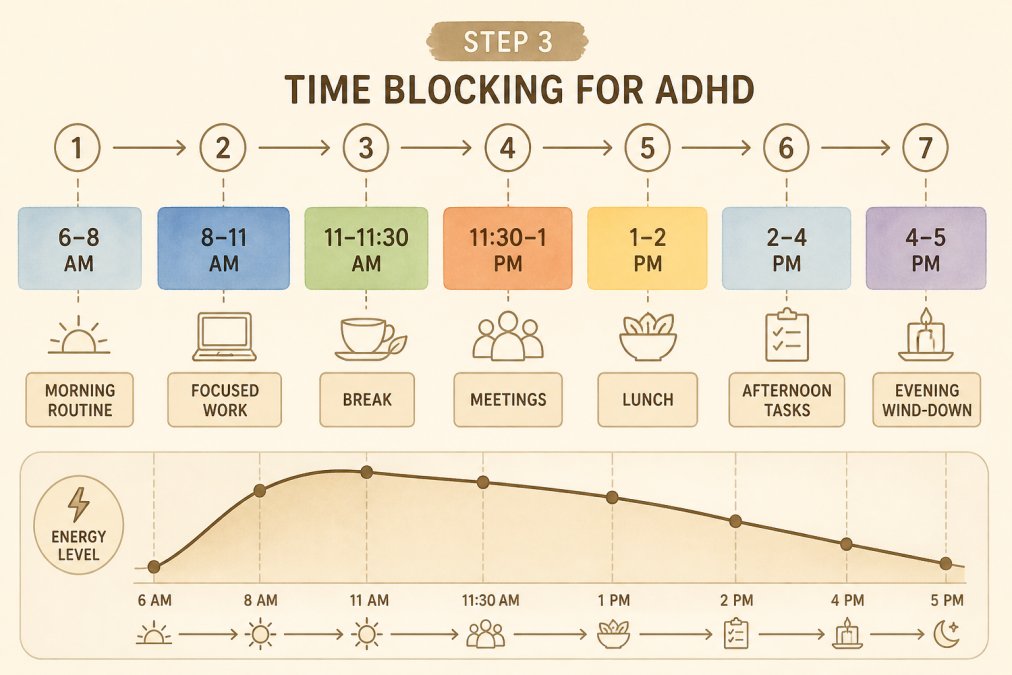
Here's how it works: instead of a to-do list, you block out chunks of time for different types of work.
The key is matching blocks to your energy levels. If you're sharpest in the morning, put your hardest work there. If you crash mid-afternoon, schedule movement or easier tasks. If you're a night person, adjust accordingly.
(https://anchorgrovestudio.com/products/printable-adhd-planner-no-shame-daily-system) includes a priority-based daily planning page, brain dump system, and flexible weekly layout, all built for ADHD brains. If you prefer digital planning, the [Digital ADHD Planner: Tablet & GoodNotes-Ready PDF](https://anchorgrovestudio.com/products/digital-adhd-planner-good-notes-tablet-ready) works on tablets and includes time-blocking templates. For a low-cost trial, start with the [1-Month ADHD Printable Planner: Try the Low-Clutter System](https://anchorgrovestudio.com/products/1-month-printable-adhd-planner-trial-low-clutter-printable) to see if this approach fits before investing in the full system.Frequently Asked Questions
How do you build a routine with ADHD when you struggle with task initiation?
Start with three priorities instead of ten. Write them down, then pick just one next step. Use a tool like the Printable ADHD Planner: No-Shame Daily Planning System ($22), which includes a Brain Dump & Triage System to move tasks out of your head and decide what actually matters. The key is removing decision fatigue, fewer choices mean easier starts.
What makes a daily routine flexible enough to handle unpredictable days?
A flexible routine has a core structure but no rigid streaks or all-or-nothing thinking. Instead of 'do this every day at 8am,' frame it as 'morning tasks: shower, eat, check priorities.' If you miss a day or your energy crashes, you restart the next day without shame. The routine adapts to your capacity, not the other way around.
How can you stick to a routine when your schedule changes?
Build your routine around time blocks and energy levels, not clock times. If your meeting runs late, shift afternoon tasks forward rather than abandoning the whole day. Keep a checklist of what matters most, if you complete three priorities, the routine worked, even if the timing shifted. The Digital ADHD Planner ($22) lets you adjust pages on the fly without starting over.
How do you restart a routine after falling behind without feeling like you've failed?
Open your planner, pick one priority, and begin again. There's no 'failed' page or guilt. Many ADHD-friendly systems, like the 1-Month ADHD Printable Planner Trial ($5), are designed so you can restart anytime without losing progress. Think of it as pressing play, not starting from zero.