
Best Onplanners Alternative for Neurodivergent Adults
Table of Contents
- Why Traditional Planners Fail Neurodivergent Brains
- What to Look for in an Onplanners Alternative
- Best ADHD Planners for 2026: The Anchor Grove Studio Lineup
- Notion Templates for Neurodivergent Users
- How to Organize a Neurodivergent Life Without Rigid Systems
- Comparing the Options: Features, Pricing, and Formats
- Frequently Asked Questions
Last Updated: September 12, 2026
Why Traditional Planners Fail Neurodivergent Brains
Most paper planners are built for a brain that remembers to open them. That is the core problem with the standard planner market, and it is why so many adults with ADHD cycle through five, six, seven systems in a single year before giving up. At Anchor Grove Studio, we hear this constantly: the planner was not the issue. The planner assumed a working memory, a consistent energy level, and a reward system that many neurodivergent people simply do not have on demand.
Executive dysfunction is the clinical term for the breakdown between knowing what to do and actually starting it (chadd.org). Time blindness makes a 2 p.m. deadline feel identical to a 2 a.m. one. Task paralysis freezes the decision-making process entirely when a list gets too long. A rigid, dated, streak-based planner does not solve any of these. It adds a layer of guilt on top of an already exhausting cognitive load.
The CHADD overview of executive function explains that these challenges are neurological, not motivational. Once you accept that, the search for an onplanners alternative for neurodivergent users stops being about finding a prettier layout and starts being about finding a system that survives an off day.
What to Look for in an Onplanners Alternative
The best alternative to a rigid dated planner is one that is undated, low-clutter, and built around a small number of priorities rather than a full day's worth of tasks. Format matters less than flexibility. A system that punishes you for missing Tuesday will be abandoned by Thursday.
Three criteria separate a planner that works for ADHD from one that collects dust:
- Undated pages. No wasted days, no visible gaps, no shame.
- Reduced visual noise. Fewer boxes, fewer colors, less sensory overload.
- A reset mechanism. A page or section designed specifically for restarting after a lapse.
Digital vs. Paper: Which Format Actually Sticks
Paper wins for people who need to physically write to process a thought, and it removes the friction of unlocking a device that also contains every distraction you own. Digital wins for people who lose paper, want search, or need their planner on a tablet they already carry.
There is no universal answer, which is exactly why the strongest systems offer both. Anchor Grove Studio's Printable ADHD Planner: No-Shame Daily Planning System and Digital ADHD Planner: Tablet & GoodNotes-Ready PDF are the same planning logic in two formats, so you can switch without rebuilding your routine.


Sensory-Friendly Design and Cognitive Load
Sensory-friendly design in a planner means fewer competing visual elements, consistent typography, and no aggressive color coding that demands you remember what each color means (the American Dental Association). Every extra decision a page forces on you is cognitive load, and cognitive load is the enemy of task initiation.
A common mistake is buying a planner with a complex legend system. If you have to consult a key to use your own planner, it will not get used.
Best ADHD Planners for 2026: The Anchor Grove Studio Lineup
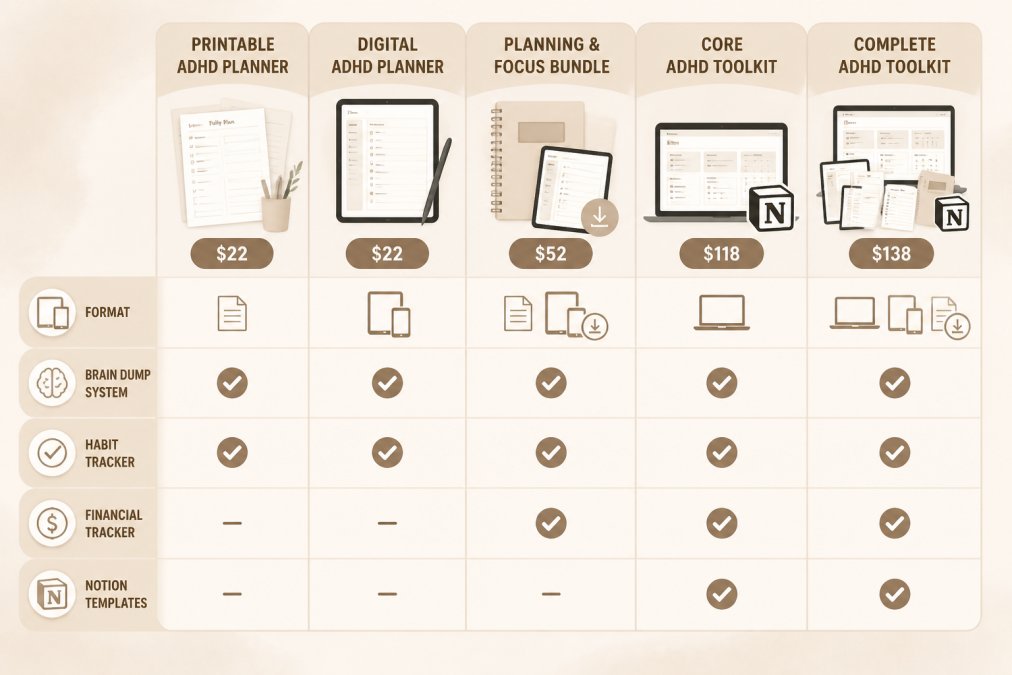
The strongest ADHD planners for 2026 are undated, reprintable, and designed to be restarted without penalty. Here is how the Anchor Grove Studio line compares across format, features, and price.
Printable ADHD Planner: No-Shame Daily Planning System
This is the entry point, and for many people it is the only tool they need. The Printable ADHD Planner is undated and reprintable, built around three priorities instead of ten. It includes a Brain Dump & Triage System for getting thoughts out of your head before deciding what matters, a Low-Pressure Habit Tracker with no streak mechanics, and a Dopamine Menu for choosing small rewards that make starting easier.
The one drawback: it is a digital download you print yourself, so you need access to a printer or a local print shop.
Digital ADHD Planner: Tablet and GoodNotes-Ready PDF
For tablet users, the Digital ADHD Planner puts the same low-clutter logic into a hyperlinked PDF that works in GoodNotes and similar annotation apps. It handles high- and low-energy days with flexible daily and weekly pages rather than a fixed schedule.
Where it falls short: GoodNotes, a tablet, and a stylus are not included.
Notion Templates for Neurodivergent Users
Notion templates for neurodivergent users work best when they arrive pre-built, because the setup phase is where most people quit. A blank Notion workspace with infinite nesting options is a task paralysis trap.
Anchor Grove Studio's Notion templates are delivered as duplicate-ready links. You copy them into your workspace and start using them, rather than spending a weekend building a database structure you will never maintain. If you already live in Notion, this is the lowest-friction way to add planning without adding another app.
How to Organize a Neurodivergent Life Without Rigid Systems
Organizing a neurodivergent life works better with flexible anchors than with fixed schedules. Habit stacking, external memory tools, and time blocking all help, but only when they bend around your actual energy instead of demanding you match a template.
The practical version looks like this:
- Externalize first. Get every task out of your head and onto one page before prioritizing anything.
- Pick three. Choose no more than three priorities for the day.
- Time block loosely. Assign rough blocks, not exact minutes.
- Build one habit stack. Attach a new routine to something you already do.
- Reset without penalty. When you miss a day, start on the next blank page.
That fifth step is the one most systems get wrong.
Beating Task Paralysis and the Abandonment Cycle
The abandonment cycle is the pattern where you start a system with enthusiasm, miss a few days, feel behind, and quit entirely rather than face the gap. Breaking it requires removing the concept of "behind" from your planner altogether.
Undated pages do this structurally. There is no missed Tuesday because there is no Tuesday. You open the planner, pick your three priorities, and begin. Spoon theory is useful here too: on low-capacity days, the goal is not to catch up. It is to do the smallest useful thing and stop without guilt.
Comparing the Options: Features, Pricing, and Formats
Anchor Grove Studio prices are one-time purchases with no subscription, and every product is an instant digital download with no shipping wait. The table below summarizes the current lineup.
| Product | Price | Format | Best For |
|---|---|---|---|
| Printable ADHD Planner | $22 | Print-ready PDF + editable PPTX | Paper planners who want to reprint |
| Digital ADHD Planner | $22 | Hyperlinked PDF for tablets | GoodNotes and tablet users |
| Planning & Focus Bundle | $52 | Printable + digital + focus system | Task initiation support |
| Core ADHD Toolkit (10 tools) | $118 | Planners, trackers, guides, Notion | Full planning and life management |
| Complete ADHD Toolkit (12 tools) | $138 | Everything above plus workbooks | The widest coverage |
The Planning & Focus Bundle helps with starting work. The Core ADHD Toolkit adds financial tracking, meal planning, and bedtime routines for people who want one system across their whole week.

The hardest part of leaving a rigid planner behind is trusting that a flexible system will not collapse into chaos. It will not, provided the system is built for restarting rather than perfect consistency. Anchor Grove Studio makes undated, no-shame planning tools across printable, tablet, and Notion formats, with an instant digital download so you can start today. Get started with Anchor Grove Studio and build a planning routine that survives your off days.
Frequently Asked Questions
Why do traditional planners often fail for neurodivergent users?
Rigid planners assume consistent daily energy, linear task completion, and working memory that holds a full to-do list. For ADHD and autistic users, executive dysfunction, time blindness, and task paralysis make that model collapse fast. Missing one day often triggers shame, and the planner gets abandoned. An onplanners alternative built around fewer priorities, no streaks, and reset-friendly pages works with how neurodivergent brains actually function instead of against them.
Are digital or paper planners better for neurodivergent individuals?
It depends on your sensory profile and workflow. Paper planners like the Printable ADHD Planner ($22) offer tactile input, no notifications, and zero screen fatigue, which helps with sensory overload. Tablet planners like the Digital ADHD Planner ($22) suit people who already carry a device and want hyperlinked navigation. Many neurodivergent users run both: a printed weekly page on the desk and a digital brain dump on the tablet for capturing thoughts fast.
What features should I look for in an ADHD-friendly planner?
Prioritize three-priority daily pages over ten-item to-do lists, a brain dump and triage system, a low-pressure habit tracker without streak penalties, and undated pages you can reprint or restart anytime. A dopamine menu of small rewards helps with task initiation. Skip anything that uses streak counters, red overdue warnings, or guilt language. Those features raise cognitive load and speed up the abandonment cycle rather than reducing it.
How do I organize a neurodivergent life without burning out?
Start with one capture system, not five. Use a brain dump page to empty mental clutter, then pick three priorities for the day. Add habit stacking only after the capture habit holds. The Core ADHD Toolkit ($118) bundles planning, financial tracking, meal planning, and sleep tools so you are not building each system from scratch. Build routines for low-energy days first, then scale up when capacity allows.
What is the best life planner app for people with neurodivergent brains?
Notion works well because it adapts to how you think instead of forcing a fixed layout. Anchor Grove Studio's Notion templates for neurodivergent users are delivered as links you duplicate into your own workspace. They are plug-and-play, so you skip hours of setup. Pair a Notion dashboard with a printable or tablet planner for daily task initiation and you cover both big-picture and moment-to-moment planning.