
Shame-Free Productivity Tools for ADHD: A 2026 Guide
Table of Contents
- What Makes a Shame-Free Productivity Tool for ADHD
- Best ADHD Productivity Apps and Digital Systems
- ADHD Planner for Adults: Printable vs. Digital Trade-Offs
- Frequently Asked Questions
Last Updated: October 18, 2026
What Makes a Shame-Free Productivity Tool for ADHD
Shame free productivity tools for adhd are built around flexibility, self-compassion, and realistic expectations rather than perfectionism. Unlike traditional planners that punish missed days, these tools work with how ADHD brains function: no demanded consistency, energy fluctuations accommodated, and restarts without guilt.
At Anchor Grove Studio, our entire approach is built around this principle: no "failed" page if you stop using it for a while, and a system that adapts when your energy crashes.
No Guilt Language or All-or-Nothing Design
Shame-free tools avoid perfectionism-triggering language: no "failed," "broken," or "behind", instead "reset," "restart," and "next step." That shift changes how you relate to the tool.
All-or-nothing thinking is a hallmark of ADHD.
The interface matters too: low visual clutter and white space feel calming, not demanding. Rigid streaks and harsh notifications become gentle reminders and pattern recognition, tracking what works, not grading yourself.
Flexible Restart and Recovery
Missing a day or a week shouldn't end the system.
Recovery is built in: abandon the tool for a month and restarting takes seconds. No deleting everything, no acknowledging the gap, just open it again.
Customization follows the same logic: some days you need five priorities, some days one. The tool adapts rather than forcing a rigid template.
Task Initiation and Energy Awareness
The hardest part of ADHD isn't focus, it's starting. Shame-free tools break tasks into smaller first steps: instead of "finish report," you see "open the document and write the first paragraph." The two-minute floor, body doubling prompts, and temptation bundling become built-in supports.
Energy awareness is equally critical. ADHD brains don't run on a consistent energy curve, so a shame-free tool lets you mark your current energy level and suggests matching tasks: complex work on high-energy days, maintenance on low-energy days.
Best ADHD Productivity Apps and Digital Systems
Anchor Grove Studio offers a focused collection of shame free productivity tools for adhd designed for how ADHD brains work. Each is instant-access, flexible, and judgment-free.
Printable ADHD Planner: No-Shame Daily Planning System
The Printable ADHD Planner is the foundational system for paper lovers: three priorities instead of ten, a brain dump and triage system, and a habit tracker that notices patterns instead of demanding perfect streaks.

What makes this different: you can reprint it. If a week didn't work, grab a fresh copy; start over on Tuesday if you want.
Daily pages focus on today, the weekly view shows the bigger picture without overwhelm, and the monthly check-in reveals what's working.
Digital ADHD Planner: Tablet & GoodNotes-Ready PDF
If you prefer digital planning, the Digital ADHD Planner brings the same shame-free approach to your tablet: a low-clutter PDF for GoodNotes and similar apps, with hyperlinked navigation between sections.

The layouts match the printable version in philosophy but are optimized for screens: fewer visual elements, clear navigation, natural stylus writing.
Printable ADHD Planner: No-Shame Daily Planning System →
The digital version excels for tablet-native users who want to avoid printing: searchable notes, access anywhere. The trade-off is needing a tablet and compatible app; GoodNotes is not included.
ADHD Focus & Deep Work System: Task Initiation Planner
Starting is the real problem. The ADHD Focus & Deep Work System is built for the moment between "I need to do this" and actually beginning: a focus session planner, a deep work log that notices patterns without grading you, and a task-initiation toolkit with body doubling prompts, the two-minute floor, and temptation bundling.

At $16.00, it's the lowest-priced individual tool. Use it alongside the daily planner or standalone if task initiation is your only barrier. The distraction triage section captures interruptions without losing momentum; the weekly focus review shows what conditions support your work.
ADHD Planning & Focus Bundle: 3 Digital Tools
For the complete system, the ADHD Planning & Focus Bundle includes the Printable ADHD Planner, the Digital ADHD Planner, and the ADHD Focus & Deep Work System.
It's our most popular option because it covers every angle: daily planning, task initiation, focus support, and digital flexibility. High-energy day? Digital planner on your tablet.
The bundle lets you use different tools on different days: printable planning Monday, digital Wednesday, just the focus system Friday. You're not locked into one format.
1-Month ADHD Printable Planner: Try the Low-Clutter System
Not ready to commit? The 1-Month ADHD Printable Planner is a nine-page, $5.00 one-time trial giving you a full month to test the approach.
It includes a four-week layout, the Top 3 daily priority structure, brain dump and triage pages, and a pattern-noticing habit tracker. By week four, a check-in page helps you decide whether the full undated planner is right for you.
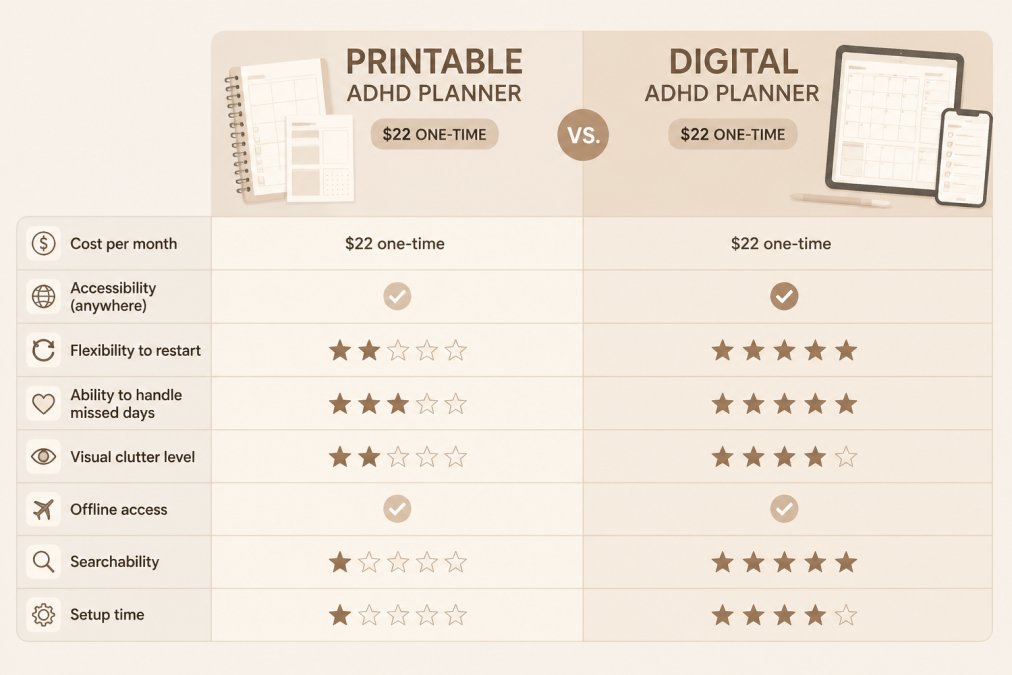
ADHD Planner for Adults: Printable vs. Digital Trade-Offs
Printable systems are tactile and offline: handwriting engages different cognitive pathways than typing, with no screen glare, notifications, or phone temptation.
Digital systems give instant access anywhere, searchable notes, and no printing costs.
Frequently Asked Questions
What makes shame-free productivity tools for ADHD actually different from regular planners?
Shame-free tools are designed without guilt language, rigid streaks, or all-or-nothing thinking. Instead of marking tasks as 'failed,' they let you restart any day or week without penalty. They focus on noticing patterns instead of demanding perfect consistency. The Printable ADHD Planner ($22.00) includes a low-pressure habit tracker and a dopamine menu to make starting easier, not a system that punishes you for missing a day.
How do I choose between a printable ADHD planner for adults and a digital one?
Printable planners work best if you prefer tactile planning, want to avoid screen fatigue, or like the flexibility to print only what you need. Digital planners suit you if you use tablets regularly, want hyperlinked navigation, or prefer always having your system accessible. The Printable ADHD Planner ($22.00) and Digital ADHD Planner ($22.00) both use the same shame-free approach, pick based on your daily habits and energy patterns.
Can an ADHD habit tracker actually help me if I struggle with consistency?
Yes, but only if it's designed to notice patterns instead of demand perfection. Traditional trackers create shame spirals when you miss days. Shame-free habit trackers in systems like the Printable ADHD Planner show you what conditions help (energy level, time of day, support) without grading your performance. This reframes missed days as data, not failure.
What ADHD time management strategies work when I can't even start tasks?
Task initiation is the real bottleneck for many ADHD adults. The ADHD Focus & Deep Work System ($16.00) includes practical strategies like the two-minute floor (start with just two minutes), body doubling prompts, and temptation bundling (pairing a task with something enjoyable). It also helps you notice what conditions support your focus, so you can recreate them.
Should I buy individual tools or get the bundle?
The ADHD Planning & Focus Bundle ($52.00) saves $22 compared to buying separately ($74 value). It includes the Printable Planner, Digital Planner, and Focus & Deep Work System. Start with the 1-Month Trial ($5.00) if you're unsure, or buy the bundle if you want both paper and digital options plus task initiation support.
The real difference between shame-free productivity tools and everything else is this: they're designed for the person you actually are, not the person you think you should be. No perfectionism. No guilt. Just a system that works with your brain, not against it. Start with one tool, one priority, and one next step. That's how you actually build something that sticks.