
Simple Evening Routine for ADHD Productivity
Table of Contents
- Why Evening Routines Matter for ADHD Productivity
- The Four-Step Evening Shutdown Process
- ADHD Nighttime Routine Checklist: What to Include
- ADHD Routine Examples for Different Energy Levels
- Using ADHD Time Blindness Strategies to Stay on Track
- Setting Up Your ADHD Daily Schedule Template for Success
- Preparing for the Next Morning
- Troubleshooting Common Evening Routine Breakdowns
- Frequently Asked Questions
Last Updated: October 20, 2026
Why Evening Routines Matter for ADHD Productivity
An evening routine isn't about perfection. It's about giving your brain a way to shift gears before bed so tomorrow starts well.
With ADHD, executive function works differently: working memory is shorter, task initiation feels harder, and racing thoughts keep you awake. A simple evening routine for ADHD productivity tackles all three with a predictable wind-down your brain can follow, even on low-energy nights.
Most productivity systems assume rigid schedules and ignore time blindness, attention shifts, and empty-energy days. That's why they fail. A simple evening routine for ADHD productivity bends, has fallback options, and doesn't require you to be "on" all the time.
People with ADHD often abandon traditional planners because they feel like judgment waiting to happen. When a routine is built around flexibility and self-compassion instead of perfection, they stick with it and return to it even after missing a week.
With a real system, you stop waking up in panic mode. You know what's waiting tomorrow because you decided it last night, and racing thoughts have somewhere to go instead of spinning at 2 a.m.
The Four-Step Evening Shutdown Process
A simple evening routine for ADHD productivity follows one core structure: get it out, decide what matters, plan tomorrow, then calm down.
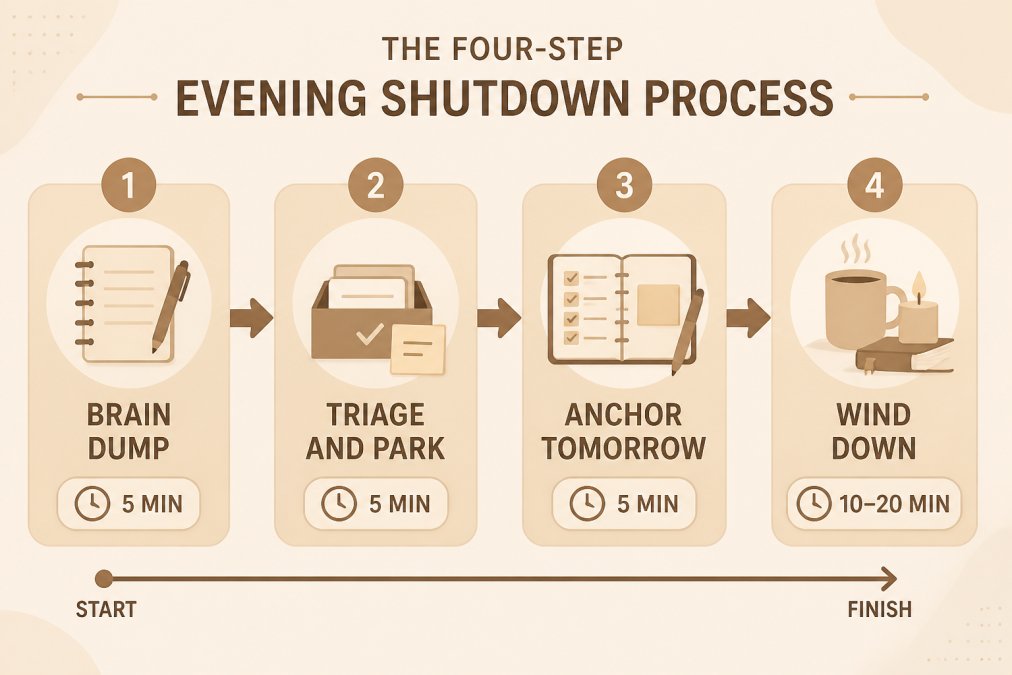
Step 1: Brain Dump (5 minutes)
Open a notebook or your phone and write down everything in your head. Don't organize or edit. Just dump it.
Racing thoughts, forgotten tasks, worries about next week: write them all.
ADHD brains often struggle with working memory, trying to hold everything at once and creating mental noise.
Step 2: Triage and Park (5 minutes)
Look at what you dumped. Pick out 1-3 things that actually matter tomorrow. Circle them or move them to a separate list.
Everything else goes to a "parking lot," a holding space for later. Not forgotten, just parked until you have time and energy.
ADHD brains often freeze at a list of 47 things. Triaging forces you to choose and kills the paralysis.
Step 3: Anchor Tomorrow (5 minutes)
Write those 1-3 priorities down for tomorrow and add one concrete next step for each.
Task initiation is hard with ADHD. Your brain sees "finish the project" and goes blank, but "open the file" is tiny and doable.
Step 4: Wind Down (10-20 minutes)
Do something low-stimulation that signals to your nervous system the day is over. Not your phone. Not work.
A shower. Stretching. Reading. A quiet walk. Gentle music. The specific activity doesn't matter as long as it's calm and predictable.
ADHD Nighttime Routine Checklist: What to Include
A nighttime routine checklist for ADHD works best when it's short and flexible. Track these:
- Brain Dump complete (racing thoughts out of your head)
- Top 3 priorities for tomorrow identified
- One next step written for each priority
- Phone/work put away (at least 30 minutes before bed)
- Low-stimulation activity chosen
- Bedroom temperature cool
- Lights dimmed or off
That's it. Not 20 items. Not a rigid schedule. Just the essentials.
The ADHD nighttime routine checklist removes decision-making from your evening. Your tired brain doesn't want to figure out what's next; the checklist tells you, and you follow it.

Many people add items that help them sleep: a specific tea, a stretching sequence, journaling prompts, or a gratitude practice. Add what works and remove what doesn't.
Use the same checklist most nights so your brain learns the pattern. When it knows what's coming, it cooperates better.
ADHD Routine Examples for Different Energy Levels
Your energy changes day to day. Your routine needs to change with it.
High-Energy Evening
On high-energy nights, do the full four-step process plus extras.
- Brain Dump: Write everything down. Spend a full 10 minutes if you need it.
- Triage and Park: Be thorough. Organize your parking lot by category (work, home, personal).
- Anchor Tomorrow: Write your top 3 priorities and detailed next steps for each.
- Wind Down: Take a longer wind-down. 20-30 minutes. A shower, a walk, stretching.
Use high-energy nights to set yourself up for success. The clearer tomorrow looks, the easier it is to start.
Low-Energy or Disrupted Evening
On nights when you're exhausted, sick, or derailed, do the minimum.
- Brain Dump: 5 minutes. Get the main things out. Don't be thorough.
- Skip Triage and Park if you need to.
- Anchor Tomorrow: Just one priority. One next step.
- Wind Down: 10 minutes. Anything calm. A short walk. Breathing exercises. Lying down with a podcast.
Still do something. A partial routine beats none: your brain gets the signal the day is ending, and you still know what matters tomorrow.
A routine doesn't have to be perfect to be useful. People with ADHD often abandon systems requiring rigid consistency, so build in the fallback from the start and you'll stick with it.
ADHD Sleep & Bedtime Guide: Wind-Down Routine PDF →
Using ADHD Time Blindness Strategies to Stay on Track
Time blindness means your internal clock works differently: five minutes feels like 30, an hour disappears, and you lose track of when to do things.
An evening routine with ADHD time blindness strategies uses external cues instead of your internal sense of time.
Set a timer. Start a 5-minute timer for your brain dump. When it goes off, move to the next step. The timer tells you how long you've been going.
Use alarms as transitions. Set an alarm for when wind-down should start, especially if you tend to realize at midnight that you haven't begun.
Create visual cues. A specific lamp, a notebook you only use at night, or a particular chair for your brain dump teaches your brain: "this object = evening routine time."
Use a checklist as your guide. Don't rely on memory. The checklist tells you what's next, so no decision-making is required.
These ADHD time blindness strategies move the responsibility off your internal clock and onto external systems. The timer, alarm, and visual cue remember for you.
Setting Up Your ADHD Daily Schedule Template for Success
An ADHD daily schedule template works best when it's simple and visual. Include:
- Morning priorities (1-2 things)
- Afternoon focus area (1 thing)
- Evening wind-down time (when it starts)
- One flexible slot for unexpected tasks
- One "rest or catch-up" slot
That's your template. Not 10 time slots. Not a minute-by-minute breakdown. Just the anchors.
People with ADHD often struggle with task switching, and too many transitions get the brain stuck. A template with only essential anchors gives room to move while still providing structure.
Make your template visible: print it, put it on your wall, or use it as your phone wallpaper. The more you see it, the more your brain internalizes the pattern until the routine becomes automatic.
Preparing for the Next Morning
The best evening routine for ADHD productivity sets up your morning for success.
In your Anchor Tomorrow step, you identified your top 3 priorities. Now take one more minute to set up the physical space.
- Set out clothes if you know what you're wearing
- Put your bag by the door if you're leaving the house
- Set up your workspace if you work from home
- Lay out supplies for your first task
This removes decision-making and friction from your morning. You wake up with a clear path forward: no "what should I wear" paralysis, no "where did I put that file" panic.
For people with ADHD, mornings are often chaotic: groggy, low executive function, immediate decision fatigue. When the night before has made decisions for you, your morning becomes manageable.
Troubleshooting Common Evening Routine Breakdowns
Your routine will break. That's not failure. That's normal.
"I started the routine but got distracted halfway through."
Your brain got stuck, which is common with ADHD. Break each step into smaller pieces: instead of "Brain Dump," do "Brain Dump, just work stuff" or "Brain Dump, just worries."
"I do the routine but still can't fall asleep."
Your wind-down might not be calm enough. If it's a podcast, try silence; if it's reading, try stretching. Your nervous system needs a specific signal, so experiment until you find what works.
"I skipped the routine for three days and now I don't know how to restart."
Don't wait for Monday. Do it tonight, even a 10-minute version. Your brain needs to relearn the pattern, and one night is enough to restart.
"My routine works on weekdays but falls apart on weekends."
You might need a different routine for different days. Weekend routine can be shorter or later. It doesn't have to match your weekday routine. Flexibility is the point.
"I keep forgetting to do the routine."
You need a trigger. Tie it to something you already do. "After dinner, I do my brain dump." "When I close my laptop, I start my wind-down." Anchoring to an existing habit makes it automatic.
A simple evening routine for ADHD productivity isn't about becoming a perfect planner. It's about giving your brain a predictable way to close one day and prepare for the next. When your routine is short, flexible, and designed around how your brain actually works, you stop fighting yourself. You start winning.
Building an evening routine that sticks is the foundation for productive mornings and better sleep. The ADHD Sleep & Bedtime Guide ($12.00) and the Printable ADHD Planner ($22.00) both include evening routines designed to work with your brain, not against it.

Frequently Asked Questions
What should I include in an ADHD evening routine?
A practical ADHD evening routine includes four core steps: dumping racing thoughts onto paper, deciding what can wait until tomorrow, reviewing your top three priorities for the next day, and choosing a calming activity. You don't need complex rituals, the goal is to shift your brain from work mode to sleep mode without judgment. Include personal hygiene if it fits your energy, set out tomorrow's essentials, and use visual cues like a checklist or timer to track progress without relying on time blindness awareness alone.
How can I remember to follow an evening routine with ADHD?
Visual cues and environmental reminders work better than willpower. Set a phone alarm 30 minutes before your target wind-down time, place a printed checklist on your bathroom mirror or bedside table, or use a dedicated notebook as your trigger. Many people find success with a specific location, always sit in the same chair or at the same desk to start their routine. The ADHD Nighttime Shut-Down Notebook provides pre-made sheets and a four-step process that removes the need to remember what comes next; you simply follow the structure.
Can an evening routine help with ADHD productivity the next day?
Yes. When you clarify tomorrow's top three priorities and set out essentials the night before, you reduce decision fatigue and task initiation friction in the morning. Your brain starts the day with a clear anchor point instead of racing through options. This is especially powerful for ADHD brains that struggle with executive function, you've already done the mental work when you had time and calm. Consistent evening preparation also improves sleep quality, which directly supports focus, attention, and working memory the following day.
What do I do on nights when I have no energy for a full routine?
Use a fallback version. On low-energy nights, skip the longer wind-down activity and do only the brain dump and tomorrow's top three priorities, this takes five minutes. If you're completely overwhelmed, just do the brain dump. The routine is flexible by design; any step you complete is better than abandoning the whole process. Having a tiered routine removes the all-or-nothing thinking that often derails ADHD routines and helps you maintain consistency without shame.