
Start Over on Any Page or Week for Adaptive Goal Tracking
Table of Contents
- Why Starting Over Mid-Week Works Better Than Rigid Streaks
- The Reset Protocol: How to Start Over on Any Page or Week
- Best Practices for Adaptive Goal Setting
- Undated Planners for ADHD: Why Flexibility Beats Perfection
- How to Reset Your Planning System Without Starting from Scratch
- Tools and Systems That Support Mid-Week Restarts
- Frequently Asked Questions
Last Updated: October 2, 2026
Why Starting Over Mid-Week Works Better Than Rigid Streaks
Rigid productivity systems fail ADHD brains. Miss one day and shame collapses the whole system.
Start over adaptive goal tracking flips this dynamic entirely. Instead of chasing unbroken streaks, you build flexibility into your planning from the beginning.
Consistency means returning, not perfection. Systems that punish off days get abandoned. Systems that welcome you back get used.
Traditional planners assume linear progress, miss a week and the whole thing feels ruined.
Anchor Grove Studio builds planning tools for this reality: undated, reprintable systems that let you reset on a Tuesday at 3 PM without guilt.
The Reset Protocol: How to Start Over on Any Page or Week
A reset is data collection, not failure. The Reset Protocol has three steps: review what happened, identify what broke your consistency, and adjust your micro-goals. This 10-15 minute process transforms defeat into actionable insight.
Step 1: Conduct a Guilt-Free Performance Review
Open your planner and look at the past week without judgment. What did you complete? What did you start but not finish? Write down three observations, not failures, patterns. "I completed tasks on Mondays and Tuesdays but lost momentum by Wednesday" is an observation. "I failed to follow my plan" is judgment.
Step 2: Identify What Broke Your Consistency
Consistency breaks for a reason: task initiation friction (task felt too big), energy mismatch (plan ignored low-energy days), decision fatigue (too many priorities), or unexpected disruption (meeting, illness, crisis). Name the primary blocker, not everything that went wrong. This clarity makes next week different.
Step 3: Adjust Your Micro-Goals and Task Blocks
Micro-goals are small enough to complete in one sitting: "Write the project outline" not "finish the project." Task blocks are time-bounded: "work 10-10:30 AM" not "work all day." Vague goals create decision fatigue; micro-goals create momentum. Adjust both for next week: schedule hard tasks on high-energy days, and add "first step" prompts for task initiation blockers.
| Component | Original Approach | Adjusted Approach |
|---|---|---|
| Goal Size | "Finish the report" | "Write the report outline" |
| Time Boundary | "Work on it today" | "Work 10-10:30 AM" |
| Energy Match | Same goals all week | High-energy goals Mon/Tue, lighter goals Wed/Thu |
| Friction Point | Ignored | Explicitly addressed with prompts |
Best Practices for Adaptive Goal Setting
Adaptive goal setting means goals change based on what you learn each week. This works because it's built on feedback loops, not willpower. Willpower runs out; feedback loops sustain effort.
Cognitive Load Management and Decision Fatigue
Decision fatigue depletes mental energy throughout the day (Checking your browser). Adaptive goal tracking reduces it by limiting choices upfront: choose three priorities instead of ten, define specific time blocks instead of open-ended work. The Brain Dump & Triage System works: get everything out of your head, then decide what matters this week in one focused session. For ADHD brains, fewer daily decisions means more mental energy for actual work.
Data-Driven Pivot Points
A pivot point is the moment you decide to adjust your approach. Without data, pivot points are emotional, you quit when you feel bad.
After two weeks of data, you'll see patterns. Maybe you complete 80% of your micro-goals on Mondays but only 40% on Fridays. That's a pivot point.
This isn't about perfection. It's about working with your actual capacity, not against it. The data tells you when to adjust.
Undated Planners for ADHD: Why Flexibility Beats Perfection
Undated planners have no fixed dates printed on the pages. You write in the dates yourself. This tiny change transforms how you use the planner.
With a dated planner, missing a week means wasted pages. You skip the dates you missed, and the planner feels ruined. With an undated planner, there are no wasted pages.
For ADHD brains, this flexibility is essential. Your energy, capacity, and focus change week to week. A rigid planner assumes consistency. An undated planner assumes variation.
The Printable ADHD Planner from Anchor Grove Studio is undated and reprintable specifically for this reason. You print one week at a time. If a week doesn't work, you print a fresh copy and start over. No wasted pages. No shame. Just reset and continue.

This design choice alone changes how people engage with planning.
How to Reset Your Planning System Without Starting from Scratch
Starting from scratch is paralyzing. You have to redesign everything, rebuild habits, and recommit to goals. Most people quit before they begin.
A true reset doesn't mean starting from scratch. It means keeping what works and adjusting what doesn't.
Printable ADHD Planner: No-Shame Daily Planning System →
Analog vs. Digital Hybrid Systems
Some people work better with paper. Some work better with digital. Most work better with both.
A hybrid system uses paper for planning and digital for tracking. You write your weekly priorities on paper, this forces intentional thinking.
Or reverse it: digital planning, analog tracking.
The key is matching the tool to the task. Planning requires thinking and intentionality, paper often works better. Tracking requires data collection and pattern recognition, digital tools shine here.
If you're using a Notion template for planning, pair it with a printable habit tracker.
The Digital ADHD Planner from Anchor Grove Studio is built for tablet use with GoodNotes, which bridges this gap. You get the tactile feel of writing on paper (using a stylus on a tablet) plus the searchability and organization of digital files. For people who want hybrid without managing two separate systems, this is the sweet spot.

Tools and Systems That Support Mid-Week Restarts
The right tool makes restarting feel natural. The wrong tool makes it feel like failure.
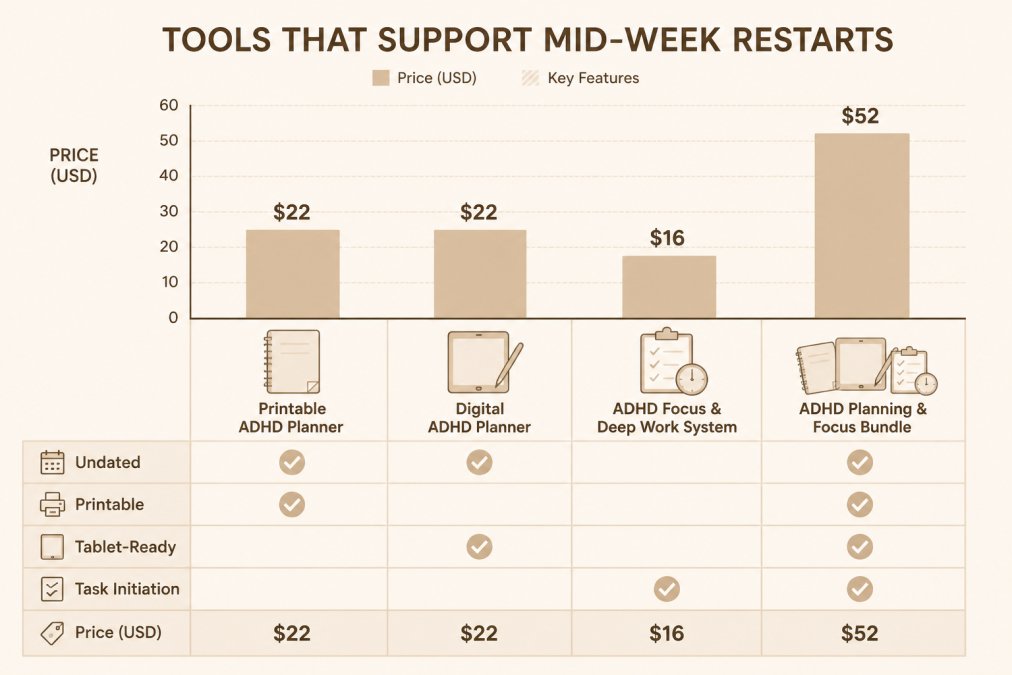
A good reset-friendly system has these features:
- Undated or flexible dating. You can use it any week, any time, without skipping pages.
- Low-pressure habit tracking. It notices patterns without demanding perfection.
- Micro-goal focus. It breaks big goals into small, completable tasks.
- Brain dump space. It gives you a place to get thoughts out of your head before deciding what matters.
- Flexible daily structure. It works on high-energy days and low-energy days.
Anchor Grove Studio offers several systems built around this exact framework:
For print-and-paper planning: The Printable ADHD Planner ($22.00) gives you daily, weekly, and monthly planning pages built around three priorities instead of ten. It includes a Brain Dump & Triage System, a low-pressure habit tracker, and a Dopamine Menu for choosing small rewards. Because it's undated and reprintable, you can reset any time without guilt.
For tablet-based planning: The Digital ADHD Planner ($22.00) is a GoodNotes-ready PDF designed for iPad or Android tablets.
For task initiation specifically: The ADHD Focus & Deep Work System ($16.00) addresses the moment between "I need to do this" and actually starting. It includes a Focus Session Planner, a Deep Work Log, and a Task-Initiation Toolkit with practical prompts like body doubling and the two-minute floor. This is perfect if your blocker is starting, not planning.

For a complete system: The ADHD Planning & Focus Bundle ($52.00) includes the Printable Planner, Digital Planner, and Focus System together.
The common thread across all of these is that they're built for restarting. No rigid streaks. No shame language. No "failed" pages.
Anchor Grove Studio's approach is different.
Start over on any page or week isn't just a feature, it's the foundation.
Get started with the Printable ADHD Planner and experience the difference a flexible, shame-free planning system makes. Choose your format, print, digital, or both, and build a planning routine that actually sticks.
Frequently Asked Questions
Why is it important to have a goal tracking system that allows for restarts?
Traditional planners punish missed days with guilt or force you to start over completely. A goal tracking system that allows restarts removes shame and keeps you engaged. When you can reset on any page or week without penalty, you're more likely to return to planning instead of abandoning it entirely. This is especially critical for ADHD brains, where all-or-nothing thinking often derails progress. Restarting is not failure, it's part of adaptive goal tracking.
How do adaptive planners help with executive dysfunction?
Executive dysfunction makes task initiation, prioritization, and sustained focus difficult. Adaptive planners reduce cognitive load by limiting choices (three priorities instead of ten), offering brain dump pages to externalize thoughts, and including flexible habit trackers that notice patterns without rigid streaks. They work with your capacity on low-energy days and scale up on high-energy days. This flexibility means the planner remains useful even when executive function is compromised.
What are the benefits of undated planners for goal tracking?
Undated planners for ADHD eliminate the pressure of 'starting on Monday' or feeling behind if you miss a date. You can print pages as needed, reuse them, and start fresh any day without waste or guilt. This removes decision fatigue around when to begin and lets you focus on what matters today. Undated formats also work with variable schedules and energy fluctuations, making them ideal for adaptive goal tracking where consistency looks different week to week.
How can I maintain consistency in goal tracking after missing a week?
Consistency doesn't mean unbroken streaks, it means returning to the system. After missing a week, conduct a quick performance review: What happened? Was the goal realistic, or did life interrupt? Adjust your micro-goals if needed, then open your planner and choose one priority for today. Many ADHD-friendly systems include a 'reset' page or check-in section specifically for this moment. The key is making re-entry frictionless so you don't spend energy on guilt instead of planning.