
Stop Feeling Guilty About Missing Planning: 7 Steps
Table of Contents
- Why a Missed Planning Day Feels Like a Personal Failure
- Planning Guilt Is Not a Productivity Problem
- ADHD Planning Paralysis: When Starting Feels Impossible
- How to Recover From a Missed Planning Day (Without Shame)
- Set Boundaries With Social Commitments So You Stop Overbooking
- Best Digital Planners for ADHD: Tools That Forgive You
- Move Forward Without the Weight of 'Should Have'
- Frequently Asked Questions
Last Updated: September 9, 2026
Why a Missed Planning Day Feels Like a Personal Failure
You opened your planner on Monday with the best intentions. By Thursday, it sat untouched, and now you feel a familiar knot of guilt every time you look at it. That feeling is planning guilt, and it is the reason so many people abandon their organizational systems entirely. At Anchor Grove Studio, we design planners specifically for ADHD brains, and we hear this exact story constantly: the shame of missing a planning session does more damage than the missed session itself.
Planning guilt is the emotional distress that follows when you fail to follow through on a scheduled planning block. It is not laziness or a lack of discipline. It is a predictable psychological response to setting expectations your brain could not realistically meet, often compounded by an executive function challenge like ADHD.
The Planning Fallacy: Why Your Brain Overcommits
The planning fallacy is a cognitive bias where you underestimate how long tasks will take while overestimating your future availability and focus. Research in cognitive psychology literature on the planning fallacy shows this bias affects nearly everyone, but it hits harder when executive dysfunction is involved. You plan a two-hour Sunday reset as if your energy, attention, and motivation will all cooperate perfectly. When they do not, your brain interprets the failure as a character flaw rather than a prediction error.
Planning Guilt Is Not a Productivity Problem
Here is the uncomfortable truth: guilt does not make you more productive. It makes you less productive. The guilt cycle looks like this: you miss a planning session, you criticize yourself for missing it, your motivation drops because you feel bad, and then you miss the next session too. Each round of self-criticism makes starting harder, not easier.
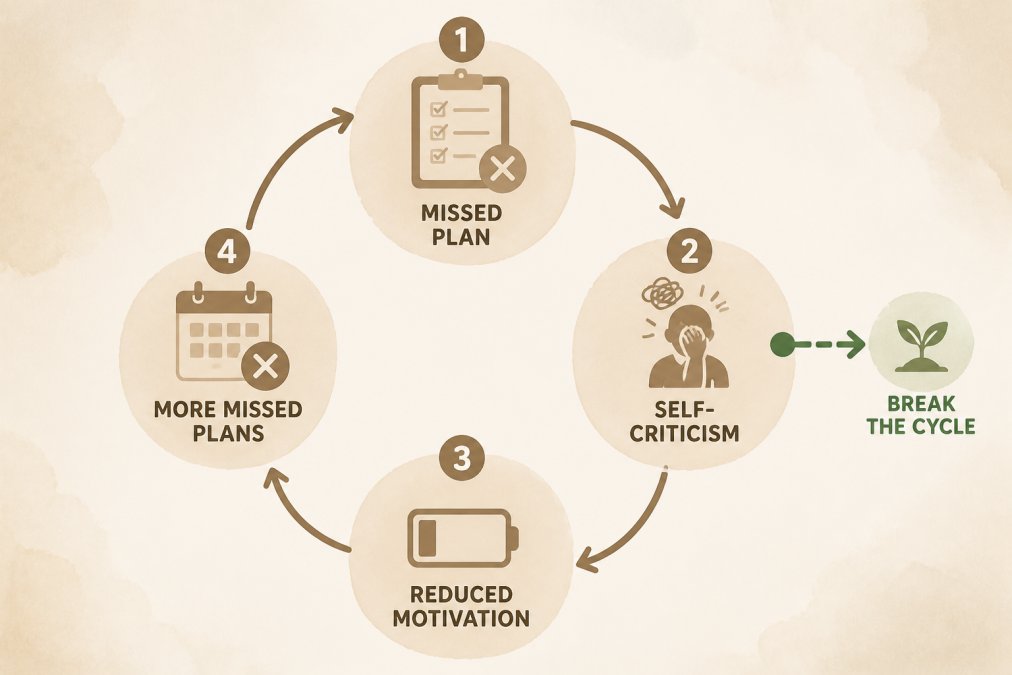
What most productivity advice gets wrong is treating guilt as a useful motivator. It is not. Guilt is emotional labor that drains the exact energy you need for task initiation. When you stop feeling guilty about missing planning, you free up mental bandwidth for the actual work. The goal is not to become someone who never misses a plan. The goal is to become someone who can miss a plan and simply start again without the emotional tax.
ADHD Planning Paralysis: When Starting Feels Impossible
ADHD planning paralysis is the state where you know what needs to be done but cannot make yourself begin. It is not indecision or laziness. It is an executive function stall where the perceived size of the task triggers overwhelm, and your brain responds by freezing rather than acting. Many adults with ADHD describe this as feeling physically stuck, watching time pass while unable to move toward the task.
A common mistake is trying to break through paralysis with more structure. More elaborate planning systems, longer planning sessions, and stricter schedules usually backfire because they raise the stakes. When the stakes are higher, the freeze response intensifies.
Instead, shrink the starting point until it feels almost trivial. Do not plan your entire week. Plan your next hour. Do not write a full to-do list. Write down the single most important thing you want to accomplish before your next break. This approach, sometimes called micro-planning, works because it lowers the cognitive cost of starting.
How to Recover From a Missed Planning Day (Without Shame)
Recovery from a missed planning day is a skill, and it follows a specific sequence. The order matters because each step rebuilds momentum without triggering the shame response.
- Name the feeling. Say to yourself, "I missed my planning session, and I feel guilty about it." Naming the emotion reduces its intensity.
- Check the facts. Ask whether the missed session actually caused harm. Usually, the answer is no. The world did not end because you did not plan for two hours.
- Lower the bar. Do not attempt a full planning reset. Choose one small action that moves you forward.
- Take that action immediately. The faster you act, the less time guilt has to compound.
- Let the missed session go. Treat it like a missed bus. You do not stand at the stop apologizing to the bus. You wait for the next one.
The Planning Fallacy: Why Your Guilt Is Based on a Prediction Error
Before you can recover from a missed planning day, you need to understand why you missed it in the first place. The planning fallacy is a well-documented cognitive bias first named by psychologists Daniel Kahneman and Amos Tversky in 1979 (apa.org). It describes the tendency to underestimate how long a task will take while overestimating your future availability, focus, and energy.
Here is how the planning fallacy operates in daily life: on Sunday evening, you look at the week ahead and estimate that a two-hour planning session on Tuesday will be easy to complete. You imagine your Tuesday self as well-rested, motivated, and free of interruptions. You do not account for the fact that Tuesday will bring an unexpected work deadline, a low-energy afternoon, or a phone call that derails your focus.
When Tuesday arrives and the planning session does not happen, your brain does not say, "My estimate was wrong." It says, "I failed." This is the core of the planning fallacy: you treat a prediction error as a character flaw. The guilt you feel is not evidence that you are undisciplined. It is evidence that your brain made a systematic error in estimating future conditions, an error that affects nearly everyone.
The Three Sources of the Planning Fallacy
Cognitive psychology research identifies three mechanisms that drive the planning fallacy. Understanding each one helps you see why your missed planning session was predictable, not a personal failure.
1. Optimism bias. Your brain is wired to imagine a best-case scenario for the future. When you plan, you unconsciously assume that everything will go smoothly, that you will have energy, that no emergencies will arise, and that your focus will cooperate. This optimism is not a flaw; it is a survival mechanism that helps you take action despite uncertainty. But it also means your plans are systematically overconfident.
2. Ignoring base rates. When estimating how long a planning session will take, you focus on the specific details of this week, the tasks you want to organize, the projects you need to schedule. You ignore the base rate: how often have you actually completed a full planning session in the past? For most people, the base rate is low. You have missed more planning sessions than you have completed. The planning fallacy occurs when you ignore that historical data and assume this time will be different.
3. Focusing on the singular, not the distribution. Your brain treats each planning session as a unique event with its own circumstances. It does not naturally think in terms of distributions, that out of ten planned sessions, you will likely complete six and miss four. When you miss one, you experience it as an isolated failure rather than a predictable outcome within a normal range.
Reframing the Miss: From Character Flaw to Data Point
Once you understand the planning fallacy, the recovery sequence changes. Step two, "check the facts", becomes more powerful when you add a cognitive audit. Ask yourself these three questions:
- Did I underestimate the time or energy required? If yes, your estimate was wrong, not your character.
- Did I ignore my base rate? If you have missed 40 percent of your planning sessions this month, missing one more is not an anomaly. It is your base rate showing up.
- Did I assume ideal conditions? If you planned for a quiet evening and then your child got sick or your boss sent an urgent email, you fell victim to optimism bias.
The 5-Minute Reset Rule
The 5-minute reset rule is simple: when you notice you have fallen off your planning routine, you commit to only five minutes of re-engagement. Set a timer, open your planner, and write down just three things you want to accomplish today. When the timer goes off, you stop. This rule works because it removes the expectation of a full planning session. It rebuilds the habit through tiny, pressure-free repetitions.

To make the reset rule even more effective, pair it with a planning-fallacy correction. Before you set the timer, ask yourself: "What is the most realistic amount of time I have right now?" If the honest answer is five minutes, then five minutes is a complete success. You are not doing a shortened version of a real planning session. You are doing the correct amount for your current circumstances. This reframing turns the 5-minute reset from a consolation prize into a legitimate planning outcome.
Set Boundaries With Social Commitments So You Stop Overbooking
Overcommitting socially is a leading cause of missed planning days. When your calendar is full of other people's requests, your own planning time gets squeezed out, and then you feel guilty about neglecting your system. The fix is learning to set boundaries with social commitments before they accumulate.
Boundary setting is the practice of clearly communicating your limits around time and energy. For people prone to planning guilt, the most important boundary is protecting planning time as legitimate, non-negotiable time. This is difficult because planning feels optional compared to external commitments, but it is the foundation that makes everything else manageable.
Start by auditing your current week. Identify where social commitments are crowding out planning windows. Then decide which commitments genuinely matter and which you accepted out of obligation or fear of disappointing someone. The ones in the second category are candidates for polite decline.
Templates for Declining Plans Gracefully
Declining an invitation does not require a lengthy explanation. A short, honest response protects your time and your relationships. Here are three templates that work:
"I appreciate the invite, but I have a commitment that evening. I hope you have a great time."
"I am protecting some quiet time this week to reset. Can we catch up next week instead?"
"That sounds fun, but I am at capacity right now. Let me check my calendar and get back to you."
Notice what these templates share: they do not over-explain, they do not apologize excessively, and they do not invite negotiation. You are allowed to protect your planning time without justifying it to anyone. guidance on setting healthy boundaries emphasizes that clear limits are essential for mental health and stress management.
Best Digital Planners for ADHD: Tools That Forgive You
The best digital planners for ADHD share a common trait: they forgive you when you miss a day. Traditional paper planners with dated pages punish you with blank spaces that remind you of every missed entry. Digital and undated systems let you start fresh on any page or week, which is why they tend to work better for neurodivergent users.
Anchor Grove Studio offers a range of ADHD-friendly planning tools designed around this principle. The Printable ADHD Planner: No-Shame Daily Planning System is undated and reprintable, so you can begin again on any day without staring at empty pages from last week. It focuses on choosing a few realistic priorities rather than building a perfect routine.
For those who want to test the approach before committing, the 1-Month ADHD Printable Planner offers a low-clutter trial for $5.00. If task initiation is your primary struggle, the ADHD Focus & Deep Work System targets the moment between knowing what to do and actually starting. There is also a Planning & Focus Bundle that combines three tools for a complete system.


| Tool | Format | Price | Best For |
|---|---|---|---|
| No-Shame Daily Planning System | Printable, undated | $22.00 | Full flexible system |
| 1-Month Trial Planner | Printable, 9 pages | $5.00 | Testing the approach |
| Focus & Deep Work System | Printable, digital | $16.00 | Task initiation struggles |
| Planning & Focus Bundle | 3 digital tools | $52.00 | Complete setup |
The defining feature across these tools is flexibility. There are no rigid streaks to break and no shame built into the design. You can start over on any page or week, which directly addresses the fear that a missed day ruins the entire system.
Move Forward Without the Weight of 'Should Have'
The phrase "I should have planned" is one of the most corrosive sentences for ADHD mental health. It carries internalized pressure, perfectionism, and a judgment that you are falling short. Replacing "should have" with "next time" changes the frame from shame to learning. "I should have planned" looks backward at a failure. "Next time I will plan for Tuesday instead of Sunday" looks forward at an adjustment.
This reframing is not positive thinking fluff. It is a practical shift in how you approach habit formation. Every missed planning day is data about what does not work in your current system, whether that is the time of day you chose, the length of the session, or the tool you used. Treating missed days as feedback rather than failure makes the entire process sustainable.
The physiological impact of planning guilt is real. Chronic guilt activates the same stress pathways as other forms of psychological distress, which means the longer you carry it, the harder everything else becomes. Letting go of that guilt is not optional self-care. It is a necessary step for maintaining the energy to plan at all.
Stop feeling guilty about missing planning is not about becoming perfectly consistent. It is about building a system that survives your worst days, not just your best ones. A planner that you use twice a week is infinitely more valuable than one you use daily for three weeks and then abandon. The goal is a tool you can return to, no matter how many days you miss, without the weight of "should have" dragging you down.
Frequently Asked Questions
How do I stop feeling guilty about saying no to plans?
Start by separating the guilt from the decision. You are allowed to decline an invitation without justifying your reasons. Use a simple script like, 'I can't make it this time, but thank you for thinking of me.' Remind yourself that protecting your energy and time is a valid priority. Planning guilt often comes from overestimating how much others expect from you. Most friends and family will understand a straightforward decline far better than a last-minute cancellation.
Why does missing a task on my planner feel like such a big deal?
A missed task feels like a personal failure because we attach our worth to follow-through. This is especially common with ADHD planning paralysis, where the gap between intention and action feels wide. The shame response is a habit, not a fact. You can break it by reframing the miss as data: the task was too big, the timing was wrong, or your energy was low. Adjust the plan, not your self-worth.
How do I recover from a missed planning day without spiraling?
Use the 5-Minute Reset Rule: open your planner, pick one single task that matters most today, and do that for five minutes. Do not try to rebuild the entire week or catch up on every missed item. That pressure triggers avoidance. Acknowledge the missed day, write down what got in the way, and close the planner. Consistency returns faster when you start small than when you demand a perfect comeback.
What is the difference between planning guilt and ADHD planning paralysis?
Planning guilt is the emotional response after you miss a plan: shame, self-criticism, and rumination. ADHD planning paralysis is the struggle to start planning in the first place, often because the task feels too big or under-stimulating. One fuels the other: guilt from a missed day can make the next planning session feel heavier, increasing paralysis. Breaking the cycle means addressing the emotion first, then using smaller, low-pressure planning tools.
Planning guilt thrives when your system punishes imperfection. Anchor Grove Studio builds planners that do the opposite, with undated pages, no rigid streaks, and instant digital downloads that work across printable, tablet, and Notion formats. Whether you choose the full No-Shame Daily Planning System or start with the 1-month trial, you get tools designed to work with your brain, not against it. Get started with Anchor Grove Studio and build a planning habit you can actually keep.