ADHD Friendly Daily Schedule Template: A 2026 Guide
Table of Contents
- Why Traditional Planners Fail the ADHD Brain
- What Makes an ADHD Daily Schedule Template Actually Work
- ADHD Time Blindness Strategies That Ground You in the Present
- Time Blocking for ADHD: A Flexible, Guilt-Free Approach
- ADHD Daily Routine Examples: Morning and Evening Structures
- How to Build Your ADHD Daily Schedule Template Step by Step
- Maintaining Consistency Without Shame or Rigid Streaks
- Frequently Asked Questions
Last Updated: August 22, 2026
Why Traditional Planners Fail the ADHD Brain
Most planners are designed by people without ADHD, for people without ADHD. They assume stable attention, consistent motivation, and the ability to pick up where you left off. For an ADHD brain, none of those assumptions hold. The result is a $30 planner abandoned after nine days.
An ADHD friendly daily schedule template must be built differently from the ground up, not just with prettier fonts, but with a fundamentally different structure that accounts for how ADHD brains process time, motivation, and task initiation.
The Role of Executive Function and Cognitive Load
Executive function governs planning, task initiation, time estimation, and self-regulation. According to the CDC's overview of ADHD and executive functioning, ADHD is a disorder of executive function, meaning the very skills required to use a traditional planner are the skills most affected by ADHD.
Traditional planners add cognitive load rather than reducing it. They require you to remember the system, track where you left off, and translate blank pages into action. For a brain struggling with working memory, that's too many steps before the first task is written.
A well-designed ADHD schedule template removes those decision points and pre-structures the day so cognitive energy goes toward doing, not organizing.
Planner Burnout: Why You Quit (and How to Stop the Cycle)
Planner burnout is the pattern of starting a new system with high motivation, using it intensely for days, then abandoning it entirely when life interrupts. It's one of the most common experiences among adults with ADHD, and it is not a character flaw.
The cycle: you buy a planner, fill it for a week, miss a day, feel you've "ruined" it, and stop completely. All-or-nothing thinking turns one missed day into total abandonment.
The fix is structural. A good ADHD planner explicitly invites you to start over on any day without treating gaps as failure. Systems that build in reset points, rather than expecting perfect streaks, survive contact with real ADHD life.
What Makes an ADHD Daily Schedule Template Actually Work
A functional ADHD daily schedule template is not about more detail, it's about the right kind of structure in the right amount. Effective templates reduce decision points, provide visual anchors rather than blank fields, and build reward into the process itself.
Sensory-Friendly Design and Visual Organization
Sensory-friendly design means layouts that don't overwhelm at first glance, enough white space to feel approachable, and visual organization that guides attention without demanding it.
For many with ADHD, a densely packed planner triggers immediate shutdown. High-contrast, cluttered templates that photograph well are often unusable in practice.
Effective visual organization typically includes:
- Clear time anchors (morning, afternoon, evening) rather than hour-by-hour grids
- Distinct sections for tasks, notes, and priorities
- Enough space to write without cramping
- Optional color-coding that supports, rather than requires, categorization
The goal is a page that feels calm to open.
Building in Dopamine Rewards and the Dopamine Menu Concept
The ADHD brain is not unmotivated, it is differently motivated. Dopamine plays a central role in how ADHD brains experience reward, and a schedule ignoring this works against its user.
The Dopamine Menu involves pre-selecting genuinely enjoyable activities and pairing them with tasks as deliberate rewards. Rather than vaguely promising yourself a break, you choose specific options in advance: a favorite playlist, a ten-minute walk, a particular snack. These become scheduled micro-rewards tied to task completion.
Building a Dopamine Menu into your daily template means adding a small section where you list two or three "reward activities" at the start of the day. When you complete a task block, you choose from the menu. This creates a predictable dopamine reward loop that makes task initiation easier.
ADHD Time Blindness Strategies That Ground You in the Present
Time blindness is perceiving time as either "now" or "not now," with little reliable sense of how much time has passed or remains. According to CHADD's resource on ADHD and time management, time blindness is neurological, not laziness, and requires external tools rather than willpower.
The most effective strategies make time visible and physical:
- Time timers and visual clocks: Show time as a shrinking area rather than changing numbers
- Time-stamped anchors: Write "do laundry at 10:00 AM, takes 30 minutes" instead of just "do laundry"
- Transition alarms: Set alarms for transitions, not just appointments
- Body doubling: Working alongside another person creates external accountability
- Time estimation practice: Regularly guess task duration, then time them to build accuracy
Time blindness strategies work best when built into the template itself. A schedule including time estimates next to each task is a time blindness tool by design.
Time Blocking for ADHD: A Flexible, Guilt-Free Approach
Traditional time blocking fails ADHD users because it assumes you can predict task duration and maintain consistent energy. Neither is true for most people with ADHD.
Flexible time blocking assigns tasks to loose time zones with built-in buffer time and explicit permission to shift blocks when hyperfocus or low energy changes the plan.
How to Set Up Your Time Blocks Without Overcommitting
The biggest mistake is filling every block. A full schedule collapses by 11 AM.
| Time Zone | Block Name | Purpose |
|---|---|---|
| Morning | Focus Block | High-priority, cognitively demanding tasks |
| Mid-Morning | Buffer Block | Overflow, email, or unexpected tasks |
| Afternoon | Admin Block | Low-effort tasks, routine items |
| Late Afternoon | Flex Block | Catch-up or personal tasks |
| Evening | Wind-Down Block | Transition to rest, prep for tomorrow |
For ADHD, realistic goal setting means assigning one to three tasks per block maximum, not ten with the assumption you'll complete most. One to three, chosen deliberately, is a genuine success.
ADHD Daily Routine Examples: Morning and Evening Structures
Routine building for ADHD works best when the routine is short enough to repeat on bad days. A ninety-minute morning ritual works on good days. A twenty-minute ritual works on almost every day.

A Sample Morning Ritual for Low-Energy Days
- Hydrate first (2 minutes): A glass of water before anything else
- Check your anchor (3 minutes): Look at your planner and identify the one thing that must happen today
- Eat something (10 minutes): A simple, pre-decided breakfast
- Set your first timer (1 minute): Start a fifteen-minute timer and begin the one thing
- Reward yourself (5 minutes): Pick from your Dopamine Menu
Total: Under 25 minutes to first task started. The morning ritual's job is to create enough momentum that you start. Everything else follows.
A Bedtime Routine That Supports Self-Regulation
A bedtime routine helps the nervous system shift from stimulation to rest, which is harder for ADHD brains prone to hyperarousal at night.
- Set a "last screen" alarm 45 minutes before sleep
- Write tomorrow's anchor task in your planner (removes morning anxiety)
- Prepare one thing for tomorrow: lay out clothes, pack a bag, or set out breakfast items
- Choose a low-stimulation activity: reading, light stretching, or a calm podcast
- Acknowledge one thing that went okay today: just one thing
Self-regulation at night directly affects executive function the next morning.
How to Build Your ADHD Daily Schedule Template Step by Step
Building an ADHD daily schedule template that you'll actually use requires starting with your real life, not an idealized version.
Step 1: Audit Your Current Daily Workflow
Spend three days observing what actually happens in your day. Note when you naturally have energy, when you hit a wall, which tasks you avoid, and which you complete easily. This data becomes the foundation of your time blocks.
Step 2: Choose Your Format, Printable PDF or Digital Template
| Format | Best For | Limitation |
|---|---|---|
| Printable PDF | Tactile learners, offline use, visual anchoring | Can't be updated easily |
| Digital template | Easy editing, calendar integration, searchable | Requires device access |
| Notion-based | Customizable, links to other systems | Setup time; learning curve |
Step 3: Integrate With Your Existing Digital Ecosystem
The biggest reason new planners get abandoned is that they exist in isolation. An ADHD daily schedule template that doesn't connect to your calendar, reminders, or task list is easy to forget.
According to ADDitude Magazine's guide on digital tools for ADHD, adults with ADHD benefit most from systems that consolidate information rather than adding new platforms. The goal is one trusted place.
Step 4: Set Realistic Goals and Build Habit Tracking In
Habit tracking for ADHD works best when simple and forgiving. A tracker requiring daily perfection will be abandoned after the first miss. A tracker showing overall patterns without punishing gaps is far more useful.
Build habit tracking directly into your daily template. A small checkbox next to recurring items, reviewed weekly rather than daily, gives you pattern data without shame spirals.
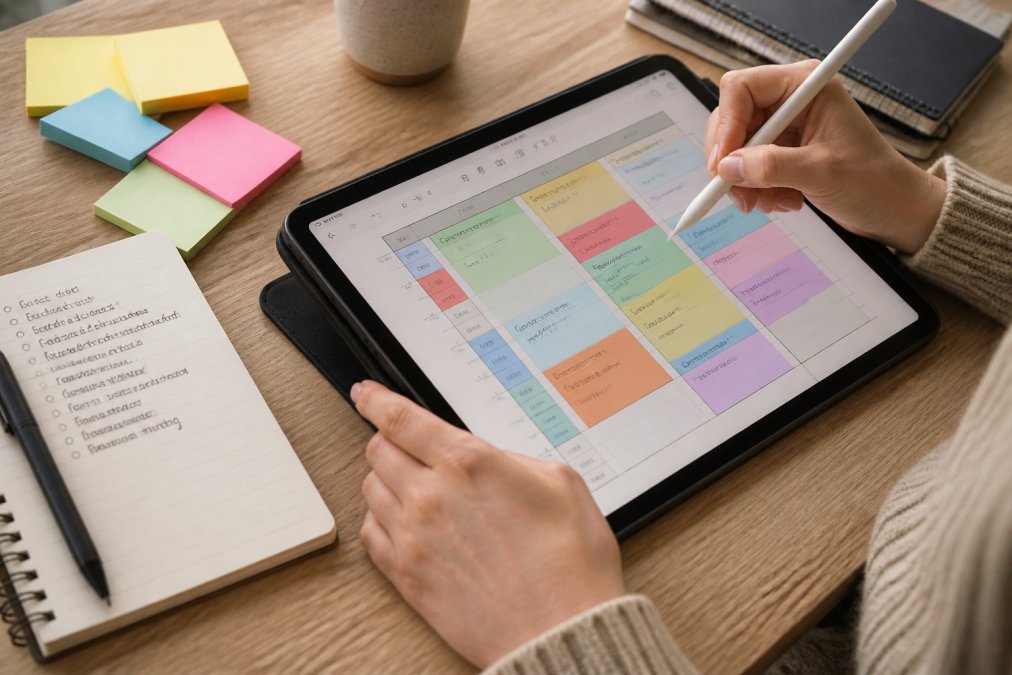
Realistic goal setting means choosing two or three habits to track at a time, not twelve. Start narrow, build confidence, then expand.
Maintaining Consistency Without Shame or Rigid Streaks
Consistency for ADHD doesn't look like a perfect streak, it looks like returning to the system after stepping away.
The most consistent ADHD planners make returning easy. If picking up your planner after a week away requires reconstructing context or confronting a visual record of absence, you won't pick it up. If any page is a valid starting point, you will.
According to the National Institute of Mental Health's ADHD resource page, behavioral strategies for ADHD work best when they reduce friction rather than add accountability pressure. Shame is not sustainable for any brain.
Principles that support long-term consistency:
- No penalty pages: Your template should have no visual record of missed days needing explanation
- Weekly resets built in: A weekly overview that starts fresh removes accumulation of "undone" items
- Flexible accountability: Accountability works better when chosen, not imposed
- Permission to simplify: On low-energy days, the template should have a "minimum viable day" mode: one task, one meal, one self-care item
Anchor Grove Studio's templates are designed around this principle: no rigid streaks, no shame for starting over, and a structure that works whether you're having a high-functioning week or barely keeping the lights on. The system should serve you, not the other way around.
The goal isn't a perfect planner. It's a planner you keep coming back to.
Maintaining a daily structure with ADHD is genuinely hard, and most tools make it harder than necessary. Anchor Grove Studio offers ADHD-friendly planners, Notion templates, and printable PDF systems designed specifically to reduce cognitive load, support task initiation, and make returning to your routine feel easy rather than shameful. With instant digital downloads, flexible formats, and no rigid streak requirements, these tools are built to work with your brain on its own terms. Add to cart and start your first day today.
Frequently Asked Questions
What is a good daily schedule for someone with ADHD?
A good ADHD daily schedule prioritizes flexibility over rigidity. Start with 2-3 anchored time blocks, morning, midday, and evening, and fill them with your highest-priority tasks. Build in transition buffers between activities, include short dopamine reward breaks, and use visual cues like color-coding to reduce cognitive load. The goal is a structure loose enough to survive a low-energy day but consistent enough to reduce decision fatigue. An ADHD daily schedule template can give you that starting framework without requiring perfection.
Why do traditional planners fail for ADHD brains?
Traditional planners assume consistent executive function, accurate time estimation, and the motivation to maintain daily streaks, three things that ADHD brains genuinely struggle with. When one day gets missed, the all-or-nothing thinking that often accompanies ADHD turns a single skipped entry into full planner abandonment. ADHD-friendly templates address this by removing streak requirements, using visual organization instead of dense text, and making it easy to start fresh on any page without shame or guilt.
How do I use time blocking if I have ADHD and keep losing track of time?
Time blindness makes standard time blocking difficult, but a few adjustments help. Use external timers, a visual timer or phone alarm, to signal the start and end of each block rather than relying on internal awareness. Keep blocks shorter than you think you need, around 25-45 minutes, and schedule a 10-minute buffer between them. Label blocks by energy level (high, medium, low) rather than strict clock times so your ADHD daily schedule adapts to how you actually feel that day.
What is the 1-3-5 rule for ADHD planning?
The 1-3-5 rule is a task prioritization method where each day you plan 1 big task, 3 medium tasks, and 5 small tasks. For ADHD, it works because it sets a realistic ceiling on daily expectations, which reduces the overwhelm that causes task avoidance. It pairs well with an ADHD-friendly daily schedule template by giving you a pre-defined to-do list structure that prevents both over-scheduling and the paralysis of a blank page.
This article was written using GrandRanker