
ADHD Meal Planning Templates for Beginners
Table of Contents
- Why ADHD Meal Planning Feels Impossible (And How Templates Help)
- How to Meal Plan With Executive Dysfunction
- ADHD Meal Prep Tips for Beginners: Start Small
- Creating a Simple ADHD Grocery List Template
- Printable vs. Digital: Choosing Your Template Format
- Building Your First ADHD Meal Planning Template
- Common Mistakes to Avoid When Starting Out
- Maintaining Your System on Low-Energy Days
- Frequently Asked Questions
Last Updated: September 30, 2026
Why ADHD Meal Planning Feels Impossible (And How Templates Help)
Meal planning with ADHD isn't just hard. It feels impossible. You open your fridge. Your brain goes blank. The question "What should I eat?" triggers a cascade of decisions that drain your mental energy before you've even started cooking. This is executive dysfunction, and it's the reason ADHD meal planning templates exist.

Executive dysfunction is when your brain struggles to initiate tasks, make decisions, or organize information, even when you know exactly what you want to do. For people with ADHD, meal planning triggers this dysfunction because it demands too many decisions at once: What proteins sound good? What vegetables haven't rotted yet? Do I have the energy to cook? What if I mess up?
At Anchor Grove Studio, we understand why many people abandon meal planning systems because they were built for neurotypical brains. Rigid meal plans fail. Complicated spreadsheets fail. Systems that demand willpower every single day fail. What works is something radically different: templates that reduce decisions, build in flexibility, and work WITH your ADHD brain instead of against it.
The good news: ADHD meal planning templates for beginners don't need to be complicated. They just need to be designed for how your brain actually works.
How to Meal Plan With Executive Dysfunction
Executive dysfunction makes meal planning feel like you're solving a math problem while running a marathon. Your brain is already tired. Adding more decisions makes it worse. The solution isn't trying harder, it's reducing the number of decisions you have to make.
When you have executive dysfunction, every choice costs energy. Traditional meal planning asks you to choose a different meal for every day of the week. That's seven decisions. Seven opportunities to feel overwhelmed. Seven chances to give up and order takeout instead.
The Repeat Rotation Method flips this. Instead of planning seven different meals, you plan five meals you actually like. Then you rotate them. Monday might be tacos. Tuesday is pasta. Wednesday is rice bowls. Thursday is tacos again. Friday is something quick. You've already decided. Your brain gets to rest.
The Repeat Rotation Method
The Repeat Rotation Method is the foundation of ADHD meal planning templates for beginners because it cuts decision fatigue in half. Here's how it works:
Step 1: Choose five meals you genuinely enjoy. Not meals you think you "should" eat. Not meals that are trendy. Meals you actually want to eat when you're tired, stressed, or running on fumes. These become your autopilot meals.
Step 2: Rotate them through your week. If your five meals are tacos, pasta, rice bowls, breakfast for dinner, and rotisserie chicken with sides, you rotate them. Week one: taco, pasta, rice bowl, breakfast, chicken. Week two: pasta, rice bowl, breakfast, chicken, taco. The meals change order, so it doesn't feel repetitive.
Step 3: Keep the same proteins and vegetables. You don't need to reinvent the wheel every rotation. Use the same proteins you know how to cook. Use the same vegetables you'll actually eat. Consistency reduces decisions.
The Repeat Rotation Method works because it removes the hardest part of meal planning: deciding what to eat. You've already decided. You just follow the rotation.
Building Your Low-Energy Backup List
Low-energy days happen. Days when you can barely get out of bed. Days when cooking feels impossible. A low-energy backup list saves you on those days.
Your backup list contains meals that require almost no energy:
- Cereal or toast with peanut butter
- Canned soup heated in the microwave
- Rotisserie chicken from the grocery store with pre-cut vegetables
- Pasta with jarred sauce
- Scrambled eggs with toast
- Peanut butter and banana sandwich
- Yogurt with granola
These aren't "ideal" meals. They're survival meals. And they're infinitely better than skipping food or defaulting to expensive delivery. On low-energy days, your only job is to eat something from this list. That's it.
ADHD Meal Prep Tips for Beginners: Start Small
Meal prep sounds great until you realize it means spending three hours on a Sunday cooking. For people with ADHD, three-hour tasks are motivation killers. You'll plan to do it. You won't do it. Then you'll feel guilty.
Start smaller. Meal prep for ADHD doesn't mean cooking an entire week's worth of food. It means doing one or two small things that make the week easier.
Prep one protein. Cook a batch of ground beef, chicken, or beans. Use it in multiple meals. Taco Tuesday becomes taco Wednesday too because you already have the protein ready.
Chop one vegetable. Buy pre-cut vegetables if they fit your budget. If not, chop one type, carrots or bell peppers, and store them in containers. One small prep task removes one decision later.
Cook rice or pasta ahead. These take time but no active attention.
ADHD Meal Planning Guide: No-Decision →
Creating a Simple ADHD Grocery List Template
Grocery shopping with decision fatigue is torture. You walk into the store. Too many choices. Too many decisions. You forget half of what you came for. You buy things you don't need. You spend too much money.
Here's what a basic template looks like:
| Category | Items |
|---|---|
| Proteins | Ground beef, chicken, eggs, canned beans |
| Grains | Rice, pasta, bread, tortillas |
| Vegetables | Carrots, bell peppers, frozen broccoli |
| Pantry | Olive oil, canned tomatoes, pasta sauce |
| Dairy | Milk, cheese, yogurt |
| Backup | Cereal, peanut butter, canned soup |
Automating Your Grocery List
Grocery list automation is a game-changer for ADHD brains. When your list is digital and connected to your meal plan, you don't have to manually write it. The system does it for you.
Printable vs. Digital: Choosing Your Template Format
ADHD meal planning templates come in two formats: printable and digital. Each has advantages. The right choice depends on your brain and your habits.
Printable templates work best if:
- You prefer writing by hand
- You like having a physical reference on your fridge
- You want to avoid screen time
- You like the tactile experience of checking boxes
Digital templates work best if:
- You always have your phone with you
- You like having your system accessible anywhere
- You want to sync with grocery apps
- You prefer typing over writing
Building Your First ADHD Meal Planning Template
You're ready to build your first template. This takes about 30 minutes. Don't overthink it. Overthinking kills momentum.
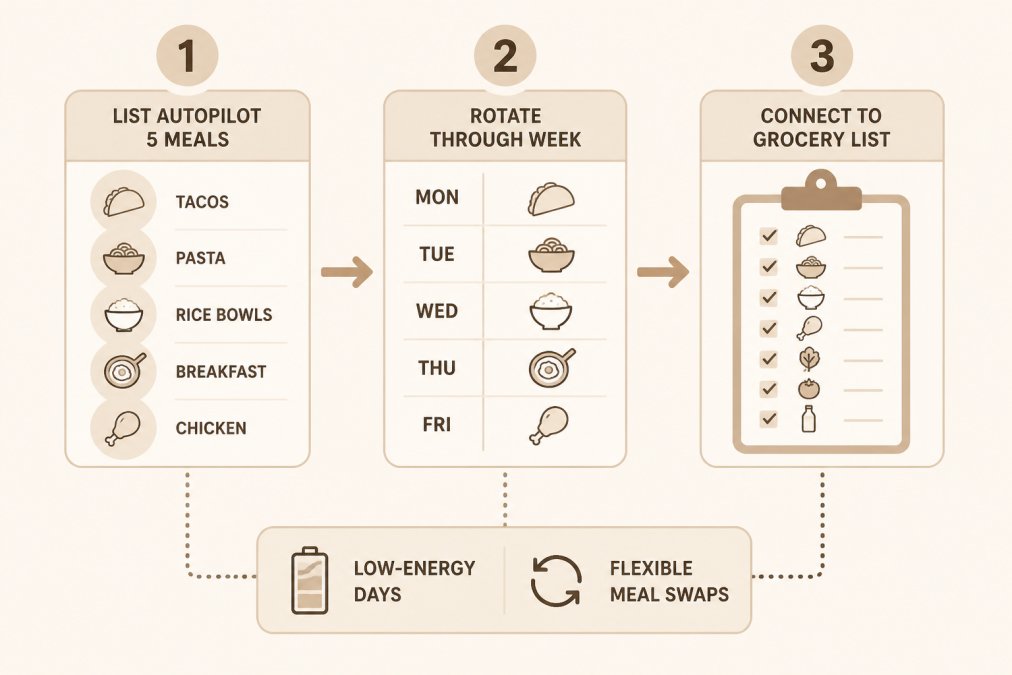
Step 1: List Your Autopilot 5 Meals
Open a document. Write down five meals you genuinely enjoy. Not five meals you think you should eat. Five meals that make you think, "Yeah, I could eat that right now."
Examples:
- Tacos with ground beef
- Pasta with jarred sauce
- Rice bowls with rotisserie chicken
- Scrambled eggs with toast and bacon
- Rotisserie chicken with roasted vegetables
That's it. Five meals. Done.
Step 2: Plan One Week at a Time
Don't plan a month. Don't plan two weeks. Plan one week. One week feels manageable. One week doesn't trigger overwhelm.
Step 3: Connect Your Meal Plan to Your Grocery List
For each meal, write down what you need to buy. Don't get fancy. Just list the ingredients.
Common Mistakes to Avoid When Starting Out
The biggest mistake people make with ADHD meal planning templates for beginners is planning too much. They create meal plans with 10 different meals. They plan three weeks ahead. They add complexity. Then they abandon the system.
Maintaining Your System on Low-Energy Days
The real test of an ADHD meal planning template isn't how it works on good days. It's how it works on low-energy days. Days when you can barely function. Days when the system needs to work for you, not against you.
On low-energy days:
- Use your backup list. Don't cook.
- Order groceries if shopping feels impossible.
- Eat cereal for dinner if that's what you can manage.
- Skip meal prep. Use pre-cooked proteins.
- Shift meals around. Eat Friday's meal on Tuesday if it fits.
Frequently Asked Questions
Why is meal planning so hard with ADHD?
Decision fatigue, executive dysfunction, and time blindness make it difficult to move from 'What should I eat?' to actually eating. Your brain has to make dozens of micro-decisions daily, and meal planning adds cognitive load on top of that. ADHD meal planning templates reduce decisions by using a repeat rotation of trusted meals and automating your grocery list, so you're not starting from scratch every time you're hungry or low on energy.
How do I start meal planning if I'm a beginner with ADHD?
Start with your Autopilot 5: five meals you can eat on repeat without getting bored. Write down meals you've actually enjoyed eating, not meals you think you should eat. Then use a simple ADHD grocery list template to automate your shopping. Plan one week at a time, not a month. Keep a low-energy backup list for days when capacity is low. The ADHD Meal Planning Guide walks you through this exact process with fillable worksheets.
What ADHD meal prep tips actually work for beginners?
Focus on batch cooking one or two components (rice, roasted vegetables, cooked protein) rather than entire meals. Use your pantry staples to build flexible meals instead of rigid recipes. Set up your grocery list to auto-populate based on your meal plan so you're not rewriting it weekly. Accept that some weeks you'll eat the same thing five days in a row, and that's fine. The goal is reducing decision fatigue, not variety.
Are printable or digital ADHD meal planning templates better?
It depends on your brain. Printable templates work well if you hyperfocus on visual planning or prefer paper. Digital templates (including Notion) are better if you're already on your phone, want to sync with grocery delivery apps, or need to access your plan from anywhere. Many people use both: a printable weekly view on the fridge and a digital version for grocery shopping. Choose whichever format you'll actually look at when you're hungry and overwhelmed.