
Anti-Boring Task Initiation Alternatives That Work
Table of Contents
- Why Task Initiation Is Hard for ADHD Brains
- ADHD Executive Dysfunction Hacks That Lower the Bar
- How to Overcome Task Paralysis Without Shame
- Gamified Task Management Tools and Dopamine Menus
- Anti-Boring Task Initiation Alternatives for Real Life
- Building Momentum After You Start
- Choosing a Flexible System That Fits Your Brain
- Frequently Asked Questions
Last Updated: September 20, 2026
Why Task Initiation Is Hard for ADHD Brains
Task initiation is the cognitive process of moving from intention to action, and for ADHD brains it is often the hardest part of any task. The work itself may be manageable. Starting it is not.
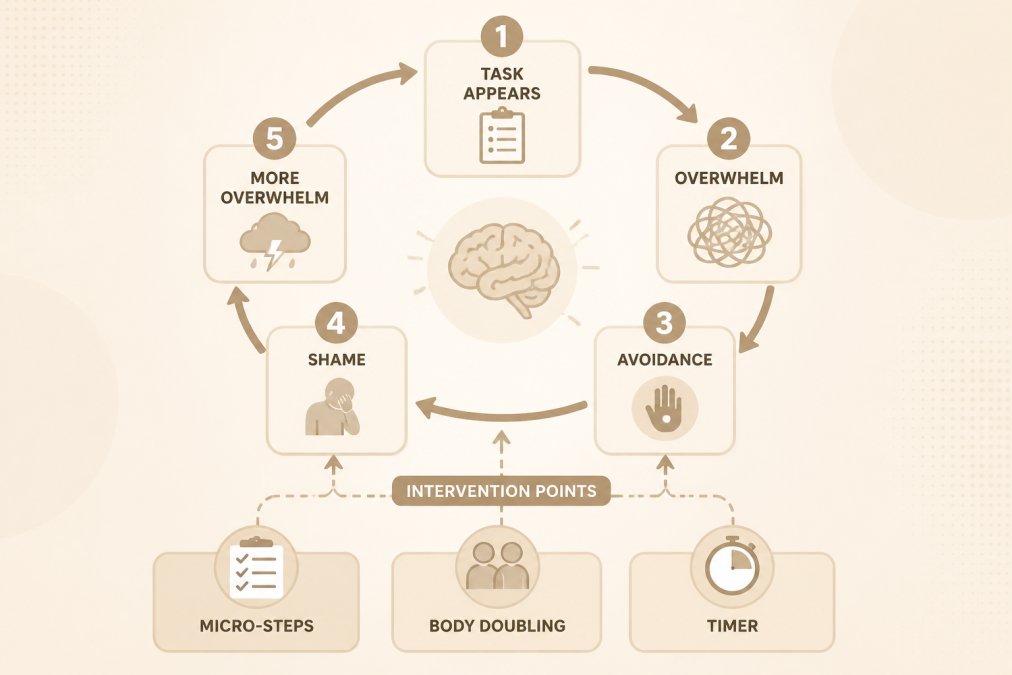
The Role of Dopamine and Executive Dysfunction
Dopamine regulates motivation and reward-seeking. In ADHD brains, dopamine signaling is less efficient, making boring or distant tasks feel genuinely unrewarding.
ADHD Executive Dysfunction Hacks That Lower the Bar
The most effective ADHD executive dysfunction hacks shrink the first step until starting feels almost trivial. You are not building discipline, you are lowering the activation energy.
Micro-Steps, Timers, and the Two-Minute Floor
Micro-steps shrink the first action until it takes under two minutes. "Write report" becomes "open the document and type the title."
| Technique | What It Does | Best For | Time to Try |
|---|---|---|---|
| Micro-steps | Shrinks the first action | Task paralysis | Under 2 minutes |
| Two-minute floor | Bypasses negotiation | Avoidance | 2 minutes |
| Timer-based work | Creates a boundary | Focus and momentum | 10-25 minutes |
| Body doubling | Adds accountability | Lonely tasks | Full session |
How to Overcome Task Paralysis Without Shame
To overcome task paralysis, address both mental friction and your body's physical state. Standard advice covers the first and ignores the second. The two fastest levers are somatic regulation and structured body doubling.
Somatic Regulation: A Pre-Initiation Protocol
Somatic regulation uses physical input to shift your nervous system before you try to start. When you are stuck, your body is often in a low-arousal or overwhelmed state, and no amount of list-making will move you until that shifts.
- Temperature shift (30 seconds). Cold water on your wrists, a cold pack on your forehead, or a splash on your face. This triggers a mild dive reflex that increases alertness and interrupts the freeze response. Most practitioners find cold is more effective than warm for initiation.
- Movement (60 seconds). Ten jumping jacks, a brisk walk to the mailbox, or a short dance break. Movement raises arousal and increases blood flow to the prefrontal cortex, the area responsible for starting tasks.
- Breath pattern (60 seconds). Try a 4-7-8 breath: inhale for four counts, hold for seven, exhale for eight. This shifts you out of sympathetic overdrive without dropping you into fatigue. If you tend toward shutdown rather than anxiety, use a faster breath instead, two quick inhales through the nose, one long exhale, repeated ten times.
Body Doubling: How to Actually Run a Session
Body doubling means working alongside another person, in person or on video. Their presence provides gentle accountability without pressure. It does not have to be a productivity partner, a friend reading nearby works just as well.
- Set a clear start and end time. "We work from 2:00 to 3:00" is better than "let's work together sometime."
- State your task out loud before you begin. Say exactly what you will work on. This creates a light commitment and primes your brain.
- Agree on silence. No chatting, no checking in mid-session. The other person's presence is the accountability, not their feedback.
- Use a shared timer. Both start and stop together. This removes the negotiation of when to quit.
- End with a one-sentence debrief. "I got the outline done" or "I only opened the file." Both are wins. The debrief reinforces that showing up counts.
Digital Friction Reduction
Every open tab, notification, and cluttered desktop adds cognitive load. Before you start, close what you are not using and put your task in front of you:
- Close every browser tab except the one your task requires.
- Silence notifications on your phone and computer, not just the ringer.
- Clear your desktop of everything except the file or app you need.
- If your task is on paper, clear the physical surface first.
Gamified Task Management Tools and Dopamine Menus
Gamification attaches small rewards to tasks with no natural payoff. A dopamine menu is a written list of those rewards, sorted by how much energy they take.
A simple dopamine menu might include:
- A five-minute snack or drink
- One song, played loud
- A short walk outside
- A two-minute stretch
- A single round of a game
Anti-Boring Task Initiation Alternatives for Real Life
The best anti-boring alternative for task initiation changes your sensory and physical state, not just your to-do list. Movement and sound do more for starting than most planners ever will.
Music, Movement, and Sensory Input
Auditory stimulation is one of the fastest levers available. Many people with ADHD find music with a strong beat raises arousal enough to begin; others need silence or brown noise. Test both.
Building Momentum After You Start
Post-initiation momentum maintenance is the part almost every guide skips. Starting is hard, but stopping and restarting is harder. The goal is not to work longer, it is to avoid the restart cost.
Why Mid-Task Burnout Happens
Momentum collapses for predictable reasons. Knowing them lets you intervene before the session dies.
- Decision fatigue. Every small choice, what to write next, which tab to open, whether to check email, draws from the same pool you used to start. When the pool empties, you stop.
- Arousal drop. The stimulation that got you started fades after twenty to forty minutes. Without a re-up, your brain looks for novelty elsewhere.
- Perfectionism creep. The task gets harder as you go because you start editing instead of producing. Editing and producing use different modes, and switching mid-session stalls both.
- Unresolved friction. A missing file, a slow tool, or an unclear next step creates a pause, and pauses are where sessions die.
The Momentum Maintenance Protocol
Use these moves in order. You do not need all of them every session.
- Protect the first ten minutes after starting. Do not check your phone, do not open email, and do not switch tasks because the current one got uncomfortable. The first ten minutes are when the session is most fragile.
- Re-up arousal at the midpoint. At the halfway mark of your timer, stand up, stretch, or take ten slow steps. Do not sit through the dip. A sixty-second movement break at minute fifteen often buys another twenty minutes of focus.
- Separate producing from editing. If you catch yourself rewriting the same sentence, stop and make a note to edit later. Producing and editing are different modes; switching between them mid-session is a common momentum killer.
- Leave a visible next step before you stop. Write one sentence about where you are and what comes next. Returning to a clear entry point is far easier than returning to a blank page.
- End on a partial sentence if you can. Stopping mid-thought, with the next word already known, makes restarting almost automatic. This is sometimes called the Hemingway trick, and it works because your brain wants to finish what it started.
What to Do When You Do Stop
You will stop. The question is how. A clean stop leaves a trail back in:
- One sentence describing where you are.
- One sentence describing the next action.
- The file or app left open to the exact spot.
Choosing a Flexible System That Fits Your Brain
A system that fits your brain is one you can return to after missing a day, not one you must follow perfectly. Rigid streaks and all-or-nothing thinking are the fastest route to abandoning a planner.
| Tool | Format | Best For | Price |
|---|---|---|---|
| Focus & Deep Work System | Digital download | Task initiation and focus | $16.00 |
| 1-Month Printable Planner | Printable PDF | Testing a system first | $5.00 |
| Digital ADHD Planner | Tablet PDF | GoodNotes planning | $22.00 |
| Life Dashboard | Notion template | Brain dump and meals | $26.00 |
Frequently Asked Questions
Why is task initiation so difficult for the ADHD brain?
Task initiation relies on executive function, the brain's ability to plan, prioritize, and begin action. In ADHD, differences in dopamine signaling make it harder to generate the activation energy needed to start. The task may be clear, but the neurological spark to begin is missing. This is why knowing what to do and actually starting are two separate challenges. Breaking tasks into micro-steps, using timers, or pairing the task with something enjoyable can reduce that barrier.
What are some non-traditional ways to start a task?
Traditional advice says just do it, which rarely works for ADHD brains. Alternatives include body doubling (working alongside someone), the two-minute floor (commit to just two minutes), temptation bundling (pair a boring task with something you enjoy), and somatic regulation (moving your body first to shift your nervous system). Digital friction reduction also helps: remove extra clicks, close unused tabs, and keep your task list visible. These methods lower activation energy without relying on willpower.
How do gamified task management tools help with task initiation?
Gamified task management tools add points, streaks, or rewards to daily tasks, which can provide the dopamine boost that ADHD brains often lack. A dopamine menu, for example, lets you choose small rewards before or after a task. The key is flexibility: rigid streaks can backfire. Look for tools that let you reset without shame and that make starting feel like a choice rather than a test. The goal is engagement, not perfection.
Are digital or physical tools better for ADHD task initiation?
Both can work, but the best choice depends on your habits. Digital tools like Notion dashboards or tablet planners offer quick capture and searchability, which reduces mental friction. Printable planners provide a tactile experience and no screen distractions. Many people benefit from a hybrid: a digital brain dump for capturing thoughts and a printed daily page for focus. The right system is the one you will actually return to after an off day.
How do I overcome executive dysfunction when starting a project?
Start by reducing the size of the first step until it feels almost too easy. Instead of write the report, try open the document and type one sentence. Use a timer for five minutes. Pair the task with auditory stimulation like music or a podcast. If you are still stuck, try body doubling or a pre-task ritual that signals to your brain that work is beginning. Momentum often follows action, not the other way around.
Task initiation will not become effortless, but it can become easier when you stop fighting your brain and start working with it. Anchor Grove Studio designs calm, ADHD-friendly planners, trackers, and Notion templates built for imperfect days, with no rigid streaks and no shame language. Every tool is an instant download, so you can start over on any page or week without waiting. Get started with Anchor Grove Studio and make the first step smaller.