
ADHD Systems for Task Paralysis: A 2026 Guide
Table of Contents
- What Is ADHD Task Paralysis and Why It Happens
- ADHD Task Initiation Strategies That Work
- Breaking Down Overwhelming Tasks Into Manageable Pieces
- Using Body Doubling for ADHD Task Paralysis
- ADHD-Friendly Productivity Templates and Systems
- Building Structured Routines and Emotional Regulation
- Practical Tools and Systems for Daily Implementation
- Conclusion
- Frequently Asked Questions
Last Updated: August 31, 2026
What Is ADHD Task Paralysis and Why It Happens
ADHD task paralysis is the inability to start a task despite knowing what needs to be done and having the capability to do it. Unlike simple procrastination, task paralysis stems from executive dysfunction, a neurological challenge with task initiation, not motivation or laziness. At Anchor Grove Studio, we've designed systems specifically for ADHD brains because the issue isn't effort, it's friction.
Executive Dysfunction vs. Procrastination
Executive dysfunction and procrastination look identical from the outside but operate through different mechanisms. Procrastination is a choice driven by anxiety or desire to avoid discomfort. Executive dysfunction is different: your brain literally struggles to initiate the sequence of actions required to begin, even though you want to start.
The practical difference: procrastination responds to deadline pressure. Executive dysfunction doesn't. Pushing harder makes it worse because you're already pushing against a neurological wall. What works instead is removing friction and creating external structure that jumpstarts the initiation process.
The Dopamine Regulation Connection
ADHD brains regulate dopamine differently than neurotypical brains (peer-reviewed research). Dopamine drives motivation, focus, and the ability to initiate action (the NIH). Many ADHD brains have lower baseline dopamine, which means routine tasks feel less rewarding and harder to start (peer-reviewed research).
This explains why you can hyperfocus on something interesting for six hours but can't begin a boring task for six minutes. Your brain isn't broken; it's seeking the dopamine boost that interesting work provides. Understanding this reframes the solution: you're working with a dopamine-driven system that needs either higher-interest tasks, external accountability, or structured conditions that make starting feel less effortful. Body doubling works so well because the presence of another person provides a dopamine boost that lowers the barrier to initiation.
ADHD Task Initiation Strategies That Work
The 5-Minute Rule
The 5-minute rule exploits a neurological quirk: starting is harder than continuing. Once you're in motion, momentum takes over. Commit to working for exactly five minutes. Set a timer. When it goes off, you can stop guilt-free. In practice, most people keep going because the hardest part, starting, is already done.
This works because it reframes the commitment. Instead of "I have to write this 2,000-word report," your brain hears "I have to write for five minutes." Once you start, the task's momentum often carries you forward naturally.
Environmental Design for Task Start
Your environment shapes whether task initiation feels easy or impossible. Design your workspace to minimize friction:
- Remove competing stimuli. Put your phone in another room. Close unnecessary browser tabs. Reduce visual clutter. Each competing stimulus increases cognitive load and makes starting harder.
- Pre-stage materials. Have specific tools or documents visible and ready before you sit down. Needing to hunt for something can derail task initiation entirely.
- Create a transition ritual. A small, consistent action signals to your brain that work is beginning. This might be making tea, opening a playlist, or sitting in a particular chair.
- Use body doubling, even asynchronously. Working where others are present (or on a video call with someone else working) provides enough external structure to make starting less daunting.
Breaking Down Overwhelming Tasks Into Manageable Pieces
Overwhelm is one of the biggest blockers for task initiation in ADHD. When a task feels too large or complex, your brain refuses to engage. Breaking it into smaller pieces reduces cognitive load enough that your brain will actually start.
The Task Breakdown Framework
The task breakdown framework turns a paralyzing project into a series of small, doable steps:
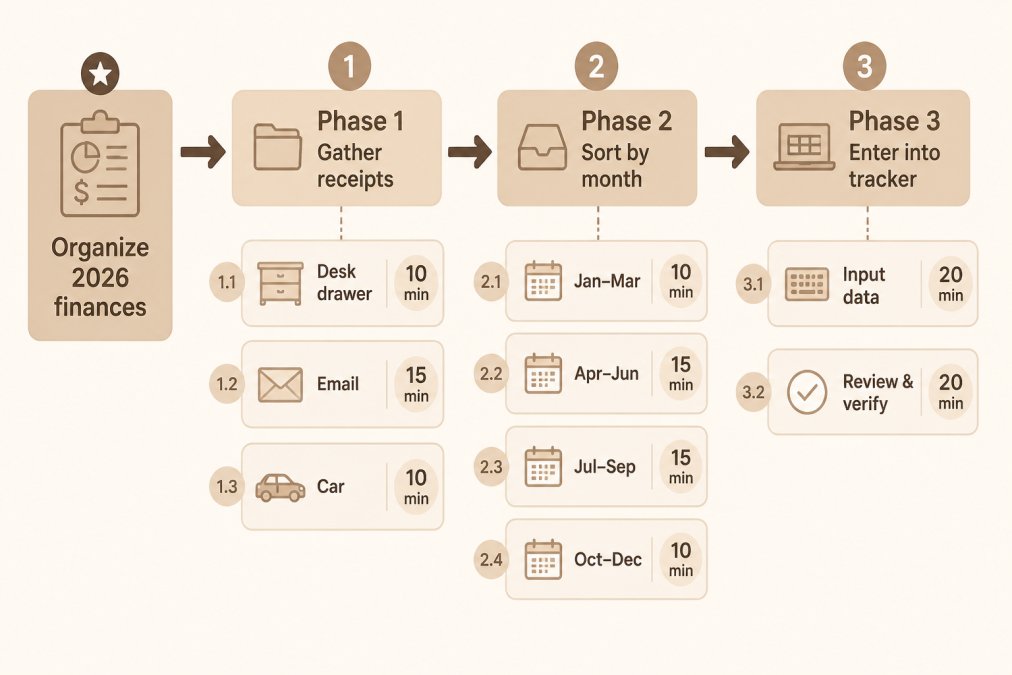
- Name the end goal clearly. "Organize my finances" is too vague. "Gather all receipts from 2026 and categorize them by month" is specific enough to work with.
- Identify 3-5 major phases. For receipts: gather, sort, categorize, enter into tracker, reconcile.
- Break each phase into 15-30 minute tasks. "Gather receipts" becomes "Gather receipts from desk drawer," "Gather receipts from email," "Gather receipts from car." Each task should feel completable in one focused session.
- Assign time estimates to each micro-task. Be honest about how long things actually take. Time estimates help your brain understand the commitment required.
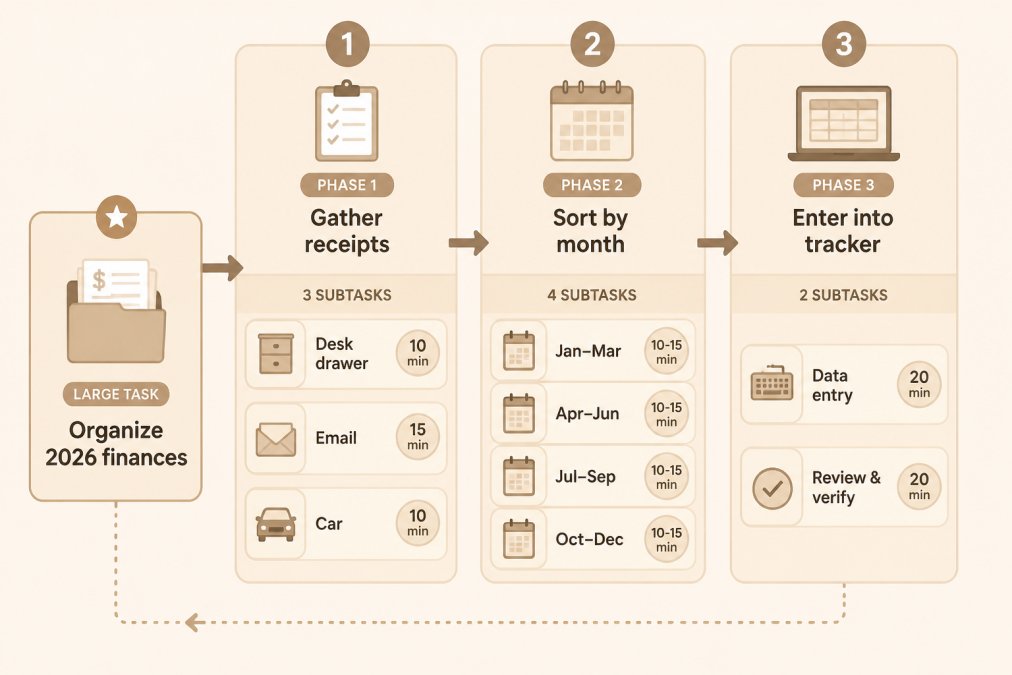
The visual breakdown alone reduces activation energy. Your brain sees "15 minutes to gather receipts from desk drawer" instead of "organize my entire financial life."
Cognitive Load and Mental Friction
Cognitive load is the mental effort required to process information and make decisions. For ADHD brains, high cognitive load triggers paralysis. When a task requires too many decisions before you start, your brain shuts down rather than engage.
This is why vague tasks are paralyzing. "Write the report" requires you to decide what to include, how to structure it, what tone to use, and how long it should be. "Write the introduction paragraph (150 words, professional tone, overview of findings)" is much lower cognitive load because decisions are already made.
Reduce cognitive load by making as many decisions as possible before you start working. Use templates, checklists, and pre-made structures. The Anchor Grove Studio ADHD Focus & Deep Work System does exactly this, it pre-decides the structure so you only have to fill in the content.

Using Body Doubling for ADHD Task Paralysis
Body doubling, working alongside another person, is one of the most effective task initiation strategies for ADHD. The presence of another person provides external accountability and a subtle dopamine boost that makes starting feel less effortful.
Synchronous and Asynchronous Body Doubling
Synchronous body doubling means working in real time with another person present, at the same table, in a coffee shop, or on a video call. The effect is powerful because it addresses multiple ADHD challenges: external accountability, motivation through modeling, and a container that holds your attention more effectively than working alone.
Asynchronous body doubling is when you work during a set time knowing others are also working simultaneously, but you're not directly watching each other. Examples include coworking spaces, online co-working sessions, or texting a friend progress updates. It's less powerful than synchronous presence but requires less coordination and can be easier to sustain long-term.
Digital Body Doubling Tools and Communities
If you don't have access to in-person body doubling, digital tools can provide similar benefits. Many ADHD communities offer scheduled body doubling sessions where people gather on video to work on their own tasks while others are present. The structure is minimal: you show up, say what you're working on, work for 25-50 minutes, and check out. That's often enough to break task paralysis.
ADHD-Friendly Productivity Templates and Systems
Generic productivity systems fail people with ADHD because they assume consistent energy levels and the ability to maintain rigid structures. You need systems flexible enough to accommodate good days and bad days.
Flexible Planning Without Rigid Streaks
Streak-based systems ("do this every day for 30 days") are designed for neurotypical brains. Miss one day and the streak breaks, triggering shame that often leads to abandoning the system entirely.
ADHD-friendly systems don't use streaks. They use flexible tracking that acknowledges reality: some days you have energy, some days you don't. Both are okay. Instead of "write every day," an ADHD-friendly system might say "write 3-4 days per week" or "write when you have the energy, track what you actually do, and adjust expectations based on your real capacity." This removes the shame mechanism while still providing structure.
Notion Templates and Digital Formats
Notion templates designed for ADHD work because they provide structure without rigidity. A good ADHD Notion template handles decision-making upfront so you only have to fill in the content. Digital formats are searchable, accessible across devices, and easier to update than paper systems.
The ADHD Productivity Focus Bundle from Anchor Grove Studio includes both printable and digital formats, recognizing that different ADHD brains have different preferences. Some people focus better with physical paper. Others need digital accessibility.

Building Structured Routines and Emotional Regulation
Structure itself isn't the problem; inflexible structure is. When routines are designed with flexibility and self-compassion, they become scaffolding that makes executive function easier.
Routine as Scaffolding, Not Punishment
Think of routines as external structure that props up your executive function. A morning routine removes decisions and creates momentum. Instead of deciding what to do next, you follow the sequence. That reduction in decision-making frees up mental energy for things that matter more.
Build routines that fit your life and energy patterns. An ADHD routine might look like: wake up, drink water, check calendar for today's non-negotiables, then decide what comes next based on current energy. Not rigid, but structured enough to prevent decision paralysis.
Managing Shame and Sensory Overload
Shame is often the hidden driver of task paralysis. You've failed at productivity systems before. That accumulated shame makes starting new things feel risky. Breaking this cycle requires explicit self-compassion: your ADHD brain isn't broken or lazy. It works differently.
Sensory overload directly impairs executive function. Too much visual clutter, too many notifications, too much noise, these aren't minor distractions. Reducing sensory input is a prerequisite for task initiation. Anchor Grove Studio's designs are intentionally minimal because visual simplicity directly supports executive function.
Practical Tools and Systems for Daily Implementation
Using Timers and the Pomodoro Technique
Timers externalize time, which is critical for people with time blindness. A timer makes abstract "work for a while" concrete: "work until this timer goes off."
The Pomodoro Technique, 25 minutes of focused work followed by a 5-minute break, works well for some ADHD brains but not all. Some people focus better with 15-minute intervals. Others need 45-minute blocks. The technique is a starting point, not a rule.
The real power of timers is that they remove the need to monitor time yourself. Your brain doesn't have to track how long you've been working; the timer does.
Task Prioritization and the Eisenhower Matrix
The Eisenhower Matrix categorizes tasks by urgency and importance, creating four quadrants. For ADHD brains that struggle with task prioritization, this framework removes the guesswork.
A more practical approach for ADHD is to combine urgency with energy requirements: what's urgent AND achievable with your current energy level? A system that accommodates both easy wins and difficult tasks is a system you'll actually use.
The Anchor Grove Studio Printable ADHD Planner builds this flexibility in. Instead of a fixed priority list, you choose what matters today based on what you actually have energy for.

Conclusion
ADHD task paralysis isn't a motivation problem or a character flaw. It's a neurological challenge with task initiation that responds to specific strategies: reducing friction, breaking tasks into smaller pieces, using external structure like body doubling, and building systems flexible enough to work with your actual brain.
The systems that work best are ones designed specifically for ADHD brains, systems that remove shame, accommodate varying energy levels, and provide structure without rigidity. Anchor Grove Studio's ADHD Focus & Deep Work System and Printable ADHD Planner are built exactly for this. They help you move from "I need to do this" to "I'm doing this" by handling structural decisions upfront, reducing cognitive load, and providing the scaffolding your brain needs to initiate tasks.
Start with the 5-minute rule and environmental design this week. Add body doubling or a timer-based system next. Build gradually. The goal isn't perfect productivity, it's systems that work with your brain instead of against it.
Frequently Asked Questions
What is the difference between ADHD task paralysis and executive dysfunction?
Task paralysis is the inability to initiate a task despite knowing what needs to be done, you're frozen at the starting point. Executive dysfunction is broader and affects planning, organization, time management, and task completion across the board. Task paralysis is one symptom of executive dysfunction. Both stem from dopamine regulation issues in the ADHD brain, but task paralysis specifically targets the moment of initiation, while executive dysfunction impacts your entire workflow from start to finish.
How can I use body doubling to overcome task paralysis?
Body doubling works by adding external structure and social accountability. Sit on a video call with another person while you both work on your own tasks, you don't need to talk or work on the same thing. The presence of another person triggers your brain to focus and reduces the mental friction of starting. You can use synchronous body doubling (live calls via Zoom) or asynchronous methods (coworking spaces, libraries, or working near a roommate). Start with just 25 minutes and build from there.
What are the best digital tools for managing ADHD task paralysis?
The best tools combine task breakdown, visual progress, and flexible planning. Notion templates allow you to customize your system without rigid structures. The ADHD Focus & Deep Work System ($16) is designed specifically for the moment between deciding to work and actually starting. Digital planners like the Digital ADHD Planner for tablets ($22) let you adjust daily without shame. Body doubling apps like Focusmate connect you with accountability partners. The key is choosing tools that reduce friction, not add more steps.
Can ADHD medication help with task paralysis?
Medication can help by improving dopamine regulation, which makes task initiation feel less overwhelming. However, medication alone isn't enough, you still need behavioral systems and environmental design. Many people find that combining medication with structured routines, body doubling, and task breakdown strategies produces the best results. If you're considering medication, discuss task paralysis specifically with your prescriber so they understand your initiation challenges.
How do I know if these systems will actually work for me when I've abandoned planners before?
Previous failures usually happen because the system was too rigid or created shame. ADHD-friendly systems differ by allowing you to restart on any page, any week, without penalty. They're designed with lower cognitive load, fewer moving parts, clearer priorities. The ADHD Productivity Focus Bundle ($52) includes multiple formats (printable, digital, Notion) so you can switch based on your energy that day. Success comes from systems that work with your brain's needs, not against them. Start with one tool and give it 2-3 weeks before switching.
What does 'flexible planning' actually mean for someone with bad energy fluctuations?
Flexible planning means your system doesn't punish you for low-energy days. Instead of a rigid daily checklist, you choose 2-3 realistic priorities each morning based on how you feel. You can use a different template or skip a day entirely without losing your streak (because there's no streak). The Printable ADHD Planner ($22) lets you reset after an off day and start fresh the next morning. Flexibility also means your tools work in multiple formats, digital on high-energy days, printable on low-energy days, so you're always supported.
How do I actually stick with a system long-term instead of abandoning it after a week?
Sustainability comes from systems that require minimal setup, don't shame you for breaks, and deliver immediate value. Start small, use just one feature for the first week. Build in body doubling or accountability check-ins to maintain momentum. Choose tools that match your actual workflow, not your ideal workflow. The Complete ADHD Product Bundle ($138) gives you multiple systems to rotate through, preventing boredom. Most importantly, treat the system as a tool you adjust, not a perfect routine you must maintain. When it stops working, change it, that's the point.
This article was written using GrandRanker