
Flexible Daily Planners for Low Energy: 5 ADHD-Friendly Systems
Table of Contents
- Why Flexible Daily Planners Matter for Low-Energy Days
- 1. Printable ADHD Planner: No-Shame Daily Planning System
- 2. Digital ADHD Planner: Tablet & GoodNotes-Ready PDF
- 3. 1-Month ADHD Printable Planner: Try the Low-Clutter System
- Undated Daily Planner Formats: Why They Work for Variable Energy
- Notion Planner for ADHD: Building a Flexible Digital System
- Daily Planner for Burnout: Planning Without the Pressure
- How to Choose the Right Flexible Planner for Your Energy Level
- Making Your Choice Stick
- Frequently Asked Questions
Last Updated: October 13, 2026
Why Flexible Daily Planners Matter for Low-Energy Days
Your to-do list doesn't shrink on hard days, but your capacity does. A flexible daily planner for low energy works with your fluctuating capacity instead of demanding the same output every day.
Many people with ADHD or chronic fatigue find rigid planners backfire: they create shame when you miss a day and make task initiation harder when your brain is already struggling.
At Anchor Grove Studio, we've designed planning systems for this challenge. Our flexible daily planners for low energy include undated pages you can restart anytime, and a brain dump system to clear mental clutter without judgment. The goal isn't productivity theater, it's a tool you'll actually use on your worst days.
Rigid planners punish inconsistency; flexible ones expect it. When you miss a week, a traditional planner makes you feel like you've failed. A flexible daily planner lets you open to any page and begin again, no guilt required.
1. Printable ADHD Planner: No-Shame Daily Planning System
The Printable ADHD Planner: No-Shame Daily Planning System is built around three priorities instead of ten. This alone changes everything for people with executive function challenges.

You get daily, weekly, and monthly planning pages. The daily page asks you to choose just three things that matter today, not ten tasks, not a ranked list.
The Brain Dump & Triage System is where the real relief happens. The planner gives you space to dump out every thought, worry, and half-remembered task, then triage what actually needs your attention, reducing the mental load that makes task initiation so hard.
The Low-Pressure Habit Tracker helps you notice patterns without all-or-nothing thinking, missed three days is data, not failure. The Dopamine Menu lets you choose small rewards and supports that make starting easier.
What you get:
- Instant digital download in editable PowerPoint format
- Undated pages you can reprint as many times as you need
- US Letter size (8.5 × 11 inches) for printing at home or through a print shop
- Flexible structure for daily, weekly, and monthly planning
At $22.00, this is the full version. No subscription. No waiting. Download it today and start planning on your terms.
2. Digital ADHD Planner: Tablet & GoodNotes-Ready PDF
If you prefer writing on a tablet, the Digital ADHD Planner: Tablet & GoodNotes-Ready PDF brings the same flexible approach to your iPad or Android device.

This low-clutter digital planner is designed for GoodNotes and similar PDF annotation apps, with ADHD-friendly daily and weekly pages and simple priority and task organization. The layouts are intentionally minimal, no visual overwhelm, just space to write and think.
The tablet version includes hyperlinked navigation, so you can jump between sections without scrolling endlessly. On high-energy days, you might plan the whole week.
This PDF works with GoodNotes and similar PDF annotation apps on iPad and Android tablets. You'll need a tablet and stylus (not included), and should check that your app supports PDF imports before purchasing.
What you get:
- Instant digital PDF download
- Compatible with GoodNotes and similar PDF annotation apps
- Hyperlinked navigation for easy jumping between sections
- Flexible planning pages designed for changing energy and capacity
At $22.00, it's the same price as the printable version. Choose based on your workflow: paper or digital.
3. 1-Month ADHD Printable Planner: Try the Low-Clutter System
Not ready to commit to a full planner? The 1-Month ADHD Printable Planner: Try the Low-Clutter System is a nine-page trial for just $5.00.

This isn't a free sample, it's a real planner for a full month, with a weekly planning layout, Top 3 daily-priority structure, Brain Dump & Triage pages, and a 4-week habit tracker that notices patterns instead of demanding perfect streaks. A week-four check-in page helps you decide whether the full undated planner is right for you.
Many people use this to test whether the flexible planning approach actually works for their brain before investing in the full system. If you've abandoned five planners in the past year, this low-risk trial lets you see if this one sticks.
What you get:
- Nine printable pages covering one month
- Top 3 daily priority structure
- Brain Dump & Triage pages
- 4-week habit tracker
- Week 4 check-in to assess fit
One-time purchase. No subscription. No recurring charges.
Undated Daily Planner Formats: Why They Work for Variable Energy
An undated daily planner removes one source of pressure: the calendar. Traditional planners force you to follow the calendar week. If you miss Monday, the whole week feels broken. An undated planner doesn't care what day it is.
For people with variable energy, this matters enormously: you plan around your actual capacity, not the calendar. Start your week on Wednesday if that's when your energy returns; skip ahead if you miss three days. The planner follows your rhythm, not the other way around.
The undated format also means you can reprint pages as needed, the same layout again if last week worked, or a different version if you need to adjust.
Printable ADHD Planner: No-Shame Daily Planning System →
Many people with ADHD find the pressure of "staying on schedule" is the biggest barrier to planning. An undated planner removes it entirely: you're not behind or ahead, just planning the next day based on what you can actually do.
Notion Planner for ADHD: Building a Flexible Digital System
Notion offers powerful flexibility if you're willing to set it up. A Notion planner for ADHD can integrate task management and habit tracking in one place, but the setup requires customization, and that's where many people get stuck.
If you already use Notion and enjoy building systems, it can become your command center: databases that filter tasks by energy level, templates for your daily planning ritual, dashboards that show patterns over time. The learning curve is real, though, if database design and formulas aren't comfortable, Notion can feel overwhelming.
For people with ADHD, the temptation with Notion is to build something too complex, hours of customizing, no actual planning. The best Notion setups for ADHD are intentionally simple: a daily task database, and maybe a weekly review template. That's it.
Daily Planner for Burnout: Planning Without the Pressure
When you're burned out, planning feels like another task. A daily planner for burnout should reduce cognitive load, not add to it.
The key is removing choice. Instead of "What should I do today?", a burnout-friendly planner asks "What's the one thing that would make today feel less overwhelming?" Not productivity, not efficiency, just one small step forward.
A good burnout planner also includes space for rest, not as a reward for productivity, but as a necessary part of the day.
The flexible daily planners from Anchor Grove Studio work well for burnout because they don't demand consistency. You're not building a streak or maintaining a routine, just choosing what matters right now, on this day, at this energy level.
Recovery from burnout is slow. A planning system that expects you to move at full speed will just make it worse. A flexible system that adapts to your capacity actually supports healing.
How to Choose the Right Flexible Planner for Your Energy Level
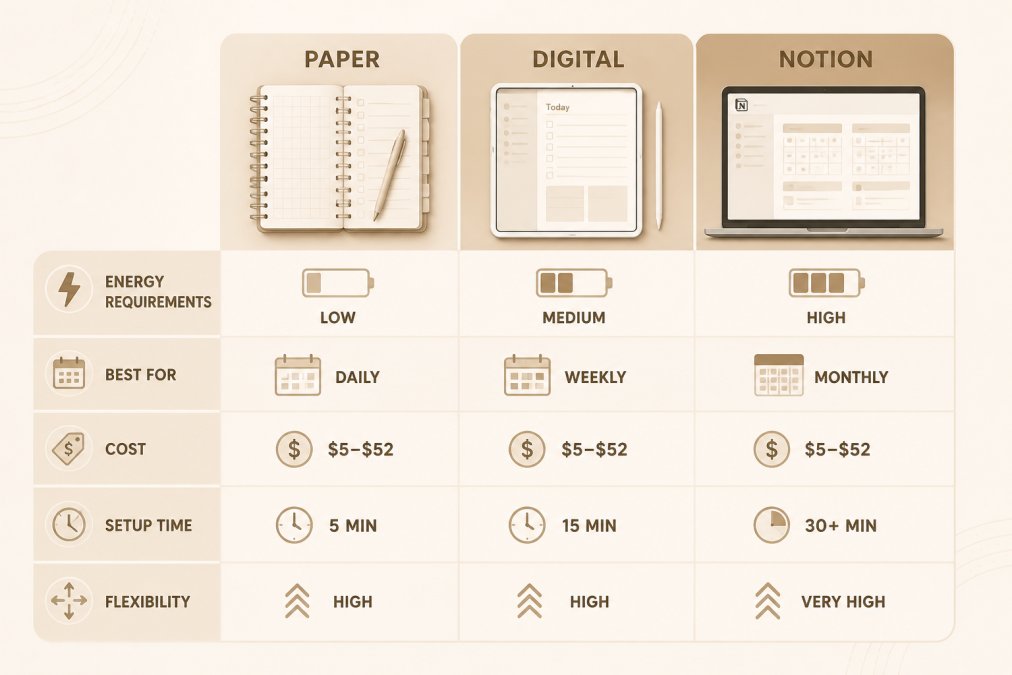
Choosing between printable, digital, and Notion-based systems comes down to three factors: your workflow, your energy for setup, and your comfort with technology.
| Format | Best For | Setup Time | Cost Range | Flexibility |
|---|---|---|---|---|
| Printable | People who prefer paper, like to write by hand, need no tech | 2-5 minutes | $5-$22 | High, reprint anytime |
| Digital (GoodNotes) | Tablet users, people who already use digital tools | 10-15 minutes | $22 | High, modify in the app |
| Notion | People who love building systems, want integration | 30+ minutes | Free-$10/mo | Very high, fully customizable |
Printable planners work best if you have the energy to print pages regularly and prefer writing by hand. They're the lowest barrier to entry: download, print, start immediately.
Digital planners suit people who already use tablets for note-taking or work.
Notion planners are for people who want everything in one place and enjoy tinkering with systems.
Making Your Choice Stick
The real question isn't which planner is best. It's which planner you'll actually use on your worst days.
A beautiful planner you abandon after two weeks helps no one; a simple system you return to consistently, even imperfectly, changes everything. That's why flexible daily planners for low energy exist: they're built for inconsistent capacity, not perfect consistency.
Start with the format that requires the least friction. If you're not sure, the 1-Month trial for $5.00 is the lowest-risk way to test whether flexible planning works for your brain. If it does, upgrade; if not, you've learned what you need instead.
The goal isn't to become a productive machine. It's to have a planning system that supports you on good days and doesn't punish you on hard days. That's what a truly flexible daily planner for low energy does.
Ready to try a planning system built for your actual capacity? Start with the 1-Month ADHD Printable Planner for $5.00 and see if flexible planning sticks. If it does, the full Printable ADHD Planner gives you unlimited reprints and complete daily, weekly, and monthly planning pages. Or combine both with the ADHD Planning & Focus Bundle for $52.00 and get digital and printable formats plus our task initiation system.
Frequently Asked Questions
What makes a flexible daily planner actually work for low-energy days?
A flexible daily planner removes rigid expectations and shame language. It uses a three-priority structure instead of endless to-do lists, includes a brain dump system to clear mental clutter, and lets you restart any page without penalty. The key is designing around capacity, not perfection. Planners like the Printable ADHD Planner ($22) build this flexibility into every page, you choose what matters today, not what should matter.
Are undated planners better for ADHD than dated ones?
Yes, for most ADHD brains. Undated planners remove the shame of skipping days and let you use pages in any order. If you miss a week, you don't have blank, guilt-inducing pages staring at you. You simply pick up the next page and start again. This is especially helpful for low-energy periods when consistency feels impossible. An undated daily planner also works across high- and low-energy seasons without waste.
Should I use a printable daily planner or a digital one for low energy?
It depends on your energy type. Printable planners work well if writing by hand helps you focus and you have energy for printing. Digital planners (like the GoodNotes-ready PDF, $22) are better if you're too tired to print or prefer typing. Tablet-based planning also reduces visual clutter. If you're unsure, try the 1-Month Printable Planner ($5) first to test the system before committing to the full version.
Can a Notion planner for ADHD actually help with task initiation?
Yes, if it's built for ADHD brains. A planner built for ADHD brains should include flexible task structures that don't demand perfect completion. The ADHD Focus & Deep Work System ($16) includes task-initiation prompts like body doubling and the two-minute floor to make starting feel smaller and more achievable.
How do I use a daily planner for burnout without feeling more pressure?
A daily planner for burnout works best when it prioritizes rest alongside tasks. Choose three priorities maximum per day, not ten. Build in a dopamine menu for small rewards and supports. The goal is noticing what you can realistically do today, not forcing productivity. Reset after hard days without guilt.