
How to Start Tasks When Paralyzed: A Practical Reset
Table of Contents
- Understanding Task Paralysis and Why Starting Feels Impossible
- The In-the-Moment Reset: What to Do When You're Frozen
- How to Break Tasks Into Smaller Steps
- How to Overcome Task Paralysis With Structure and Support
- When Common Strategies Fail: What to Try Next
- Building a System That Actually Works for You
- Frequently Asked Questions
Last Updated: October 12, 2026
Understanding Task Paralysis and Why Starting Feels Impossible
Task paralysis is when you know what needs to be done but cannot start tasks when paralyzed by competing demands, even though you want to.
This is not laziness or traditional procrastination.
When you are paralyzed, your brain is flooded with competing demands.
The good news: once you understand what is freezing you, you can use specific, practical techniques to reset and move forward.
Task Paralysis vs. Procrastination: What's the Difference?
Procrastination and task paralysis feel similar but work differently in your brain.
With procrastination, you can usually force yourself to start. With task paralysis, pushing harder makes it worse: your nervous system locks up tighter and the freeze deepens.
Procrastination involves doing something else. Task paralysis involves no action at all: you sit with the task in front of you, unable to engage.
Why Executive Dysfunction Makes Starting So Hard
Executive dysfunction is a real neurological pattern affecting attention, working memory, decision-making, and task initiation (Executive Dysfunction). If you have ADHD, depression, anxiety, or chronic stress, it can be part of your experience.
When executive dysfunction is at play, starting tasks feels harder than it should. Your brain struggles to:
- Hold the task in mind while filtering out distractions
- Break a big task into steps you can actually do
- Estimate how long something will take
- Shift from one activity to another
- Access motivation or energy on demand
This is not a character flaw; it is how your brain is wired. The solution is not trying harder but building systems that work with your brain instead of against it.
The In-the-Moment Reset: What to Do When You're Frozen
When you are paralyzed right now, you need a reset you can use today, in this moment, to get unstuck.
The steps below interrupt the freeze, identify what is blocking you, and move you toward action, even if it is tiny.
Step 1: Name What You're Feeling
Before you can fix the block, pause and notice what you are experiencing right now.
Are you feeling:
- Anxious or afraid (worried about failure, judgment, or getting it wrong)
- Overwhelmed (the task feels too big or too unclear)
- Drained or unmotivated (low energy, hard to access drive)
- Distracted or scattered (your attention is everywhere except the task)
- Stuck in perfectionism (anything less than perfect feels pointless)
Name it out loud or write it down: "I am feeling overwhelmed" or "I am anxious about this." Naming the feeling puts it in front of you where you can see it.
The fix for anxiety differs from the fix for overwhelm, and low energy differs from perfectionism. Once you name it, you can choose the right strategy.
Step 2: Reset Your Nervous System
Your nervous system is in a protective state and sees the task as a threat. Signal safety before your brain will let you move forward.
Try one of these resets:
- Movement: Stand up. Shake your arms and legs. Walk around for 30 seconds. Movement tells your nervous system you are safe.
- Breath: Take five slow breaths. Breathe in for four counts, hold for four, out for four. This activates your parasympathetic nervous system.
- Cold water: Splash cold water on your face or hold your hands under cold water for 10 seconds. This is a physiological reset.
- Sound: Hum, sing, or play music you like for one minute. Sound helps regulate your nervous system.
- Grounding: Notice five things you can see, four you can touch, three you can hear, two you can smell, one you can taste. This brings you into the present moment.
Pick one and do it for 30 to 60 seconds. You should feel a small shift: calmer, more present, more able to think.
Step 3: Identify the Real Barrier
Now that you are slightly more regulated, ask: what is the actual barrier to starting?
Is it clarity? Do you not know exactly what the first step is?
Is it size?
Is it emotion? Are you afraid of the outcome or afraid of judgment?
Is it energy? Do you genuinely not have the fuel to start right now?
Is it competing demands?
Once you know the barrier, you can address it directly.
How to Break Tasks Into Smaller Steps
One of the most powerful ways to overcome task paralysis is to make the task smaller in your mind. Broken into smaller steps, it stops feeling like a mountain and starts feeling like a path you can walk.
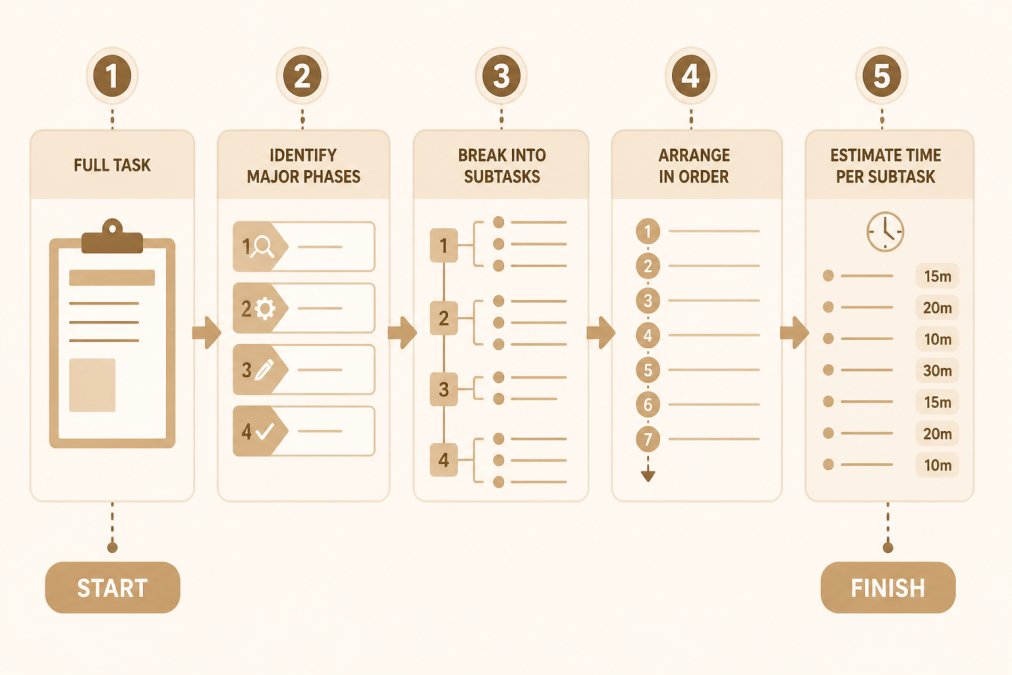
The Subtask Method: Making Tasks Feel Manageable
The subtask method is simple: break your task into the smallest possible steps, so small each feels doable even when you are tired, anxious, or stuck.
Write down your main task, then ask: what has to happen first?
Not the whole thing. Just the first small thing.
Then ask: what happens after that?
Keep going until you have a list of tiny steps. Each step should take 5 to 15 minutes.
Example: "Write a report"
ADHD Focus & Deep Work System: Task Initiation Planner →
Instead of that, you have:
- Open the template and read the instructions (5 minutes)
- Write down the three main points you want to cover (10 minutes)
- Write the first section without editing (15 minutes)
- Write the second section without editing (15 minutes)
- Write the third section without editing (15 minutes)
- Read through once and fix obvious errors (10 minutes)
- Send it (2 minutes)
Now you know how to start tasks when paralyzed by size: the task is not "write a report" but "open the template." That is doable.
Practical Examples: Different Task Types
The breakdown method works differently depending on what kind of task you are doing. Here are real examples:
Email task: "Respond to 10 emails"
Smaller steps:
- Open your email and read the first three emails (5 minutes)
- Write responses to those three (15 minutes)
- Read the next three and write responses (15 minutes)
- Read the last four and write responses (20 minutes)
- Proofread and send all (5 minutes)
Cleaning task: "Clean the kitchen"
Smaller steps:
- Clear the counters into a pile on the table (10 minutes)
- Load the dishwasher (10 minutes)
- Wipe down the counters (10 minutes)
- Put things back where they belong (10 minutes)
- Sweep (5 minutes)
Creative task: "Design a social media post"
Smaller steps:
- Gather three images you might use (10 minutes)
- Write three different headlines (10 minutes)
- Pick one image and one headline (5 minutes)
- Write the caption (15 minutes)
- Review and post (5 minutes)
The pattern is always the same: break the big task into phases, then each phase into steps you can do in one sitting.
How to Overcome Task Paralysis With Structure and Support
Knowing how to break down a task is half the battle. The other half is creating conditions that make starting easier through structure and support.
Body Doubling for ADHD: Why Working Alongside Others Helps
Body doubling is when you work alongside someone else, even if you are working on different tasks. Their presence makes starting easier and keeps you moving.
Why does this work? Someone else's presence creates external accountability, so you cannot disappear into avoidance as easily. Your nervous system feels safer, and having a witness often gives you permission to be imperfect.
The person does not need to talk to you or help you. They just need to be there.
The Pomodoro Technique for ADHD: Structured Breaks That Work
The Pomodoro Technique is a time-based structure: work for 25 minutes, take a 5-minute break, repeat. After four cycles, take a longer break.
For people with task paralysis, this works because:
- The time limit makes the task feel finite. You are not committing to hours. You are committing to 25 minutes.
- Breaks give your brain permission to rest. You do not have to push through. You get to stop.
- The structure removes decision-making. You do not have to decide when to work or when to rest. The timer decides.
Start your timer. Work until it goes off. Then rest. That is it.
External Accountability and Cues
Accountability works best when it is gentle and specific, not harsh or vague.
Check in after you start: "I just started. I will update you in 30 minutes." This creates a small external reason to keep going.
Use environmental cues to remind yourself: a sticky note on your monitor, a specific playlist that signals work time, a particular chair where you do focused work.
When Common Strategies Fail: What to Try Next
Sometimes the obvious fixes do not work. You have broken the task down, tried body doubling, set a timer, and you are still stuck.
This usually means the barrier is deeper than you thought, or you need a different approach for your situation.
If you are stuck despite trying these strategies, ask yourself:
- Is the barrier emotional (fear, shame, perfectionism) rather than practical? If so, focus on self-compassion and smaller first steps, not just task breakdown.
- Is your energy genuinely too low? If so, the answer might be rest, not more strategies. Try again tomorrow.
- Is there a competing priority that is drowning this task out? If so, address the competing priority first or reduce the scope of this task.
- Do you need professional support? If executive dysfunction, anxiety, or depression is severe, talking to a therapist or doctor might be the actual fix.
There is no shame in needing different help. Task paralysis is often a signal that something needs to change: your approach, environment, workload, or support system.
Building a System That Actually Works for You
The strategies above work in the moment. But to truly overcome task paralysis, you need a system that supports you every day.
This system should include:
- A way to track what needs to happen so it is not all in your head
- A way to break tasks down before you get stuck
- A way to schedule focused work time without overwhelming yourself
- A way to notice what helps so you can repeat it
- Permission to start over whenever you need to
This is exactly what the Anchor Grove Studio ADHD Focus & Deep Work System is designed for.

The system is built for imperfect days. You do not have to execute it perfectly, just use it when you need it.
Task paralysis is not a personal failure.
When you are ready to build a system that actually works with your brain, the ADHD Focus & Deep Work System from Anchor Grove Studio gives you everything you need to plan a realistic work session, break tasks into manageable steps, and notice what helps you focus.
Frequently Asked Questions
What's the difference between task paralysis and procrastination?
Task paralysis is a cognitive freeze where your brain cannot initiate action, even though you want to start. Procrastination is deliberate delay despite knowing the consequence. With task paralysis, the barrier is neurological (executive dysfunction, overwhelm, anxiety); with procrastination, it's often emotional avoidance. You might feel paralyzed by a task while procrastinating on another. Task paralysis feels involuntary; procrastination feels like a choice you're making.
How can body doubling for ADHD help me start tasks when paralyzed?
Body doubling, working alongside someone else, even silently, activates your brain's social accountability system and reduces executive load. The presence of another person creates external structure and motivation without judgment. You don't need conversation; a friend on a video call, a coworking session, or even a virtual body-doubling community can work. Many people find they can initiate tasks in body-doubling that feel impossible alone.
What should I do first when I feel completely frozen before a task?
Name what you're experiencing (overwhelm, anxiety, decision fatigue, low energy), then reset your nervous system with a 2-minute break: step outside, splash cold water on your face, do 10 deep breaths, or move your body. Next, identify the real barrier: Is it unclear where to start? Too much at once? Fear of failure? Distractions? Once you know the barrier, you can pick the right strategy. Finally, make the first step absurdly small, even just opening the document counts.
Is task paralysis the same as ADHD?
Task paralysis is not exclusive to ADHD, but it's very common in ADHD due to executive dysfunction, working memory challenges, and difficulty with task initiation. Anxiety, depression, overwhelm, perfectionism, and trauma can also cause task paralysis. If you suspect ADHD, speak with a healthcare provider. Regardless of cause, the reset and breakdown strategies in this guide can help you move forward.