
Managing Productivity with Energy Fluctuations: 7 Steps
Table of Contents
- Why Energy Fluctuations Break Traditional Productivity Systems
- How to Track Daily Energy Levels Without Adding Another Chore
- Task Initiation Strategies for Low-Energy Mornings and Afternoons
- The Best Habit Trackers for People Whose Energy Changes Daily
- Matching Tasks to Energy: A Four-Tier Framework
- Neurodivergent Energy Management: ADHD, Autism, and Chronic Fatigue
- Digital Environment Changes That Protect Your Focus
- Common Mistakes When Managing Productivity with Energy Fluctuations
- Frequently Asked Questions
Last Updated: September 11, 2026
Why Energy Fluctuations Break Traditional Productivity Systems
Managing productivity with energy fluctuations starts with accepting a hard truth: your output was never going to be flat, no matter how disciplined you are. Energy fluctuations are the natural rises and dips in your physical and mental capacity across a day, and they follow predictable biological patterns rather than failures of willpower. This guide walks through a system for planning around those shifts instead of fighting them.
Most productivity advice assumes you wake up at the same capacity every morning. You don't. Your biological clock regulates alertness, digestion, and focus on a roughly 24-hour loop, which means a task that takes twenty minutes at your peak can take two hours at your trough. When a rigid system demands the same output at 7 a.m. and 3 p.m., it sets you up to fail on schedule.
That's the core problem with streak-based planners and color-coded calendars. They measure consistency, not capacity.
How to Track Daily Energy Levels Without Adding Another Chore
Tracking works when it takes under sixty seconds. Rate your energy from 1 to 10 three times a day, morning, afternoon, and evening, and note it somewhere you already look, like a phone note or the margin of a paper planner. That's the whole system.
A common mistake is building an elaborate spreadsheet with fourteen columns. Nobody sustains that past week one.
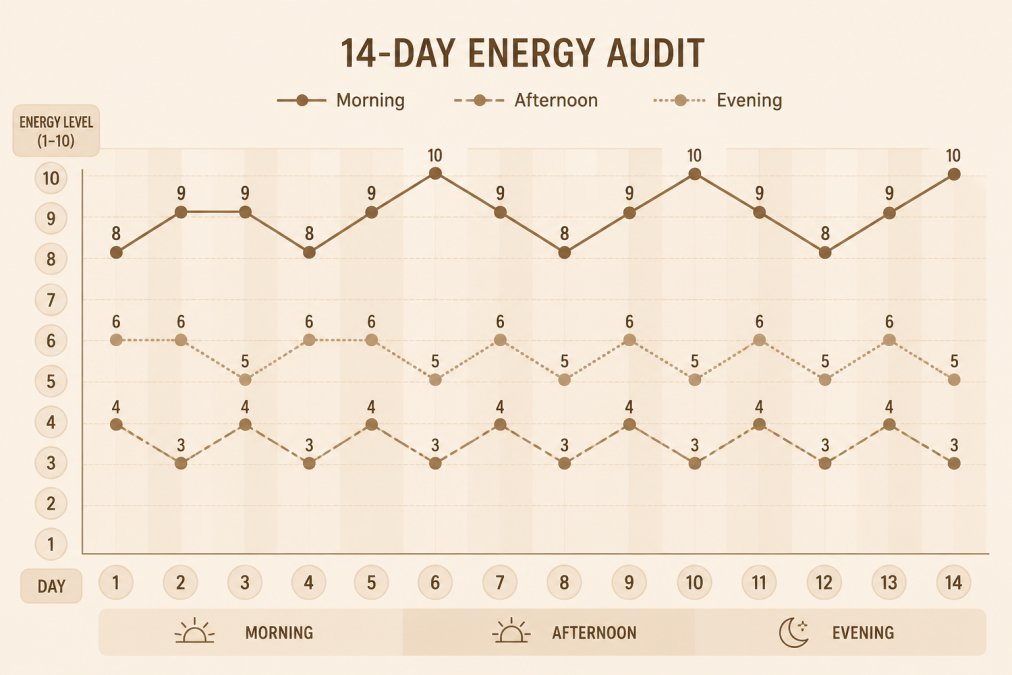
A Simple 14-Day Energy Audit
Run this for two weeks before changing anything else:
- Pick three fixed check-in times: after waking, after lunch, before bed
- Rate energy 1-10 at each check-in
- Write one word about what you were doing
- At day 14, look for repeating high and low windows
- Circle the two hours where your ratings were highest most often
Those circled hours are your peak performance window. Protect them. The lowest-rated window is where you schedule admin, not deep work.

Task Initiation Strategies for Low-Energy Mornings and Afternoons
Starting is the hardest part, and it gets harder when energy is low. The fix is lowering the activation cost of the first step until it's almost embarrassing.
The ADDitude resource center on executive function explains that task initiation depends on the brain's ability to bridge intention and action, which is why "just start" advice fails so often.
The Two-Minute Entry Point
Define a first step so small it takes under two minutes. Not "write the report." Open the document and type the title. Not "clean the kitchen." Put five dishes in the sink.
Once you're in motion, continuing is easier than starting. If you stop after two minutes, you still broke the freeze.
The Best Habit Trackers for People Whose Energy Changes Daily
The best habit trackers for variable energy are the ones that don't punish a missed day. Look for undated layouts, no streak counters, and the ability to restart mid-week without losing progress.
The ADHD Focus & Deep Work System: Task Initiation Planner is built around the moment between "I need to do this" and taking the first step, with no rigid streaks to break. If you prefer paper, the Printable ADHD Planner is undated and reprintable, so an off day costs you nothing.

| Tracker Type | Best For | Restart Friendly | Format |
|---|---|---|---|
| Undated printable planner | Paper-based routines | Yes, reprint any page | |
| Digital tablet planner | Stylus users | Yes, duplicate pages | |
| Notion template | Desktop workflows | Yes, no streaks | Notion |
| Streak-based app | Fixed daily habits | No, resets on miss | App |
Matching Tasks to Energy: A Four-Tier Framework
Match the task to the energy you actually have, not the energy you wish you had. Sort everything you do into four tiers, then assign each tier to a matching window. The tiers are the easy part. The hard part is the mapping, so here is the full mechanism.
- Tier 1, Deep work: Writing, coding, complex decisions, anything where a single interruption costs you more than the task itself. Needs your peak window.
- Tier 2, Focused admin: Email, scheduling, invoices, short calls. Needs moderate energy and tolerates interruption.
- Tier 3, Mechanical tasks: Filing, tidying, data entry, laundry. Works at low energy and even benefits from a wandering mind.
- Tier 4, Restorative: Rest, a walk, a snack, a nap. Non-negotiable, not a reward.
Why the Tiers Work: Ultradian Rhythms
Your day is not one long curve. It is a stack of roughly 90-minute cycles called ultradian rhythms, and within each cycle your focus rises, peaks, and falls before your body signals a need to recover. Within each cycle your focus rises, peaks, and falls before your body signals a need to recover. That is why the same Tier 1 task that flies at 9 a.m. can stall at 2 p.m. even if you slept well.
The Sleep Foundation's guidance on circadian rhythm notes that alertness follows a predictable daily curve, which is why the same task lands differently at 9 a.m. and 3 p.m. Ultradian rhythms sit on top of that curve and explain the shorter dips inside each window.
Strategic Task Batching
Batching is not just grouping similar tasks. It is grouping tasks that share the same energy tier so you stop paying the switching cost between them. A common pattern is to batch all Tier 2 admin into one 45-minute block after lunch, when your focus is too shallow for deep work but too alert for filing. Save Tier 3 for the late-afternoon trough, when folding laundry or clearing a downloads folder is genuinely the best use of a tired brain.
A simple rule: never put a Tier 1 task next to a Tier 3 task in the same block. The mental gear change costs more than either task alone.
A Worked Example
Say your 14-day audit shows a peak from 8:30 to 10:30 a.m. and a trough from 1:30 to 3 p.m. Your day might look like this:
| Window | Energy | Tier | Example |
|---|---|---|---|
| 8:30-10:30 a.m. | Peak | Tier 1 | Draft the proposal, no meetings |
| 10:30-11 a.m. | Recovery | Tier 4 | Walk, water, no screens |
| 11 a.m.-12 p.m. | Moderate | Tier 2 | Email, scheduling, quick calls |
| 1:30-3 p.m. | Trough | Tier 3 | File receipts, tidy desk, data entry |
| 3-3:30 p.m. | Recovery | Tier 4 | Snack, stretch |
| 3:30-5 p.m. | Moderate | Tier 2 | Follow-ups, planning tomorrow |
Notice that nothing important is scheduled in the trough. That is the whole point. A plan that respects the trough beats a plan that pretends it does not exist.
When to Break the Framework
Rigid tiering fails on days when your energy never rises above a 5. On those days, drop Tier 1 entirely and run a Tier 2 and Tier 3 day. The framework is a sorting tool, not a contract. The goal is to stop wasting your best hours on your worst tasks, and to stop judging a trough day by peak-day standards.
Neurodivergent Energy Management: ADHD, Autism, and Chronic Fatigue
Standard energy advice often assumes a neurotypical baseline that doesn't apply. For ADHD, autism, and chronic fatigue, energy dips can be steeper, less predictable, and tied to sensory load or cognitive load rather than time of day.
The CDC overview of ADHD describes ADHD as a persistent pattern affecting attention and organization, which makes rigid systems a poor fit. Build in more slack than feels reasonable. A plan with three priorities beats a plan with twelve.
If you're recovering from illness, treat capacity as something that rebuilds slowly, and expect setbacks without treating them as failure.
Digital Environment Changes That Protect Your Focus
Your devices drain energy before you've done any work. Notifications, open tabs, and cluttered desktops all add cognitive load, and every glance at a badge costs you a few minutes of refocusing.
A common mistake is trying to fix this with willpower. Change the environment instead.
- Turn off all non-human notifications
- Close tabs you aren't using right now
- Move your phone to another room during Tier 1 work
- Use one browser window per task
- Set a timer so context switching has a boundary
Common Mistakes When Managing Productivity with Energy Fluctuations
The biggest mistake is treating a low-energy day as a moral failure. It isn't. It's data. Here are some common traps that show up most often.
A Five-Minute Diagnostic
Answer these four questions honestly. Each one points to a specific fix.
- Did you build your plan for your best day? If yes, you are judging yourself by a standard you only hit twice a week. Fix: plan for a 6-out-of-10 day and treat peaks as bonus time.
- Are you scheduling deep work during your natural trough? If yes, you are fighting biology. Fix: move Tier 1 tasks to your audited peak window, even if that means rearranging meetings.
- Does your tracker reset when you miss a day? If yes, you are punishing yourself for having a body. Fix: switch to undated or no-streak formats.
- Are you copying someone else's routine? If yes, you are running their energy curve on your hardware. Fix: run your own 14-day audit before adopting any system.
The Traps That Cost the Most
- Building a plan for your best day, then judging yourself by it on your worst. This is the single most common pattern, and it turns a normal trough into evidence that you are failing.
- Scheduling deep work during your natural trough. A task that takes twenty minutes at peak can take two hours at trough. The math never works in your favor.
- Skipping restorative breaks because they feel unproductive. Tier 4 is not a reward. It is the input that makes the next Tier 1 block possible.
- Using streak counters that reset and erase your progress. A broken streak teaches you nothing about your energy. It only teaches you to avoid the tracker.
- Treating a low day as a character flaw instead of a data point. The audit exists so you can see the pattern, not so you can grade yourself against it.
The Neurodivergent Angle Most Advice Misses
If you have ADHD, autism, or a chronic illness, the standard advice assumes a baseline you may not have. Energy dips can be steeper, less predictable, and tied to sensory load or cognitive load rather than time of day. A meeting that costs a neurotypical worker a 3 out of 10 might cost you a 7. That is not a discipline problem. It is a different energy curve, and it needs a different plan.
The CDC overview of ADHD describes ADHD as a persistent pattern affecting attention and organization, which makes rigid systems a poor fit. Build in more slack than feels reasonable. A plan with three priorities beats a plan with twelve. And if you are recovering from illness, treat capacity as something that rebuilds slowly, and expect setbacks without treating them as failure.
The National Institute of Mental Health notes that sleep, stress, and physical health all shape daily functioning, so energy management is partly a health question, not just a scheduling one. That is why the diagnostic above starts with your plan, not your willpower.
Frequently Asked Questions
What time of day are energy levels highest?
Most adults hit their first energy peak two to four hours after waking, when core body temperature and cortisol are rising. A second, smaller peak often arrives in the late afternoon. These patterns shift with sleep debt, meals, and illness, so the only reliable answer is your own data. Run a 14-day energy audit, rating your focus at three fixed points each day, and you will see your personal curve instead of guessing from averages.
How do I track energy levels for better productivity without turning it into a project?
Use three fixed check-ins: one hour after waking, after lunch, and mid-evening. Rate focus from 1 to 10 and note one word about what you ate, how you slept, or what you were doing. That is it. Ten seconds per check-in. After two weeks, look for patterns: which tasks consistently land on low-energy days, and which hours reliably produce your best work. Then schedule your hardest tasks into those hours and stop fighting the rest of the day.
What are the best habit trackers for someone with ADHD and unpredictable energy?
The best habit trackers for ADHD brains avoid streak-based pressure, which tends to trigger abandonment after one missed day. Look for trackers that let you log a partial win, reset without losing history, and view a week at a glance rather than a rigid daily checklist. A paper or digital planner with an undated weekly layout works well because you can start over on any page. The ADHD Planning & Focus Bundle at Anchor Grove Studio includes printable, digital, and focus tools built around this exact approach.
What are signs of energy burnout versus a normal low-energy day?
A normal low-energy day recovers after sleep, food, or a break. Burnout does not. Watch for three or more consecutive weeks of feeling drained after adequate rest, losing interest in work you used to find easy, and needing more time to recover from routine tasks. If low energy is paired with sleep problems, irritability, or a sense that nothing you do helps, that is a signal to talk to a healthcare provider rather than push through with another productivity system.