
Why Time Blocking Fails for ADHD Brains
Table of Contents
- Why Traditional Time Blocking Fails for ADHD Brains
- Executive Function, Dopamine, and Why Schedules Feel Impossible
- The Shame Cycle: How Time Blocking Backfires
- Time Blindness Strategies That Actually Work
- Building an ADHD-Friendly Daily Schedule Template
- ADHD Task Initiation Tips for Getting Started
- Alternatives to Rigid Time Blocking
- Frequently Asked Questions
Last Updated: September 27, 2026
Why Traditional Time Blocking Fails for ADHD Brains
Time blocking sounds perfect on paper: pick a task, assign a time slot, focus for that duration. But for ADHD brains, this rigid structure backfires because it ignores how your executive function actually operates.
Why time blocking fails for ADHD brains comes down to one fundamental mismatch: the system assumes you can estimate time accurately, start tasks on cue, and maintain consistent energy throughout the day. None of those assumptions hold true for most people with ADHD.
This guide breaks down why time blocking fails for ADHD brains and what actually works instead.
Executive Function, Dopamine, and Why Schedules Feel Impossible
Executive function helps you plan, organize, and follow through on tasks. For people with ADHD, this system runs on inconsistent dopamine availability, so your ability to start tasks, estimate time, and maintain focus fluctuates unpredictably.
When dopamine is low, a task that felt manageable yesterday feels impossible today. Time blocking assumes steady motivation and focus, ignoring that your energy and task initiation ability changes hour to hour.

Time Blindness and the Planning Fallacy
Time blindness, difficulty perceiving how much time has passed or how long a task will take, is acute for most people with ADHD. You sit down for 30 minutes and three hours vanish, or a task you estimate at one hour takes five.
Time blocking requires accurate duration prediction, but ADHD brains don't process time that way. The planning fallacy compounds this: you estimate optimistically, block insufficient time, then feel shame when you miss the deadline.
Energy Fluctuations and Cognitive Load
ADHD brains don't operate at consistent energy levels. You might have strong executive function in the morning and hit a wall by afternoon, or need movement and stimulation to access focus.
Time blocking ignores energy fluctuations. It says "Do this task from 2 PM to 3 PM" without asking whether your brain has dopamine availability at that moment. On low-energy days, the entire schedule collapses.
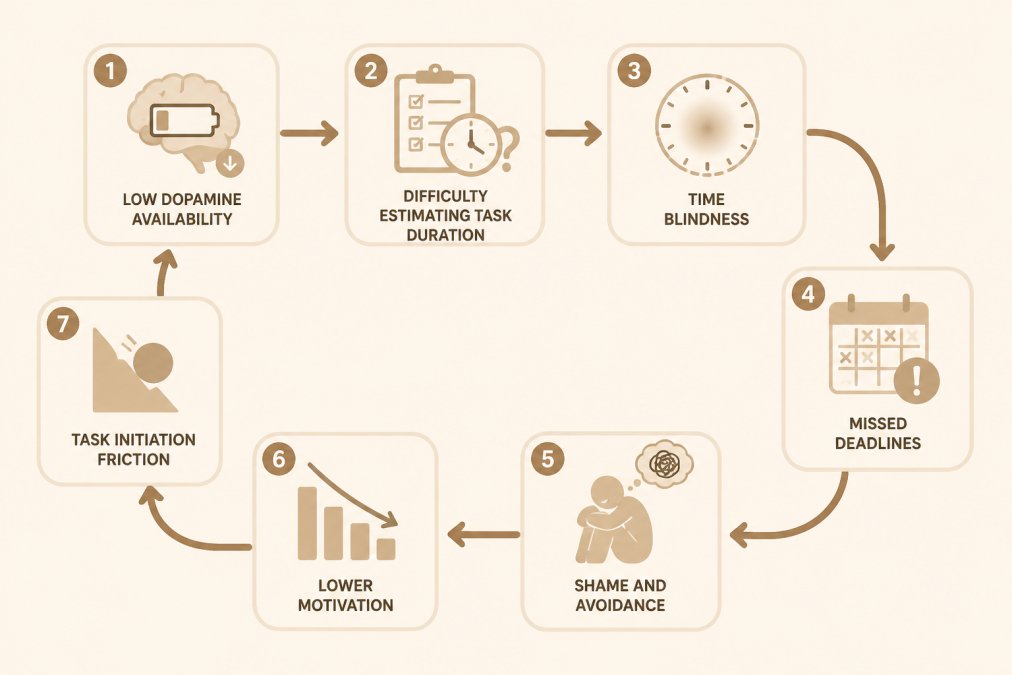
The Shame Cycle: How Time Blocking Backfires
Time blocking becomes actively harmful when you miss a block: you're not just disappointed, you're triggering nervous system responses that make future task initiation harder.
You set a 2 PM deadline. 3 PM arrives and the task isn't done. Your brain interprets this as inadequacy, and your nervous system shifts into threat mode. Repeatedly failing to meet externally imposed deadlines teaches your brain to associate task initiation with shame and failure, activating your sympathetic nervous system (fight-flight-freeze) rather than the parasympathetic calm you need to work.
This shame cycle is self-reinforcing: missed deadline → shame and threat response → task becomes associated with danger → harder task initiation → longer avoidance → deeper shame → eroded self-trust.
This cycle has nothing to do with capability or effort. A neurotypical brain misses a deadline and moves on. An ADHD brain, especially with rejection-sensitive dysphoria, internalizes it as character evidence. The shame becomes sticky.
Traditional productivity advice, "try harder," "build better habits," "use more discipline", deepens this cycle by reinforcing the false belief that the problem is willpower, not system design.
The real problem isn't effort or willpower, it's that the system was never designed for ADHD executive function. Shame-based productivity systems are particularly damaging because they set you up to "fail" against arbitrary deadlines instead of working with your actual neurology.
Time Blindness Strategies That Actually Work
Work with your time blindness, not against it. Visual timers are more effective than clock time because they give your brain external cues that time is passing, ADHD brains rely heavily on external structure and sensory feedback.
Externalizing time means moving time into the environment through alarms, notifications, and physical reminders. Set a timer before you start and another 5 minutes before you need to stop. The more your environment communicates time, the less you rely on internal perception.
Time-boxing differs from time blocking: instead of "work on this from 2 PM to 3 PM," try "work on this for one focused session." Focus on duration of effort, not clock time, removing deadline pressure and letting you work with your natural rhythm.
Building an ADHD-Friendly Daily Schedule Template
An ADHD-friendly schedule works with your brain instead of against it. It acknowledges energy fluctuations, builds in flexibility, and removes shame language.
Make Time Tangible and Externalizable
Write down 3-5 realistic priorities for the day, not 10, not an hour-by-hour breakdown. For each, note the task, first small step, estimated duration, and what you need to start. This removes deadline shame because the goal is "do these when your energy allows," not "complete these at specific times."
ADHD Focus & Deep Work System: Task →
Use Task Initiation Frameworks Instead of Clock Time
Task initiation is often harder than doing the task itself. Use these frameworks instead of time blocks: The two-minute floor (commit to just two minutes, starting is the hardest part), body doubling (work alongside someone for external accountability), temptation bundling (pair difficult tasks with enjoyable activities), and environmental setup (remove friction by preparing everything beforehand).
ADHD Task Initiation Tips for Getting Started
Task initiation is where most ADHD productivity systems fail. You know what needs to be done. You just can't seem to start.
Shrink the task. Break it into absurdly small pieces. Not "write the report," but "open the document and write the first sentence."
Create a starting ritual. Your brain needs a signal to switch into focus mode, making tea, a specific song, or moving to a different room. The ritual itself doesn't matter; consistency does.
Lower the stakes. Permission to do something imperfectly makes initiation easier.
Notice what conditions help you. Do you focus better with movement, background noise, in the morning or late at night? Pay attention to when you actually start and maintain focus, these are your conditions for success.
The ADHD Focus & Deep Work System: Task Initiation Planner includes a Focus Session Planner, Task-Initiation Toolkit with practical prompts, and a Deep Work Log to identify which conditions support your focus.
Alternatives to Rigid Time Blocking
These alternatives work better for ADHD brains because they remove the demand for accurate time prediction and accommodate inconsistent dopamine and executive function.
Energy-Based Scheduling
Energy-based scheduling organizes your day by dopamine availability and cognitive capacity, not clock time. Match task difficulty to your current neurological state.
Identify your natural energy peaks and valleys (high focus in the morning, crash after lunch, secondary peak in late afternoon, or your individual pattern). Then assign tasks by cognitive demand: high-energy windows for deep work and complex problem-solving, medium-energy for routine tasks and emails, low-energy for passive tasks or rest.
Unlike time blocking, you're not saying "do this from 2 PM to 3 PM." You're saying "when my energy is high, I'll tackle the hardest thing", whether that's 10 AM or 7 PM.
You're working with dopamine availability rather than against it.
Task-Based Planning
Task-based planning focuses on what needs to be done, not when. Maintain a prioritized list and work through tasks in whatever order feels manageable that day.
Rhythm-Based Planning
Rhythm-based planning replaces fixed schedules with repeating patterns. Instead of "Tuesday 2 PM is for deep work," you establish that Tuesdays are deep-work days, but the specific time and tasks stay flexible.
How it works: Assign themes or types of work to specific days of the week:
- Monday: Admin, planning, and setup
- Tuesday-Thursday: Deep work and priority tasks
- Friday: Review, reflection, and planning for next week
Or create a weekly rhythm around task types:
- Morning blocks: High-focus work
- Afternoon blocks: Meetings, collaboration, communication
- Evening blocks: Planning, reflection, or lighter tasks
The Dopamine Menu Approach
The Dopamine Menu is a curated list of activities, rewards, and sensory inputs that help regulate your dopamine and nervous system state. Unlike traditional reward systems ("finish the task, then treat yourself"), the Dopamine Menu is a toolkit for managing motivation and focus in real time.
- Instant dopamine hits (2-5 minutes): Music, a favorite snack, a few minutes of a game, a short walk, stretching, fidget tools
- Medium-engagement activities (10-20 minutes): A podcast episode, a favorite show, a creative hobby, body doubling, a call with a friend
- Movement and sensory regulation (5-15 minutes): Dancing, jumping, cold water on your face, a weighted blanket, a shower, time outside
- Social connection (10+ minutes): A text conversation, a call, working alongside someone, asking for accountability
Frequently Asked Questions
Why does time blocking fail for ADHD brains specifically?
Time blocking assumes stable executive function, accurate time perception, and consistent energy, none of which are reliable for ADHD brains. People with ADHD experience time blindness, making duration estimates wildly inaccurate. Rigid schedules also ignore dopamine availability fluctuations and task switching friction, which create burnout when you can't stick to the plan. The shame of missing blocks then makes the system feel impossible to return to.
What are effective time blindness strategies for ADHD?
Make time tangible and external rather than abstract. Use visual timers, alarm clocks, or physical objects that represent time passing. Break tasks into smaller, observable steps instead of estimating how long something will take. Build in buffer time between transitions. Track what actually happened (not what you planned) to recalibrate your perception over time. Anchor tasks to existing routines or external events rather than clock times, for example, 'after coffee' instead of '9:30 AM.'
What ADHD task initiation tips help when I can't seem to start?
Task initiation struggles stem from cognitive load and unclear starting points. Reduce friction by breaking the task into the smallest possible first step, not the whole project. Use body doubling (working near someone else, even virtually). Apply temptation bundling by pairing the task with something dopamine-rewarding. Write down exactly what 'starting' looks like: 'Open the document and write the first sentence,' not 'write the report.' Lower the bar for what counts as progress; done imperfectly beats perfect never.
Can I use an ADHD-friendly daily schedule template if my energy changes day to day?
Yes, if the template is built for flexibility. Look for systems that let you choose 2-3 realistic priorities instead of filling every hour, include a 'brain dump' space for thoughts without judgment, and don't penalize you for missed days. Templates that work with ADHD acknowledge that some days you'll have more bandwidth than others and let you reset without shame. The best ones are printable or editable so you can restart any week or day without guilt.