
7 Ways to Manage ADHD Task Paralysis
Table of Contents
- What Is ADHD Task Paralysis?
- 1. Break Tasks Into Micro-Steps
- 2. Use Body Doubling to Build Momentum
- 3. Apply Timeboxing and Timer-Based Focus
- 4. Create Pre-Start Rituals to Unfreeze
- Best Habit Trackers for ADHD Task Initiation
- ADHD Task Initiation Tips: Managing Executive Dysfunction
- Workplace Accommodations and Digital Tool Fatigue
- Frequently Asked Questions
Last Updated: October 3, 2026
What Is ADHD Task Paralysis?
ADHD task paralysis is the inability to initiate or begin a task despite knowing what needs to be done and having the capability to do it. Instead, it's an executive dysfunction symptom where the brain struggles to "unfreeze" and take that critical first step, even when the stakes feel high or the deadline is near.
This mental resistance creates a gap between intention and action. You might spend hours thinking about starting a project, organizing your workspace, or mentally rehearsing the steps, but the actual beginning never comes.
At Anchor Grove Studio, we've found that the most effective strategies don't rely on willpower or rigid productivity systems. Instead, they work with your brain's natural wiring by reducing cognitive load, breaking down the intimidation factor, and creating external structures that make starting feel manageable.
The good news: task paralysis is not a character flaw. It's a neurological pattern, and like all patterns, it responds to specific interventions. Below, we'll show you exactly how to recognize when you're stuck and seven practical ways to unfreeze and move forward.
1. Break Tasks Into Micro-Steps
The single most effective way to overcome ADHD task paralysis is to make the task smaller. Not just smaller, micro-sized. The goal isn't to complete the whole project; it's to eliminate the mental resistance around starting.
How Micro-Steps Work
When you face a large task, your brain perceives it as an enormous, undefined threat. This perception triggers executive dysfunction, which manifests as mental resistance. By breaking the task into absurdly small steps, you reduce the perceived scope to something your brain can process without freezing.
Instead of "write the report," your micro-steps might be: open the document, write one sentence, add three bullet points, format the header. Each step takes 2-5 minutes. The psychological shift is significant: a 90-minute project feels impossible; a 3-minute task feels doable.
A common mistake is breaking tasks into steps that are still too large. "Outline the project" is not a micro-step. "Write three bullet points for the intro" is. The specificity matters because it removes ambiguity, and ambiguity is what triggers the mental freeze.
The Two-Minute Floor
One of the most powerful micro-step tactics is the two-minute floor: commit to starting for just two minutes. Set a timer. Your only job is to begin and keep going for 120 seconds. You're not aiming to finish or even make meaningful progress. You're just breaking the inertia.
What happens next is often surprising. Once you start, momentum builds. The mental resistance that felt insurmountable before you began often dissolves once you're actually doing the work. The two-minute commitment is just the gateway. The real work happens after the freeze breaks.
2. Use Body Doubling to Build Momentum
Body doubling is one of the most underrated ADHD tools for managing task paralysis. It's simple: work alongside another person, even if you're not working on the same task. Their presence provides external accountability and regulates your nervous system, making it easier to initiate and maintain focus.
The mechanism isn't about motivation or judgment. Body doubling works because ADHD brains often struggle with self-regulation and task initiation when working in isolation.
You can body double in person, over video call, or even asynchronously in a shared workspace. Some people find that sitting near a friend while working is enough.
A common barrier is the shame around needing support. But body doubling isn't weakness, it's a strategic accommodation that works with your neurobiology rather than against it. Many high-performing ADHD professionals rely on it regularly.
3. Apply Timeboxing and Timer-Based Focus
Timeboxing is the practice of assigning a fixed time block to a task, then working within that boundary. For ADHD brains, this creates two powerful effects: it reduces the perceived scope (you're not working indefinitely, just 30 minutes), and it provides external structure that compensates for weak internal time management.
Timer-based focus works best when you pair it with realistic time estimates. Most ADHD adults struggle with time blindness, the inability to accurately perceive how long tasks take. This leads to underestimating complexity and overcommitting, which feeds the paralysis cycle.
Start by setting a timer for a short, achievable window: 15 or 25 minutes. Work until the timer sounds, then take a break. The break is crucial, it gives your dopamine system a reset and prevents burnout.
4. Create Pre-Start Rituals to Unfreeze
Pre-start rituals are deliberate actions you perform immediately before beginning a task. They serve as a neurological signal to your brain that work is about to start, which helps transition from the paralysis state to action.
Examples of effective pre-start rituals include: making tea, doing five minutes of stretching, playing a specific song, changing locations, or writing down three reasons why the task matters.
The ritual works because it creates a predictable transition. Your brain learns that "when I do X, work begins." This reduces the ambiguity and mental friction around the initiation moment.
Many people find that pairing a ritual with body doubling amplifies the effect. You and your accountability partner both perform your rituals, then begin work together. The combination of external structure and internal signal is powerful.
Best Habit Trackers for ADHD Task Initiation
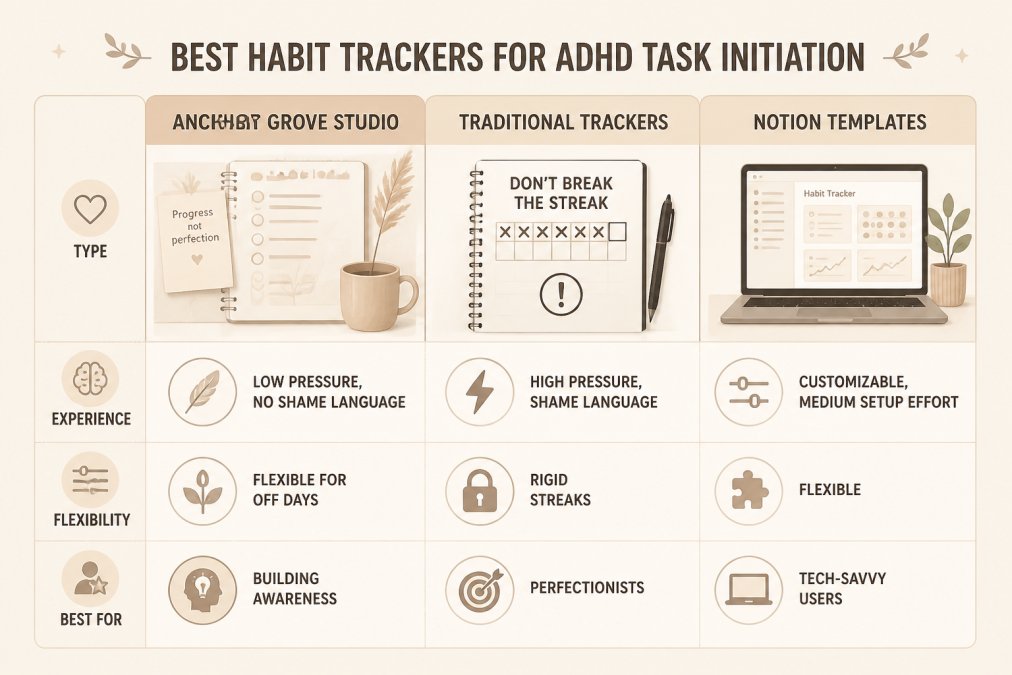
Habit trackers designed specifically for ADHD look and function differently from traditional trackers. The key difference: they're built without shame language, rigid streaks, or all-or-nothing thinking.
Why Habit Trackers Matter for Task Paralysis
Tracking your progress on task initiation, not perfection, but initiation, creates visibility into patterns. You start to notice which pre-start rituals actually work for you, which times of day your executive function is strongest, and what conditions support your focus.
ADHD Focus & Deep Work System: Task Initiation Planner →
A tracker becomes a feedback tool rather than a judgment tool. Instead of "I failed because I didn't work for 8 hours," you notice "I initiated three times this week, and I worked longest when I used body doubling in the afternoon." That's actionable data.
Low-Pressure Tracking Without Shame
The Anchor Grove Studio approach to habit tracking is fundamentally different from mainstream productivity tools. Our trackers don't penalize missed days or create streaks that feel like a debt you owe. Instead, they're designed around noticing patterns and celebrating small wins.
When you miss a day, and you will, because you're human, the tracker doesn't shame you. You simply start again the next day. No "failed streak," no guilt spiral, no motivation drain. This matters because shame is one of the biggest drivers of the paralysis cycle.
The Anchor Grove Studio Printable ADHD Planner includes a low-pressure habit tracker that lets you notice patterns without grading your performance. It's built on the principle that consistency matters more than perfection, and that noticing what helps is more valuable than hitting an arbitrary number.
ADHD Task Initiation Tips: Managing Executive Dysfunction
Executive dysfunction is the umbrella term for struggles with planning, organizing, initiating, and sustaining focus. Task paralysis is one manifestation. The strategies that help with paralysis also address the broader executive dysfunction pattern.
Physiological Regulation Before Starting
One overlooked factor in task paralysis is your nervous system state. When you're dysregulated, anxious, overstimulated, or depleted, your brain's ability to initiate tasks drops sharply. Before you try to start, regulate your nervous system.
This might mean: taking three deep breaths, doing two minutes of movement, drinking water, or stepping outside for fresh air. These aren't productivity hacks. They're neurological resets that restore your capacity for executive function.
Many people find that specific sensory inputs help. Some need stimulation (music, movement, caffeine). Others need calming (quiet, dimmed lights, weighted blankets). Noticing your own pattern is the first step.
Post-Paralysis Recovery and Self-Compassion
After a period of task paralysis, many people experience a crash. The guilt, anxiety, and shame around the delay create a secondary emotional burden that can last days. This is where self-compassion becomes a practical tool, not just feel-good language.
Self-compassion in this context means acknowledging the difficulty without judgment: "I struggled with this task. That's a real part of ADHD. It's not a character flaw." This simple reframe reduces the emotional aftermath and makes it easier to approach the next task without the weight of shame.
A practical way to build this habit is to include a brief reflection in your tracking system. After you initiate a task, even if you only worked for five minutes, write down one thing that helped and one thing you'll adjust next time.
Workplace Accommodations and Digital Tool Fatigue
If you're managing ADHD task paralysis in a work environment, formal accommodations can make a significant difference.
Digital tool fatigue is also real. Many ADHD professionals find that juggling multiple apps, email, project management, communication platforms, calendar, creates so much cognitive load that task initiation becomes even harder. The solution isn't more tools.
Choose one or two core tools and stick with them. The Anchor Grove Studio ADHD Focus & Deep Work System is designed as a single entry point for task initiation and focus planning, reducing the need to context-switch between multiple platforms.

The same principle applies to your personal system. If you're using five different trackers, three planning apps, and scattered notes, your brain is spending energy on navigation rather than work. Consolidate to one system you trust and can return to consistently.
ADHD task paralysis responds to specific, practical interventions, not to motivation, shame, or willpower.
The most sustainable approach is one that works with your brain rather than against it.
Frequently Asked Questions
What is ADHD task paralysis?
ADHD task paralysis is when your brain freezes before starting a task, even when you know what needs to be done and want to do it. This executive dysfunction creates a gap between intention and action. It's not laziness, it's a neurological response where your ADHD brain struggles with task initiation, often triggered by perceived difficulty, time blindness, or sensory overload. Micro-steps and external accountability (like body doubling) help bridge that gap.
How do you break through ADHD task paralysis quickly?
Use the two-minute floor: commit to just two minutes of work, not the whole task. Set a timer, use body doubling (work alongside someone), or create a pre-start ritual like a specific song or movement. These techniques lower the mental resistance by making the first step feel manageable. Many people find that starting is the hardest part; momentum builds once they begin.
What are the best habit trackers for ADHD?
Look for trackers that avoid shame language, allow flexibility for off days, and focus on noticing patterns rather than demanding perfect streaks. The Printable ADHD Planner ($22) includes a low-pressure habit tracker designed specifically for ADHD brains. The ADHD Planning & Focus Bundle ($52) combines planning with a focus system for task initiation support. Both prioritize grace over perfection, letting you restart any week without guilt.
Why does body doubling help with ADHD task paralysis?
Body doubling works because the presence of another person (physically or virtually) creates external accountability and reduces the cognitive load of self-regulation. Your ADHD brain doesn't have to generate all the motivation alone. Whether it's a coworker in the same room, a video call, or even someone working silently nearby, the effect is real: intrusive thoughts quiet down and momentum becomes easier to find.
Can I use digital tools to manage task paralysis if I have ADHD?
Yes, but choose tools carefully to avoid digital tool fatigue. The ADHD Focus & Deep Work System ($16) provides a structured yet flexible approach with a Focus Session Planner and Task-Initiation Toolkit. The key is selecting tools that feel calm, not overwhelming. Notion templates like the ADHD Life Dashboard ($26) let you customize your workspace without rigid structures, reducing the mental resistance that often triggers paralysis.