
Executive Dysfunction and Task Initiation: Why Starting Is Hard
Table of Contents
- What Executive Dysfunction Actually Is
- The Neurobiology Behind Task Initiation Failure
- ADHD Task Paralysis: When Knowing What to Do Isn't Enough
- Why Simple Tasks Feel Overwhelming
- Executive Dysfunction Strategies That Actually Work
- ADHD-Friendly Productivity Tools That Support Task Initiation
- Moving From Paralysis to Action
- Frequently Asked Questions
Last Updated: October 1, 2026
What Executive Dysfunction Actually Is
Executive dysfunction involves difficulty with task initiation, planning, and executing tasks, even when you know exactly what needs to be done and have the ability to do it. Executive dysfunction task initiation is the core struggle: knowing what to do but being unable to start. It's not laziness. It's not a lack of motivation. It's a neurological gap between intention and action.

The problem isn't understanding the task, it's the gap between knowing what to do and actually starting. You might spend an hour staring at a blank email, knowing exactly what to write, unable to type the first sentence. That stuck feeling is executive dysfunction at work.
This is especially common in people with ADHD, but it also shows up in depression, anxiety, chronic illness, and burnout. The experience is universal: you want to start, you know what starting looks like, and your brain simply won't cooperate. According to research on executive function from the National Institute of Mental Health, executive dysfunction affects how your brain manages working memory, impulse control, and task switching, the exact systems you need to bridge that gap between intention and action.
The Neurobiology Behind Task Initiation Failure
Understanding the neurobiology helps you stop blaming yourself and start working with your brain instead of against it.
Dopamine and the Activation Energy Problem
When dopamine levels are low or dysregulated, your brain struggles to initiate action, especially for tasks without immediate reward. This is the activation energy problem.
Think of activation energy like the push needed to get a boulder rolling downhill. In ADHD brains, that first push feels disproportionately high, a task that should feel like a small nudge feels like moving a boulder by hand.
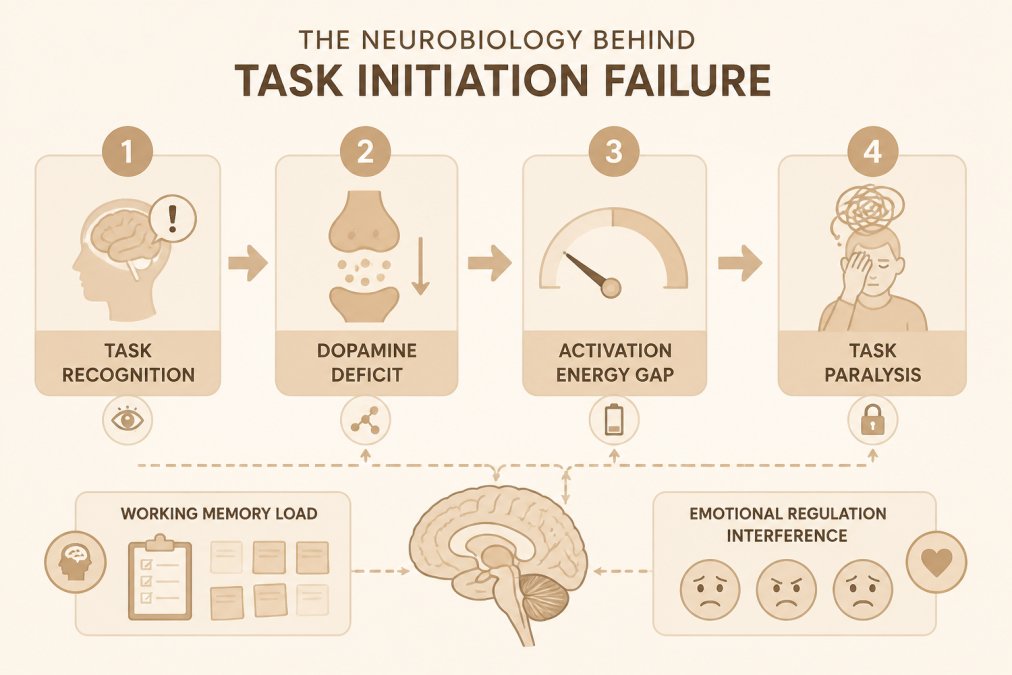
You might hyperfocus on something interesting for six hours straight, but a boring task? Your brain doesn't produce enough dopamine to make starting feel possible. This is why people with ADHD can spend three hours on a hobby but can't start a work email.
Working Memory and Task Ambiguity
When working memory is strained, even simple tasks feel overwhelming because you can't hold all the necessary information at once.
A vague task like "work on the project" requires your working memory to fill in missing details: what part? In what order? What counts as done? Your brain must generate structure while initiating action, a cognitive load that triggers paralysis.
A specific task, "Write the first three bullet points of the project outline", requires far less working memory because the structure is already there. You're not deciding what to do; you're executing a clear instruction.
ADHD Task Paralysis: When Knowing What to Do Isn't Enough
ADHD task paralysis is when the gap between knowing and doing feels impossible to cross. You understand the task and have the skills, yet cannot start.
The Transition Barrier
One of the most underestimated obstacles is the transition itself, the moment between one activity and another. For ADHD brains, this transition is not smooth; it feels like friction.
You might be scrolling your phone and know you need to switch to work. Your brain resists the shift, not because you're unmotivated, but because disengaging from one state and engaging another is neurologically difficult.
Reduce friction with a two-minute buffer activity: stretching, drinking water, or changing location. Some use a "launch ritual", the same three actions before focused work, so your brain learns the pattern and transitions more smoothly.
Perfectionism and Fear of Failure
Executive dysfunction often pairs with perfectionism and fear of failure. If you're afraid of imperfection or failure, your brain uses task avoidance as protection.
For people with ADHD who've experienced shame around productivity, your brain learned that attempting is risky, so it shuts down task initiation as protection.
The perfectionism loop: task feels important → worry about imperfection → stakes feel high → paralysis → avoidance → shame → task feels harder next time. Breaking this cycle requires permission to do the task badly or incompletely. Most tasks need completion, not perfection.
Why Simple Tasks Feel Overwhelming
The cruelest part of executive dysfunction task initiation is that simple tasks often feel harder than complex ones. A five-minute email feels impossible while a two-hour creative project feels manageable.
The Novelty and Stimulation Gap
Simple, routine tasks lack neurological stimulation. Your brain doesn't register them as "worth doing" because they don't trigger dopamine. Complex tasks with uncertainty and novelty naturally activate reward pathways.
ADHD Focus & Deep Work System: Task Initiation Planner →
This is why people with ADHD can hyperfocus on a hobby for six hours but can't send a work email. Your brain is accurately reading the email as low-stimulation and deprioritizing it.
The Shame Amplification Loop
A second layer makes simple tasks uniquely paralyzing: shame. When a task feels trivial, shame activates, and the gap between simplicity and inability feels like personal failure.
Shame suppresses dopamine further, creating a loop: task feels trivial → shame activates → dopamine drops → task feels more impossible → avoidance increases → shame deepens.
Simple tasks accumulate because avoidance adds shame. By day three, the task becomes emotionally loaded, the psychological weight multiplies even though the task hasn't changed.
The Physiological Experience of Overwhelm
When you're facing a simple task that feels overwhelming, your body often registers this as a genuine threat. You might notice:
- Physical tension: Tightness in your chest, shoulders, or jaw as your nervous system prepares for a task that feels disproportionately hard
- Mental fog: A sensation of your thinking becoming cloudy or slow, even though the task requires minimal cognitive effort
- Restlessness: An urge to do anything except the task, checking your phone, reorganizing, starting a different activity
- Fatigue: A sudden heaviness or exhaustion that appears unrelated to physical exertion
These aren't signs of laziness. They're signs of your nervous system in a state of resistance. Your body is responding to the psychological weight of the task, not its actual difficulty. This is why rest alone doesn't help; the problem isn't that you're tired. The problem is that your system is in avoidance mode.
Why Complex Tasks Feel Easier
Complex tasks feel easier because they bypass the shame loop. When a task is genuinely difficult, your brain doesn't blame you for struggling. The difficulty is obvious and external. You're not comparing yourself to an impossible standard; you're simply working on something hard.
Complex tasks also provide built-in stimulation. The novelty, the problem-solving, the multiple steps, these naturally trigger dopamine. You're not fighting your brain's reward system; you're working with it.
This is why the solution to task paralysis isn't making tasks easier. It's reframing simple tasks to have more structure, clarity, and specificity. "Send an email" feels trivial. "Write the first sentence of the email to confirm the meeting time" has enough specificity to feel like a real task. Your brain stops comparing it to an impossible standard and starts executing it as a clear instruction.
Executive Dysfunction Strategies That Actually Work
These strategies work because they address the actual neurobiology of task initiation, not just willpower or motivation.
Making Tasks Smaller and Clearer
Breaking a task into smaller pieces reduces working memory load and lowers activation energy. But the way you break it down matters.
Instead of "Work on the report," try "Open the document and read the first section." Instead of "Clean the kitchen," try "Load the dishwasher." The smaller task should take 2-5 minutes maximum and have a clear endpoint.
Creating External Structure
Your brain has difficulty generating structure internally when executive dysfunction is present. External structure compensates for this.
Managing Your Environment
Your environment either supports or sabotages task initiation. Distractions, visual clutter, and uncomfortable physical conditions all increase cognitive load and make starting harder.
ADHD-Friendly Productivity Tools That Support Task Initiation
Tools designed for ADHD brains work differently from traditional productivity systems. They don't demand rigid streaks, perfect consistency, or complex setups. They support the actual experience of executive dysfunction.
Moving From Paralysis to Action
Executive dysfunction makes starting tasks hard because your brain is working differently, not because you're lazy or unmotivated. The gap between intention and action is real, neurological, and manageable once you understand it.
Frequently Asked Questions
Why is starting a task so hard with ADHD and executive dysfunction?
Executive dysfunction affects task initiation because your brain struggles to generate the activation energy needed to begin. Even when you know exactly what to do, the gap between intention and action feels insurmountable. This happens because ADHD affects dopamine regulation, working memory capacity, and emotional regulation, all critical for transitioning from thinking about a task to actually doing it. The difficulty isn't laziness or lack of motivation; it's a neurological barrier that makes simple tasks feel overwhelming.
How does dopamine deficiency affect task initiation?
Dopamine is essential for motivation, reward anticipation, and the drive to start tasks. When dopamine regulation is impaired, your brain doesn't generate the neurochemical signal that makes beginning feel possible. This is why external rewards, body doubling, or breaking tasks into smaller chunks can help, they artificially create the dopamine boost your brain needs. Without this chemical push, even enjoyable or important tasks can trigger complete paralysis.
What's the difference between ADHD task paralysis and regular procrastination?
ADHD task paralysis is neurological, your brain literally cannot initiate action despite wanting to. Regular procrastination is usually avoidance driven by anxiety or poor time management. With task paralysis, you might spend hours unable to start something simple, even with no distractions and genuine motivation. Procrastination typically involves choosing to delay. The key difference: paralysis feels physically impossible to break through, while procrastination is a choice you're aware of making.
Can ADHD-friendly productivity tools actually help me start tasks, or are they just pretty planners?
Effective ADHD-friendly tools work because they reduce cognitive load and external friction at the moment of initiation. Systems like the ADHD Focus & Deep Work System address the specific barriers to starting: unclear task scope, decision paralysis, and distraction management. They include practical prompts like the two-minute floor and body doubling strategies that create the external structure your executive function needs. The difference between a pretty planner and a working tool is whether it acknowledges why starting feels hard and provides concrete mechanisms to lower that barrier.