
ADHD Task Initiation Strategies That Work in 2026
Table of Contents
- Why Starting Feels Impossible: The ADHD Brain at the Starting Line
- ADHD Task Initiation Strategies: The 2026 Framework
- How to Use the ADHD Task Breakdown Method
- ADHD Body Doubling Techniques: Starting Together
- Visual Tools for Time Blindness and Momentum
- The Best Habit Trackers for ADHD: What to Look For
- Your First Step: A Low-Friction Planning System
- Common Mistakes That Sabotage Your Start
- Building Momentum for the Long Term
- Frequently Asked Questions
Last Updated: September 6, 2026
Why Starting Feels Impossible: The ADHD Brain at the Starting Line
If you live with ADHD, you already know the cruel paradox: the task isn't hard, but starting it feels like pushing against a wall. This experience, often called task paralysis, isn't a motivation problem or a character flaw. It's a neurobiological reality rooted in how the ADHD brain manages executive functioning, specifically the moment of initiation.
ADHD task initiation is the process of transitioning from intention to action, and for many neurodivergent adults, this specific cognitive step is where everything stalls. The prefrontal cortex, which handles planning and impulse control, requires a certain threshold of dopamine regulation to signal "go (peer-reviewed research)." When that signal is weak, your brain perceives the task as a massive threat, spiking cognitive load and triggering avoidance.

At Anchor Grove Studio, we design planning tools around this reality. We know that the gap between "I should do this" and actually doing it is where most traditional productivity systems fail, because they assume the starting mechanism works. It doesn't, and that's okay. The strategies below are built to bypass the broken starter and get you moving anyway.
ADHD Task Initiation Strategies: The 2026 Framework
Most guides tell you to "just break it down" or "use a timer." These are fine, but they miss the two biggest barriers: your nervous system state and the hidden cost of switching. The 2026 framework addresses both before you ever touch the task list.
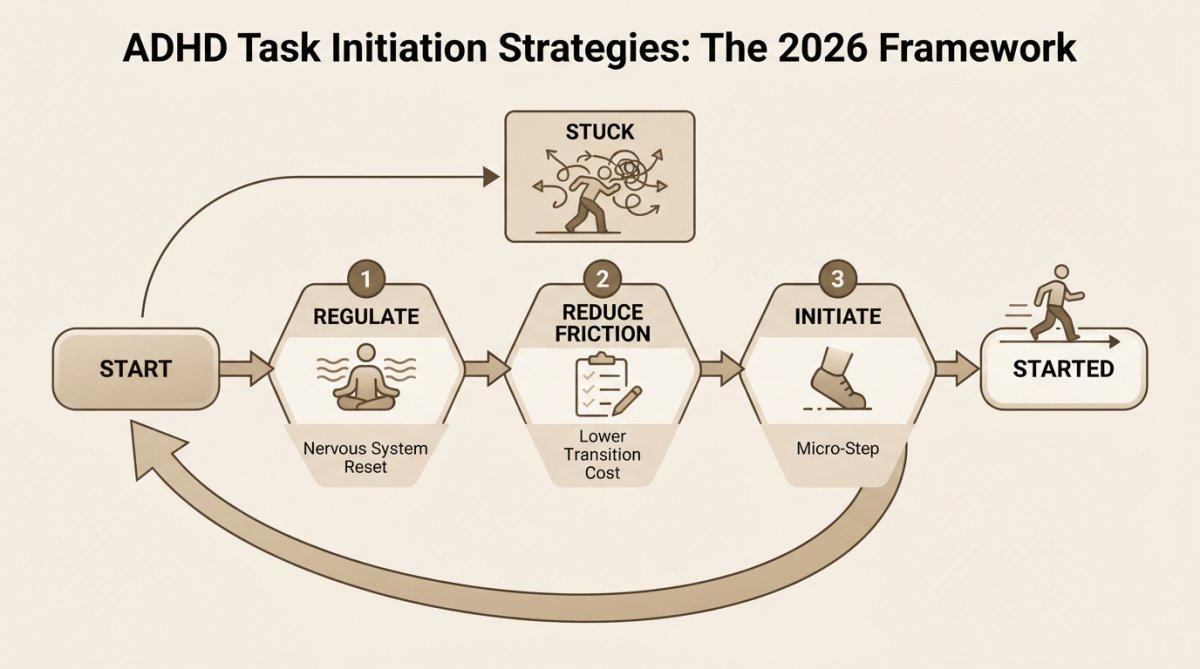
Regulate Your Nervous System First
Before you can think about executive function, you need to regulate your physiology. If you're dysregulated, whether from anxiety, sensory overload, or a racing mind, the prefrontal cortex is effectively offline. Trying to force a start in this state is like trying to start a car with a dead battery.
A quick regulation reset can take as little as two minutes. Try physiological sighs (double inhale through the nose, long exhale), standing and shaking out your arms and legs, or splashing cold water on your face. This isn't a relaxation exercise; it's a neurological prerequisite for cognitive engagement. Many people find that pairing this with a "dopamine menu" of quick sensory inputs, like a favorite song or a strong mint, helps bridge the gap to a calmer baseline.
Lower the Transition Cost
The second hidden barrier is what we call the Transition Cost, the mental energy required to switch from your current state to the task state. This is different from the task itself. Checking your phone feels like a low-cost transition because it requires no planning. Starting a report feels expensive because it demands working memory, planning, and sustained attention.
To lower this cost, externalize the next action. Write the single first physical step on a sticky note: "Open the document," "Put on shoes," "Walk to the kitchen." Do not write "Finish report." The goal is to make the first move so small and so explicit that your brain doesn't need to plan; it just executes. This strategy directly targets the planning deficit that makes task initiation so exhausting.
How to Use the ADHD Task Breakdown Method
The ADHD task breakdown method turns a vague, overwhelming project into a series of micro-steps that require zero planning. This is distinct from normal to-do lists, which often list outcomes rather than actions.
Start with the end goal, then work backward to the very first physical action. If the goal is "clean the kitchen," the breakdown is: 1) Stand up from the couch. 2) Walk to the kitchen doorway. 3) Pick up one dish. That's it. The mistake most people make is stopping at "clean the kitchen," which is a project, not a task.
Once you have your micro-steps, write them down or input them into a visual tracker. The act of writing externalizes the plan, freeing up working memory. A common mistake is trying to plan the whole day in advance. Instead, plan only the next two or three micro-steps. This prevents cognitive overload and keeps the momentum loop going. The goal is not to finish the project in one sitting; it's to initiate the process and build evidence that you can start.
ADHD Body Doubling Techniques: Starting Together
ADHD body doubling techniques are among the most effective evidence-based strategies for task initiation. Body doubling is the practice of having another person present, physically or virtually, while you work on your tasks (chadd.org). The other person is not helping you with the task; their presence simply anchors you in the present moment and reduces the feeling of isolation that often amplifies task paralysis.
The mechanism works through social accountability and stimulus control. When someone else is present, even on a video call, your brain shifts into a different mode of self-regulation. You are less likely to drift into a time-blindness spiral because the other person's presence serves as a gentle environmental cue to stay on track.
To use body doubling effectively, schedule a session. It can be a friend, a colleague, or an online body doubling community. State your intention at the start: "I will work on X for 25 minutes." Then, work in silence. The key is to start with a defined, short session to avoid the pressure of an open-ended work block. Many find that pairing body doubling with a visual timer creates a powerful external structure that compensates for internal executive dysfunction.
Visual Tools for Time Blindness and Momentum
Time blindness, the difficulty perceiving the passage of time, is a core symptom of ADHD that directly sabotages task initiation (nimh.nih.gov). If you can't feel that an hour has passed, you can't accurately estimate how long a task will take, making the task feel both daunting and formless.
Visual timers are the most direct tool for this. A physical timer that shows time draining away, like a Time Timer, makes time tangible. Set it for 10 or 15 minutes, not an hour. The goal is not to work for the full session; it's to initiate for a short, visually contained period. This is the principle behind the Pomodoro technique, which uses a 25-minute work interval followed by a 5-minute break. For ADHD, shorter intervals of 10-15 minutes are often more effective for building momentum.
The key to momentum maintenance is to avoid breaking your focus to check a clock. A visual timer does this for you. When the timer goes off, you have permission to stop. This removes the internal debate about whether you should keep working, which is a major source of cognitive load. The external signal does the deciding for you, reducing the demand on your self-regulation.
The Best Habit Trackers for ADHD: What to Look For
When searching for the best habit trackers for ADHD, you need a system that is flexible and shame-free. Traditional habit trackers that require a perfect streak are designed for neurotypical brains. For ADHD, a missed day often triggers a cascade of shame and all-or-nothing thinking, leading to abandonment of the system entirely.
The ideal tracker for ADHD should have a few key features:
- Low-clutter layout: A page with 50 boxes feels like a punishment. You want space to breathe.
- No rigid streaks: You need to be able to miss a day and simply pick up again the next day without a broken chain staring at you.
- Flexible categories: You should be able to track what matters today, not a fixed list of habits you set in January.
- Instant access: If the tracker is hard to open or use, you won't use it. It needs to be low-friction.
This is where Anchor Grove Studio's approach differs. Our planners and trackers are built on a "no-shame" philosophy. They are designed to work with your brain, not against it. You can start over on any page or week without feeling like you've failed. Whether you choose the [printable ADHD planner(/products/1-month-printable-adhd-planner-trial-low-clutter-printable) | anchorgrovestudio.com] for a tactile experience or the digital version for your tablet, the structure is designed to be forgiving. The ADHD Focus & Deep Work System Task Initiation Planner is a prime example, built specifically for the moment between "I need to do this" and actually beginning.
| System | Format | Key Feature | Best For |
|---|---|---|---|
| Focus & Deep Work System | Digital Download | Task initiation focus | Starting deep work sessions |
| Printable No-Shame System | Printable PDF | Flexible daily reset | Physical, tactile planning |
| Digital Planner | GoodNotes/Tablet | Low-clutter layouts | On-the-go tablet use |
| 1-Month Trial | Printable PDF | Top 3 daily structure | Testing the system |
Your First Step: A Low-Friction Planning System
The planning system itself must not become another task. If setting up your planner feels like a project, you will abandon it. The best system is the one you can start using in under two minutes with zero setup cost.
A low-friction planning system is one that requires you to write down only three things: your Top 3 priorities for the day, one micro-step for each, and a note of what time you'll start. That's it. No color coding, no elaborate key, no monthly goal review. The planning session should feel as light as possible.
For those who want a system that is already built, Anchor Grove Studio offers a 1 Month Printable ADHD Planner Trial for just $5.00. This is a low-cost way to test whether a low-clutter, Top-3-focused system helps you get unstuck without the commitment of a full-price planner. If it works, you can graduate to the full Printable ADHD Planner. The trial exists because we know that finding the right tool is a process, and you shouldn't pay $22 to discover a system doesn't fit.

Common Mistakes That Sabotage Your Start
Even with the best strategies, certain patterns will undo your progress. Recognizing these is half the battle.
Mistake 1: Planning instead of doing. You spend 30 minutes perfecting your to-do list, which feels productive but is actually avoidance. Planning is a task your brain prefers because it's low-risk. The fix is to set a hard time limit on planning (use a visual timer for 5 minutes) and then force the first micro-step immediately.
Mistake 2: Waiting for the "right" feeling. Motivation is not a prerequisite for action; it is a result of it. Waiting to feel ready is a trap. Behavioral activation, the practice of acting first and letting feelings follow, is a core principle in managing executive dysfunction. You are not waiting for the energy to start; you are starting to generate the energy.
Mistake 3: Ignoring physiological state. Trying to force a start when you are sleep-deprived, hungry, or overstimulated is a losing battle. Your prefrontal cortex needs basic fuel to function. If you are stuck and you haven't eaten or slept, address that first. This isn't procrastination; it's prerequisite management.
Building Momentum for the Long Term
Task initiation is a skill, not a fixed trait. Every time you successfully start a task using these strategies, you build evidence that you can do it. This is the core of self-regulation and momentum. The goal of the ADHD Productivity Focus Bundle is to provide a comprehensive, low-clutter system that supports this process across all areas of your life, from financial tracking to meal planning, without the shame of falling behind.

Start small. Pick one task today that you've been avoiding. Regulate your nervous system with a two-minute reset. Write down the single first physical step. Set a visual timer for 10 minutes. Just start.
Frequently Asked Questions
Why is task initiation so difficult with ADHD?
Task initiation is an executive function, and ADHD directly affects executive functioning. The brain struggles to organize steps, estimate time, and produce the initial dopamine signal needed to start. This isn't laziness; it's a neurobiological difference. The anticipation of a boring or complex task creates a mental block that feels like a physical wall. Understanding this helps you use strategies like body doubling or micro-steps instead of trying to force your way through the block.
What is the best ADHD task breakdown method?
A highly effective ADHD task breakdown method is to define the 'next physical action.' Instead of 'clean the kitchen,' the step is 'stand up and put the kettle on.' This method moves the goal from a vague outcome to a concrete, physical micro-step. This bypasses the planning deficit by reducing cognitive load. Write these micro-steps down so you can externalize the process. The goal is to make the first step so small it requires almost no working memory or effort to begin.
How can I use body doubling to improve task initiation?
ADHD body doubling techniques involve having another person present while you work. They don't need to help; their presence provides a social anchor that reduces distraction and helps you initiate tasks. You can use a friend, a family member, or an online community via video call. The key is to state your intention out loud to your body double. For example, 'I'm going to open the document and write the first paragraph for 15 minutes.' This creates accountability and makes the start less daunting.
Are there planners specifically designed for ADHD task initiation?
Yes. Standard planners often have rigid structures that don't work for ADHD brains. A good planner for task initiation focuses on low-clutter layouts and flexible systems. For example, the ADHD Focus & Deep Work System Task Initiation Planner from Anchor Grove Studio is designed to help you make a task feel smaller and plan a realistic work session without the pressure of perfect routines. It focuses on the moment between 'I need to do this' and actually beginning.
What is the 'five-minute rule' for ADHD task initiation?
The five-minute rule is a behavioral activation technique where you commit to working on a task for just five minutes. You give yourself permission to stop after that time. This lowers the 'transition cost' and helps bypass the initial resistance. Often, the hardest part is the start, and once you are moving, momentum takes over. Setting a visual timer makes the five-minute limit concrete, which helps with time blindness and makes the task feel less overwhelming and more like a game.
What makes the best habit trackers for ADHD different from regular ones?
The best habit trackers for ADHD are designed without shame. They avoid rigid streaks that break your motivation when you miss a day. Instead, they focus on 'resets' and flexible daily planning. Look for trackers that allow you to start over on any page or week without guilt. A good system helps you externalize your thoughts and choose a few realistic priorities. The goal is consistency over perfection, providing a calm structure that works with your energy fluctuations.
The challenge isn't your ability to finish; it's your belief that you can start. The systems you use should make starting feel possible, not perfect. Anchor Grove Studio's planners, trackers, and Notion templates are designed to be that supportive structure, offering flexible, guilt-free formats that you can begin anytime. Get started with Anchor Grove Studio and discover a planning system that meets you where you are.