
How to Build ADHD Habits That Actually Stick
Table of Contents
- Why Traditional Habit Advice Fails ADHD Brains
- How to Build ADHD Habits Using Micro-Habits and the Five-Minute Rule
- ADHD Habit Stacking Examples That Work With Your Brain
- Dopamine, Reward Systems, and Neurobiological Feedback Loops
- How Long Does It Take to Form a Habit With ADHD
- Best Habit Trackers for ADHD: Digital vs. Analog Tools
- Recovery Strategies When Your ADHD Habits Fall Apart
- Conclusion
Last Updated: August 25, 2026
Building ADHD habits is one of the most misunderstood challenges in productivity advice. The core problem is not willpower or motivation, it is neurological. The ADHD brain processes habit formation, reward, and time perception differently from a neurotypical brain, which means most habit-building frameworks are built for a brain you do not have.
Why Traditional Habit Advice Fails ADHD Brains
Conventional productivity culture worships consistency streaks, 21-day challenges, and rigid morning routines. For many people with ADHD, these systems do not just fail, they actively cause harm. Missing one day triggers shame, shame triggers avoidance, and avoidance kills the habit entirely. Traditional habit frameworks were not built with executive functioning differences in mind.
Executive Functioning and the Habit Loop
Executive functioning is the set of mental skills that includes working memory, flexible thinking, and self-control. For ADHD brains, these functions are inconsistent rather than absent. The classic habit loop (trigger, routine, reward) assumes your brain will reliably notice the trigger, initiate the routine, and feel satisfied by the reward. ADHD disrupts all three stages.
Task initiation is often the biggest barrier. Many people with ADHD describe knowing exactly what they need to do and still being unable to start. This reflects a genuine gap in the brain's ability to shift from intention to action without external scaffolding. According to ADDitude Magazine's overview of ADHD and executive function, executive function deficits affect planning, time management, and the ability to sustain effort toward future goals.
Time Blindness and Working Memory Gaps
Time blindness is one of the most underappreciated aspects of ADHD. Many people with ADHD experience time as "now" and "not now" rather than as a continuous, measurable flow. Working memory gaps compound this: you may intend to start a new habit after lunch, then completely lose that intention because something else entered your attention. External cues and visual reminders are not optional extras for ADHD habit-building, they are load-bearing structures.
How to Build ADHD Habits Using Micro-Habits and the Five-Minute Rule
The most effective starting point for ADHD habits is to make the habit so small it feels almost embarrassing. Micro-habits are habits scaled down to their absolute minimum viable version. Instead of "exercise every morning," the micro-habit is "put on your workout shoes." Instead of "journal daily," it is "write one sentence."
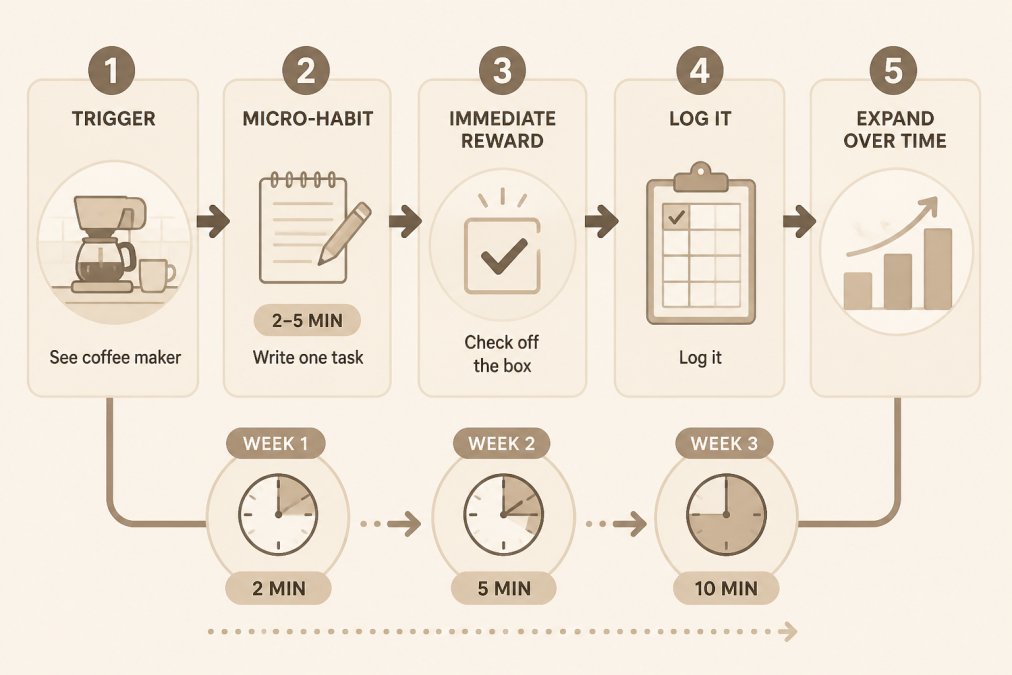
The five-minute rule works on a similar principle. Commit to doing the habit for exactly five minutes. Many people with ADHD find that once they start, momentum carries them forward, but the rule removes the pressure of an open-ended commitment that triggers overwhelm.
Reducing Friction Before You Start
Friction is the enemy of ADHD habit-building. Every extra step between you and the habit is a potential exit point for your brain. Put your journal on your pillow so you see it before bed. Pre-fill your water bottle and leave it on your desk. Keep your workout clothes next to your bed, not in a drawer. Environmental design removes the decisions that drain cognitive load before the habit even begins.
Environmental Design and External Scaffolding
External scaffolding refers to any system outside your brain that holds your habit structure in place. For neurodivergent individuals, this is a neurological accommodation, not a crutch.
Effective scaffolding tools include visual cues (sticky notes, habit boards), analog clocks and timers, body doubling, and implementation intentions. The CDC's resources on ADHD management strategies note that external structure and environmental modifications are among the most evidence-supported non-medication interventions for ADHD.
ADHD Habit Stacking Examples That Work With Your Brain
Habit stacking is the practice of attaching a new habit to an existing one. The formula is simple: "After I do [current habit], I will do [new habit]." For ADHD brains, the existing habit serves as the trigger that the new habit borrows. Stack onto habits that are already automatic and consistent, not aspirational ones.
| Anchor Habit | Stacked Habit | Time Required |
|---|---|---|
| Morning coffee | Write 3 priorities for the day | 2-3 minutes |
| Brushing teeth (AM) | Take medication | 30 seconds |
| Sitting down at desk | Open planner and identify first task | 1 minute |
| Lunch break | 5-minute walk outside | 5 minutes |
| Brushing teeth (PM) | Write one thing that went well | 1 minute |
| Getting into bed | Set tomorrow's top priority | 2 minutes |
The shorter the stacked habit, the more likely it is to survive. Start with habits under three minutes.
Habit Stacking for Sensory-Sensitive Individuals
Many people with ADHD are also sensory-sensitive, meaning certain environments, textures, sounds, or lighting conditions actively interfere with their ability to engage in habits. Sensory regulation is a prerequisite for habit execution, not an afterthought.
Design your habits around sensory comfort: choose a calm, low-stimulation location, use noise-canceling headphones or a specific playlist as a sensory cue, and pair habits with sensory rewards like a particular scent or favorite texture. Sensory-conscious habit design is working with your actual nervous system instead of fighting it.
Dopamine, Reward Systems, and Neurobiological Feedback Loops
The ADHD brain is not unmotivated, it is differently motivated. Dopamine regulation works differently in ADHD brains, which means the brain's natural reward signals are often weaker or delayed. This makes long-term, future-oriented habits harder to sustain through conventional positive reinforcement alone. The reward needs to come now, not eventually.
Effective dopamine-seeking strategies include temptation bundling (only listen to your favorite podcast while doing a specific habit), visible progress markers (checking a box, crossing off a line), celebration micro-rituals (a fist pump, a verbal "yes"), and novelty cycling (rotating habit tools every few weeks). According to CHADD's overview of ADHD neurobiology and dopamine, the dopamine-seeking behavior common in ADHD is the brain looking for the stimulation it needs to function.
How Long Does It Take to Form a Habit With ADHD
Habit formation timelines for ADHD brains are wider, more variable, and less linear than standard estimates. The commonly cited figure for neurotypical habit formation suggests 18 to 66 days. For people with ADHD, the realistic range is two to six months, and the path is rarely a straight line.
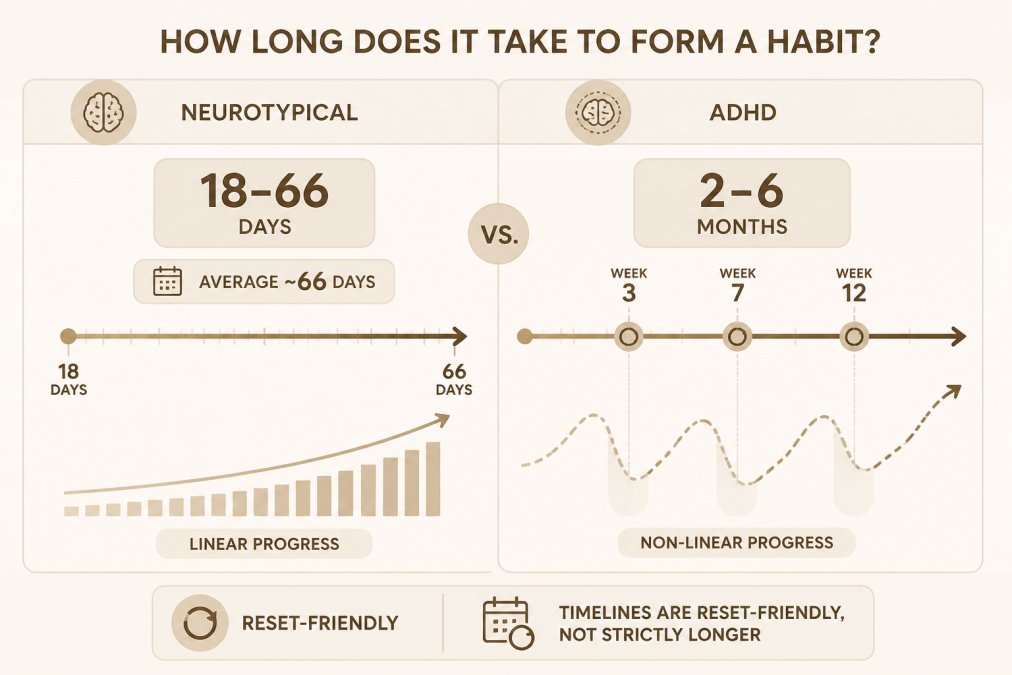
A missed week does not reset your progress to zero. Your brain still retains the neural pathway you were building. Measure habit success in weeks attempted, not consecutive days. A habit you do three times a week for three months is more durable than one you do daily for three weeks then abandon.
Best Habit Trackers for ADHD: Digital vs. Analog Tools
The best habit tracker for ADHD is the one you will actually look at every day.
Analog tools (paper, whiteboards, sticky notes) are always visible without unlocking a device, offer tactile satisfaction of physically marking completion, and have lower cognitive load to access. They are best for visual thinkers and sensory-sensitive individuals.
Digital tools (apps, Notion templates, digital planners) are searchable, adjustable, and portable, with easy reconfiguration. They are best for people who live on their devices and need flexibility.
For many ADHD brains, a hybrid system works best: a digital planning layer for scheduling paired with a physical daily habit card for immediate visual cues. The Anchor Grove Studio Printable ADHD Planner includes a low-pressure habit tracker that measures attempts rather than streaks. For those who prefer a fully digital workflow, the ADHD Focus and Deep Work System offers a task-initiation toolkit with body doubling frameworks and temptation bundling guides.

Recovery Strategies When Your ADHD Habits Fall Apart
Every ADHD habit system will fall apart at some point. The goal is not to prevent collapse but to make recovery as low-friction as possible.
The two-day rule: Never miss the same habit twice in a row. One miss is a pause; two misses is the beginning of a new habit (not doing it).
The "floor" approach: Identify the absolute minimum version of each habit. When life is hard, do the floor version only. Brushing teeth is the floor for an oral care routine. Writing one sentence is the floor for journaling.
Audit without judgment: When a habit consistently fails, treat it as a design problem, not a character problem. Ask: Is the trigger reliable? Is the friction too high? Is the reward immediate enough?
Self-compassion is not a soft add-on to ADHD habit recovery. Research consistently shows that shame and self-criticism reduce the likelihood of re-engagement. Treat a lapse with curiosity rather than condemnation.
A simple recovery checklist:
- Identify the last time the habit worked and what conditions supported it
- Reduce the habit to its floor version
- Remove one source of friction
- Re-anchor to a reliable existing habit
- Use a physical visual cue to restart the trigger
- Do the floor version for three days before expanding
Building ADHD habits is genuinely hard, and most systems were not designed for the way your brain actually works. The challenge is finding structures that account for executive functioning differences, time blindness, dopamine variability, and the reality that consistency looks different for neurodivergent people. Anchor Grove Studio's planners, trackers, and Notion templates are built around exactly these realities: flexible systems with no punishing streaks, low-clutter designs that reduce cognitive load, and instant-download access so you can start today. Whether you begin with the Printable ADHD Planner or the full ADHD Productivity and Focus Bundle, the goal is the same: tools that work with your brain, not against it. Add to cart and start where you are.

Frequently Asked Questions
Why is habit formation harder with ADHD?
ADHD affects executive functioning, working memory, and dopamine regulation, three systems that habit formation depends on. Without a strong internal sense of time, it's easy to forget routines entirely. Dopamine-seeking behavior also pulls attention toward novel tasks rather than consistent ones. This isn't a willpower problem. ADHD brains need external scaffolding, immediate rewards, and flexible systems rather than rigid streak-based approaches to build habits that last.
How can I use habit stacking to manage ADHD symptoms?
Habit stacking pairs a new behavior with one you already do automatically. For ADHD, the anchor habit should be sensory-grounded and highly consistent, like brewing coffee or brushing your teeth. Attach one small action to it: 'After I start the coffee maker, I write down my top task for the day.' Keep the new habit under two minutes at first. Over time, these micro-stacks build into a reliable routine without requiring motivation or memory to initiate.
What are the best tools for tracking ADHD habits?
The best habit trackers for ADHD combine low cognitive load with immediate visual feedback. Analog options, like a paper tracker or a simple checkbox system, reduce screen distraction and give a tactile sense of progress. Digital tools work well when they send reminders and require minimal setup. Printable ADHD planners with low-pressure habit sections, like the ones from Anchor Grove Studio, let you track without punishing missed days, which matters more than any specific app feature.
How do I maintain consistency when I have ADHD?
Consistency with ADHD looks different from neurotypical consistency. Missing a day doesn't erase progress, the goal is returning quickly, not maintaining a perfect streak. Build in a 'reset day' each week where you review and restart without judgment. Use visual cues, analog clocks, or timers to anchor routines in time. Pair habits with immediate, specific rewards. Self-compassion isn't optional here; shame actively disrupts task initiation, making the next attempt harder.
Is it possible to build habits without relying on motivation?
Yes, and for ADHD brains, this is the only reliable approach. Motivation is inconsistent and dopamine-dependent, meaning it spikes with novelty and fades with repetition. Sustainable ADHD habits are built on environmental design, not willpower. That means reducing friction (laying out your journal the night before), using implementation intentions ('When I sit down at my desk, I open my planner first'), and creating external triggers so the habit starts before you have to decide to do it.
What is the 1/3/5 rule and does it help with ADHD?
The 1/3/5 rule structures your daily task list as one large task, three medium tasks, and five small tasks. For ADHD, this works better than a long undifferentiated to-do list because it limits cognitive load and sets realistic expectations. It pairs well with brain dump and triage systems, where you first get everything out of your head and then sort by size. Starting with a small task rather than the large one also helps with task initiation on low-energy days.
This article was written using GrandRanker