
How to Manage ADHD Time Blindness: 7 Practical Strategies
Table of Contents
- What Is Time Blindness and How It Connects to ADHD
- Understanding the ADHD Time Perception Problem
- Creating an ADHD-Friendly Daily Schedule Template
- Using Time Blindness Tools for ADHD
- How to Estimate Time for Tasks Accurately
- Breaking Down Large Tasks to Combat Task Paralysis
- Building Consistent Routines That Stick
- Managing Time Anxiety and the Feedback Loop
Last Updated: August 28, 2026
What Is Time Blindness and How It Connects to ADHD
Time blindness is the inability to perceive the passage of time intuitively. People with time blindness struggle to estimate how long tasks take, lose track of hours without external reminders, and feel surprised when deadlines arrive. For those with ADHD, it's one of the most disabling symptoms: you can't estimate task duration, so schedules collapse. You can't feel time passing, so deadlines sneak up. You can't build routines because "every day at 9 AM" has no internal anchor.
ADHD involves differences in dopamine regulation and prefrontal cortex function, the systems that create an internal sense of time (peer-reviewed research). Without that neurological scaffolding, you're managing time without the biological tools most people take for granted. This isn't a character flaw; it's a mismatch between how your brain works and the demands of a time-dependent world.
At Anchor Grove Studio, we understand the experience of knowing intellectually that time is passing, but not feeling it. The strategies in this guide address that gap by externalizing time, moving it outside your brain and into tools, structures, and routines your ADHD brain can actually use.
Understanding the ADHD Time Perception Problem
The core issue is executive dysfunction. Your prefrontal cortex, responsible for planning and self-regulation, doesn't prioritize time the same way neurotypical brains do (the NIH). You might be acutely aware of a task's importance, but you have no gut sense of how long it will take or when to start.
This creates a cascade of problems: you underestimate task duration, miss deadlines, and struggle with the planning fallacy more severely than most people. Traditional time management assumes you can feel time, so standard advice rarely sticks. The feedback loop is brutal, each failure reinforces the belief that you're broken, when really you're using tools designed for a different kind of brain.
What makes ADHD time blindness different from general poor time management is that it's not responsive to willpower or discipline (peer-reviewed research). You can't think your way into better temporal awareness. But you can build external systems that compensate, structures that don't rely on your brain's broken internal clock.
Creating an ADHD-Friendly Daily Schedule Template
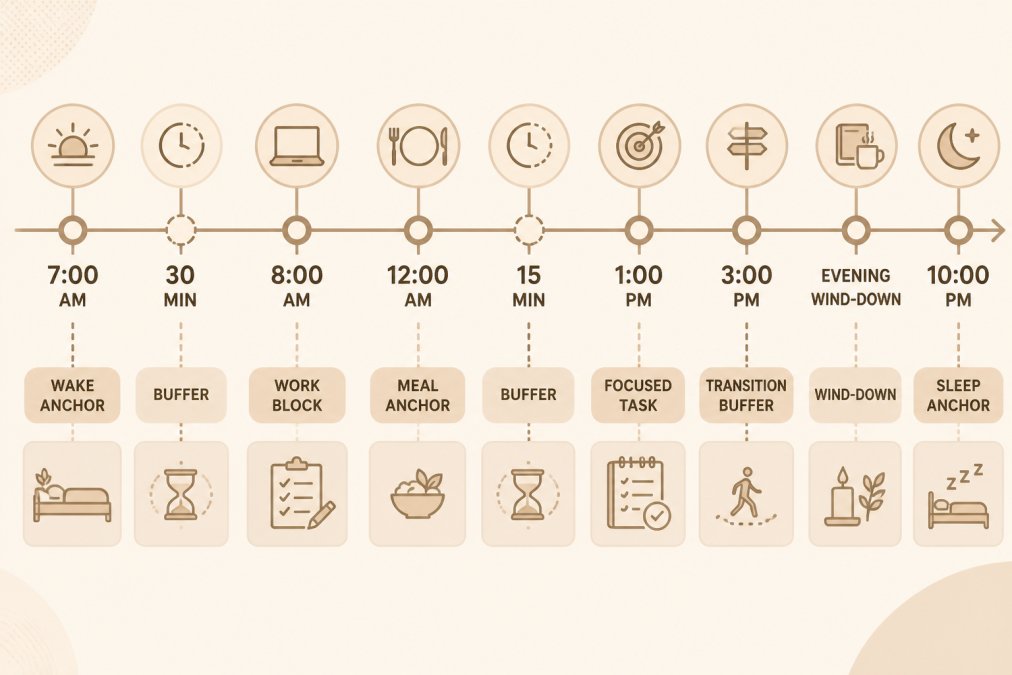
An ADHD-friendly schedule looks nothing like a typical day planner. Instead of filling every hour with commitments, anchor your day around a few non-negotiable events and leave the rest flexible. This reduces decision fatigue and gives your brain clear landmarks to navigate by.
Start by identifying your anchors: wake time, meals, work blocks, and bedtime. Add buffer zones, 15 minutes between activities reduces cognitive load and prevents hyperfocus from swallowing the next commitment. Identify your high-energy windows and schedule demanding tasks then, saving low-energy periods for routine tasks or rest.
A practical template includes: wake anchor → buffer → first task block → meal anchor → buffer → second task block → buffer → transition time → evening anchor → wind-down → sleep anchor. Keep the structure loose while maintaining this balance between structure and flexibility.
Using Time Blindness Tools for ADHD
External tools are non-negotiable for managing time blindness. Your brain can't generate an internal sense of time, so you need devices and systems that create that sense externally.
Visual Timers and Alarms
Visual timers are the single most effective tool for time blindness. Unlike digital countdowns, visual timers create a tangible representation of time passing. Watching the colored disk shrink gives your brain feedback it otherwise lacks, helping you stay oriented without relying on temporal awareness. Set visual timers for task blocks, transition periods, and breaks. Combine them with auditory alerts: the visual timer keeps you oriented during a task; the alarm brings you back when it's time to switch.
Externalizing Time Through Analog and Digital Tools
Externalizing time means moving time management out of your head and into external systems. Analog tools, physical clocks, wall calendars, paper planners, create constant visual reminders of time's passage. Digital tools offer notifications, syncing, and automated reminders. The Printable ADHD Planner from Anchor Grove Studio combines both approaches, giving you a tangible system that lives on your desk or wall, creating constant visual reference without overwhelming complexity.

Use analog tools for daily reference and routine building. Use digital tools for deadlines, appointments, and automated reminders. Together, they create a comprehensive external time management system that compensates for your brain's temporal blindness.
How to Estimate Time for Tasks Accurately
Time estimation is where ADHD time blindness causes the most practical damage. You consistently underestimate how long tasks take, which means your schedule never works and you're always running late.
Use a four-step estimation process. First, break the task into components: don't estimate "write report," estimate "outline structure," "write introduction," "draft main sections," "edit and format." Second, estimate time for each component specifically. Third, add a buffer, most people with ADHD should add 25-50% to their estimate. If you estimate 2 hours, add 30-60 minutes. Fourth, compare your estimate to actual time and keep a simple log of estimated versus actual duration for recurring tasks.
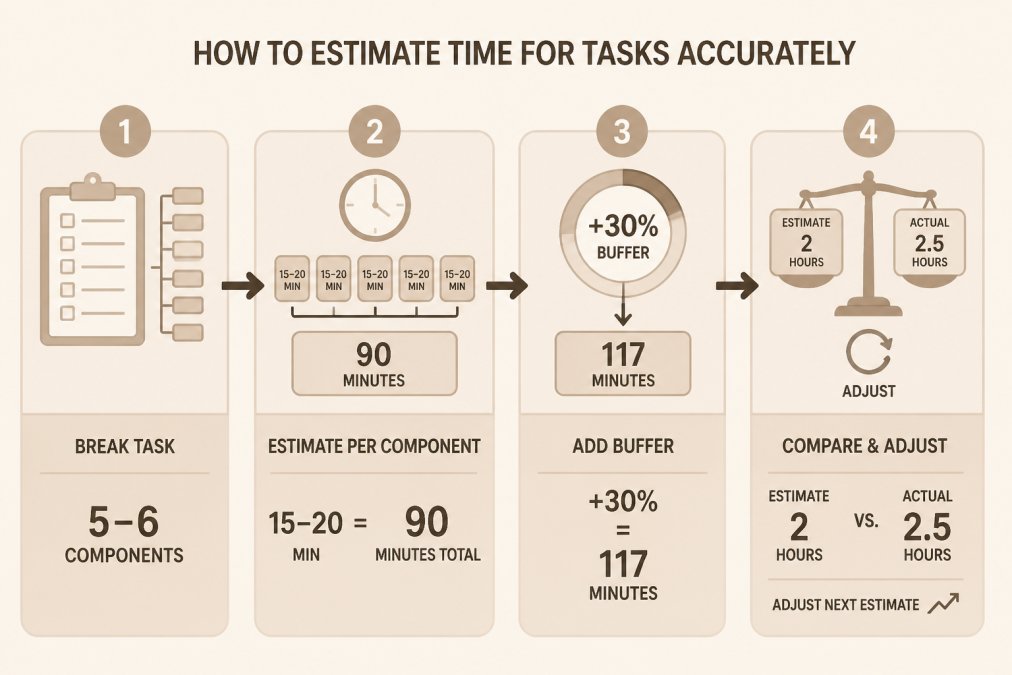
Over weeks, patterns emerge. You'll notice that writing takes longer than you think, but administrative tasks are faster. This data becomes your personal time management reference.
Breaking Down Large Tasks to Combat Task Paralysis
Task paralysis is the moment when you know you need to do something, but you can't locate where to start. The task feels too big or too abstract. The solution is radical task decomposition. Break tasks into micro-steps so small that there's no ambiguity about what "starting" means.
Instead of "clean kitchen," break it into: clear counters → wash dishes → wipe surfaces → sweep floor. Then break further: clear counters becomes move items from counter A → move items from counter B → put items in their homes. Now "clear counter A" is a micro-step you can do in 10 minutes without triggering paralysis.
Micro-steps work because they eliminate decision fatigue. You're not deciding what to do; the system has already decided. Once you start, momentum often carries you forward.
Building Consistent Routines That Stick
Routines are the scaffolding that holds an ADHD life together. Without them, every day requires fresh decisions about when to eat, sleep, work, and rest. The mistake most people make is trying to build perfect routines all at once. Build routines incrementally, one anchor point at a time.
Start with sleep. Pick realistic bedtimes and wake times you can actually sustain. Set a bedtime alarm 30 minutes before sleep to start your wind-down. Once sleep is stable (usually 2-3 weeks), add a morning routine: wake → bathroom → eat → get dressed. Next, establish meal times at consistent hours. Finally, add a wind-down routine 30 minutes before bed.
Routines work because they reduce decision fatigue, create external structure, and give your brain predictable landmarks. They're not about perfection; they're about creating enough consistency that your ADHD brain can function without constant executive effort.
Managing Time Anxiety and the Feedback Loop
Time anxiety is the stress that builds when you're constantly fighting against your own neurology. The feedback loop works like this: you underestimate a task, miss the deadline, feel shame, try harder, and fail again. Each failure reinforces the belief that you're fundamentally broken at time management.
Breaking this loop requires two things: accepting that time blindness is neurological (not a character flaw), and building systems that actually work for your brain. When you stop blaming yourself and start building external structures, anxiety decreases. The second part is building small wins. When you use visual timers, break tasks into micro-steps, and follow your routine, you start completing things. Small completions build momentum and confidence.
Many people find that externalizing time, moving it from internal pressure to external structure, reduces anxiety significantly. Your brain stops trying to hold time and deadlines in working memory. Instead, your calendar, timer, routine, and task list hold that information. You're free to focus on the actual work.
Managing ADHD time blindness isn't about becoming a different person or forcing yourself into rigid productivity systems. It's about building external structures that compensate for how your brain actually works. Visual timers, broken-down tasks, consistent routines, and realistic time estimates create a system where time blindness becomes manageable.
The tools and strategies in this guide work best when customizable to your life and energy levels. Many people find success with systems designed specifically for neurodivergent brains, built without the shame and rigidity that make traditional productivity systems fail. Anchor Grove Studio's ADHD planners and templates are created with this philosophy: work with your brain, not against it. Start with one strategy, build it into your routine, then add the next. Small, consistent changes create lasting results.
Frequently Asked Questions
Q: Do ADHD medications help with time blindness?
A: Medication can improve working memory and impulse control, which indirectly helps with time awareness. However, medication alone doesn't fix time blindness. The most effective approach combines medication with external tools like visual timers, alarms, and time-blocking strategies. Many people find that medication makes it easier to *use* these tools consistently, but the tools themselves do the actual work of externalizing time.
Q: What's the difference between analog clocks and digital tools for managing time blindness?
A: Analog clocks show the *passage* of time visually, you can see how much of the clock face remains. Digital tools (timers, alarms, phone notifications) are better for reminders and alerts. For ADHD time blindness, use both: an analog clock or visual timer while working to see time passing, and digital alarms to interrupt hyperfocus and signal transitions between tasks. Many people find the combination more effective than either alone.
Q: How do I know if a time management system will actually work for me, or if I'll abandon it like the others?
A: Look for systems designed specifically for ADHD brains, ones that don't require perfect daily streaks, allow you to restart on any page, and offer multiple formats (printable, digital, Notion). Anchor Grove Studio's ADHD-friendly planners, like the Printable ADHD Planner ($22) and ADHD Focus & Deep Work System ($16), are built without shame or rigid structures. Start with one tool and give it 2-3 weeks before deciding. If it creates more anxiety than relief, switch formats, not the whole system.
Q: Can I really use a time management system on low-energy days?
A: Yes, if it's designed for flexibility. ADHD-friendly systems should have versions for both high-energy and low-energy days. On low-energy days, you might use a simplified version, just priority and time blocking without detailed task breakdown. The key is having a system that doesn't punish you for bad days. Anchor Grove Studio's templates include layouts for fluctuating energy, so you're never starting from scratch when you're struggling.
This article was written using GrandRanker